Path 55 · The handover archive · Beginner
Close the work. Keep the learning usable.
A guided, practical route through project closure and lessons learned.
What you will be able to do
Assemble a closure pack that separates accepted outputs, residual work, operational ownership and evidence-based lessons for the next project.
Plan about 7h 39m in total. Reading and practice are editorial estimates; video runtimes come from public provider metadata. Your pace will vary.
Before you begin
Check your starting point
What you need
Basic project experience or willingness to use a fictional example. No project-management software is needed.
The selected public provider lessons are free to view. The original case can be completed with paper, a text editor or freely available local tools. Paid exams, certificates, subscriptions and optional provider software are not required for this project.
Completing this WikiFree path does not award a provider certificate. Any provider assessment, account requirement or credential must be checked separately on its official page.
Three readiness questions
Does closing a project erase open actions?
No. Residual work needs an owner and disposition.
Is a deferred change automatically a defect?
No. Compare it with the approved scope.
Is a lesson just a complaint?
No. It needs evidence and a transferable action.
Use a workable pace
At 5 hours per week, allow about 2 weeks. Start with Stage 1, continue in order and reserve 2h for the capstone. If a gate fails, use its repair step before advancing. At another weekly budget, divide 459 estimated minutes by your available weekly minutes and round up.
Keep a small evidence folder. A checked box means you reviewed your output; it is not a certificate or proof that a provider lesson was watched.
The working case
Four outputs, three dispositions
Willow Club has delivered a workshop-booking page. The form and export passed acceptance, but a help article is unfinished and an automated reminder was explicitly deferred. Operations starts Monday. A closure meeting must avoid presenting deferred scope as a defect or leaving unfinished agreed work without an owner.
| Item | State | Owner after handover |
|---|---|---|
| Booking form | accepted | Operations |
| Attendance export | accepted | Operations |
| Help article | agreed; incomplete | Editor |
| Automatic reminder | deferred change | Sponsor review |
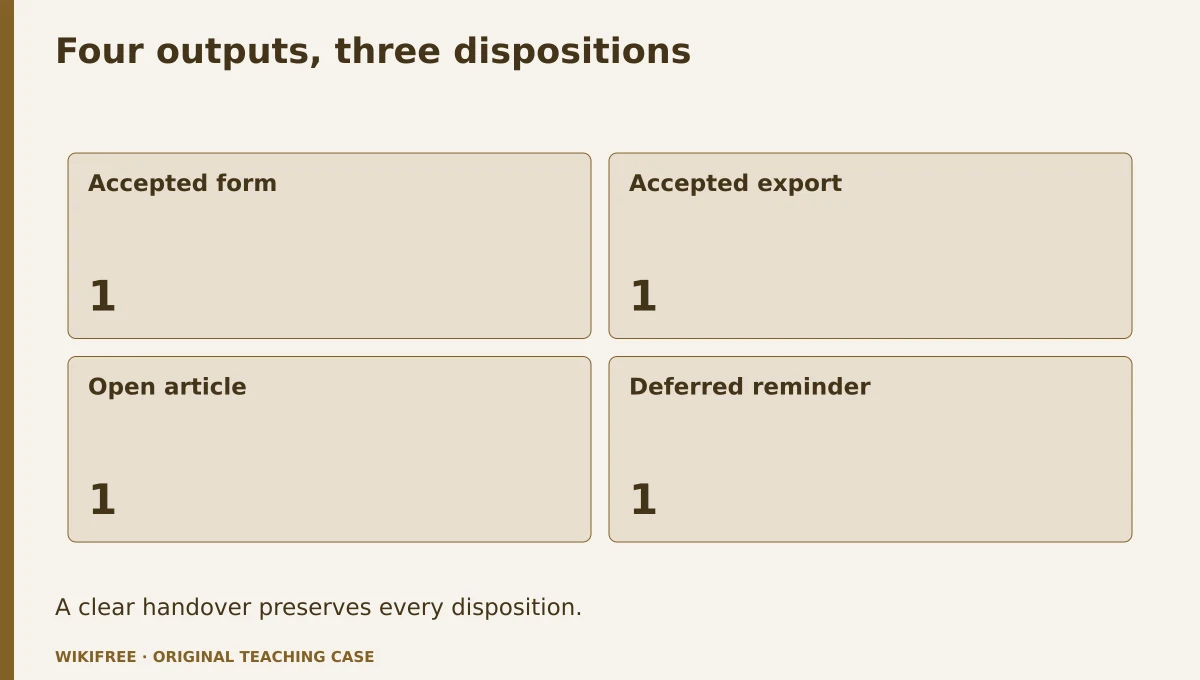
The table and explanations preserve the essential case information when the diagram is unavailable.
Your route
Five outputs, then a final handoff
- 01Agree closure conditionsClosure conditions and scope disposition
About 1h including assigned learning and practice. - 02Plan the operational handoverOperational handover checklist
About 1h 14m including assigned learning and practice. - 03Extract a useful lessonThree reusable lesson cards
About 1h 15m including assigned learning and practice. - 04Write the closure reportVersioned closure report
About 1h 16m including assigned learning and practice. - 05Run a receiving-owner reviewReceiving-owner review record
About 55m including assigned learning and practice. - FINALCapstone reviewCombine the evidence into one inspectable handoff.
About 2h .
0 of 6 outputs checked. JavaScript adds browser-only progress saving.
The complete lesson and all downloads remain available. Use the printable project workbook to track your progress.
Use the minimum useful source material
The courses behind this route
OnlinePMCourses
Project Closure: Free Course
Published closure and handover lessons support the transition artifacts.
Selected material only; this path does not claim completion of the entire provider course.
Management Courses
Managing Workplace Teams: Free Course
The team-review lesson supports a structured learning conversation.
Selected material only; this path does not claim completion of the entire provider course.
Course publication and selected public lesson metadata were checked on 13 October 2026. This is not a claim of full video playback, provider-course completion or permanent availability. Recheck the linked source if a lesson changes.
Learn, make, inspect
The five-stage workshop
Agree closure conditions
Video 10m · reading budget 0m · original practice about 50m.
Closure criteria should distinguish delivery acceptance from administrative completion and transition readiness. A project can have accepted outputs alongside explicitly transferred actions, depending on its agreed rules. The decision must be transparent. Do not silently relabel an incomplete baseline item as optional just to create a green status.
Watch these selected lessons
Do the work
Define five closure checks and classify the four supplied items against the approved scope.
Save this output
Closure conditions and scope disposition
Pass the review gate
The help article remains an open agreed item and the reminder remains a deferred change.
If you need another attempt
Return to the baseline before labeling an item a defect or a future enhancement.
Plan the operational handover
Video 9m · reading budget 0m · original practice about 1h 5m.
A handover transfers usable knowledge and responsibility. Include access arrangements, support contacts, operating instructions and unresolved issues. A folder of files is not sufficient if the receiving owner cannot perform the routine task. Use a walkthrough to test the handover and record which parts still need clarification.
Watch these selected lessons
Do the work
Create a handover index and a walkthrough for exporting attendance and handling a failed booking.
Save this output
Operational handover checklist
Pass the review gate
Every routine task points to instructions and a receiving owner; no credentials appear in the pack.
If you need another attempt
Ask the receiving role to locate the next action without the project team explaining it.
Extract a useful lesson
Video 9m · reading budget 0m · original practice about 1h 5m.
A learning review separates what happened, the evidence, contributing conditions and a change to future practice. Avoid attributing every problem to a person. A lesson becomes reusable when it says when the recommendation applies and what evidence would show it helped. Record disagreement when the available evidence cannot settle a cause.
Watch these selected lessons
Do the work
Write three lesson cards from the supplied handover situation, each with an observation, condition and next-project action.
Save this output
Three reusable lesson cards
Pass the review gate
Each card proposes an observable process change and avoids an unsupported blame claim.
If you need another attempt
Replace communicate better with a specific checkpoint, owner or shared artifact.
Write the closure report
Video 5m · reading budget 0m · original practice about 1h 10m.
A closure report is a compact decision record. Compare promised and accepted outputs, summarize remaining actions and identify where evidence lives. Distinguish measured outcomes from hoped-for benefits after transition. Include the final approved version so future readers can understand the scope without reconstructing every meeting.
Watch these selected lessons
Do the work
Draft a two-page closure report with a residual-action table and evidence links.
Save this output
Versioned closure report
Pass the review gate
The report includes the unfinished help article and does not claim later operating benefits have already occurred.
If you need another attempt
Separate delivery facts from benefit forecasts and assign dates to residual actions.
Run a receiving-owner review
Video 0m · reading budget 0m · original practice about 55m.
A closure review should test whether the transition is workable. The receiving owner may accept with explicit conditions or identify a blocking gap. Record the decision and any follow-up, then preserve the learning in a findable location. Archiving should not destroy information required to support the service or explain a prior decision.
Original application stage. Use your preceding outputs and the supplied case; there is no additional required provider lesson.
Do the work
Simulate the Monday walkthrough and record acceptance with conditions or a hold, using the evidence in your pack.
Save this output
Receiving-owner review record
Pass the review gate
The decision names the receiving role and the disposition of every open item.
If you need another attempt
Do not write handover complete before checking whether the receiving owner can use the material.
Make the result inspectable
Your final project
Deliver the closure conditions, handover index, three lesson cards, report and receiving-owner review. Reopen the pack as a new team member and locate the help-article owner and the reason the reminder was deferred.
The ZIP includes synthetic input data, a project workbook, worked reference, evidence log, scoring rubric and case-specific materials. Code projects include source and clearly stated local execution requirements.
Use one consistent rubric
| Criterion | Maximum | Evidence |
|---|---|---|
| Evidence and correctness | 30 | Calculations, source use and results match the supplied case; limitations are honest. |
| Required artifacts | 30 | All five stage outputs and the capstone handoff are present and inspectable. |
| Reasoning and decisions | 20 | Choices, assumptions, alternatives and the case-specific critical condition are explained. |
| Reproducibility | 10 | A reviewer can follow the stated steps and distinguish expected from observed results. |
| Clear communication | 10 | Labels, units, structure and evidence references make the work easy to review. |
Score at least 80/100, supply every required artifact, and satisfy the path-specific critical condition. Rework missing evidence before marking complete.
The critical condition
No unresolved baseline item disappears from the closure record and no future benefit is claimed as already realized.
Compare with a worked reference
The two accepted functions can be evidenced separately from the help article. The article needs an assigned completion date and an agreed transition decision. The reminder belongs in the deferred-change record. Treating all four as completed would misstate the scope and remove useful follow-up information.
Know the boundary
This is a small project-transition and learning exercise; retention and contractual requirements depend on the real organization.
Questions before you finish
Do I need to finish every source course?
No. This path names selected lessons or reading sections. Complete the full provider course only if it supports your wider goal. The path does not claim equivalence to that course.
How do I know when to advance?
Use the output and review gate in each stage. If evidence is missing or a result conflicts with the case, follow the repair step and retry before advancing.
Can I do the project without paid software?
The selected public provider lessons are free to view. The original case can be completed with paper, a text editor or freely available local tools. Paid exams, certificates, subscriptions and optional provider software are not required for this project.
What does my checklist prove?
It records your own review in this browser only. It does not verify viewing, skill, a provider credential or a real-world deployment.
What if a lesson or tool changes?
Use the linked course and provider page to inspect current availability. Record the change and revisit the relevant assignment; do not invent a replacement lesson or claim an unavailable activity was completed.
Questions & discussion
Share a useful question or correction. Comments appear after moderation. Please avoid personal or sensitive information.