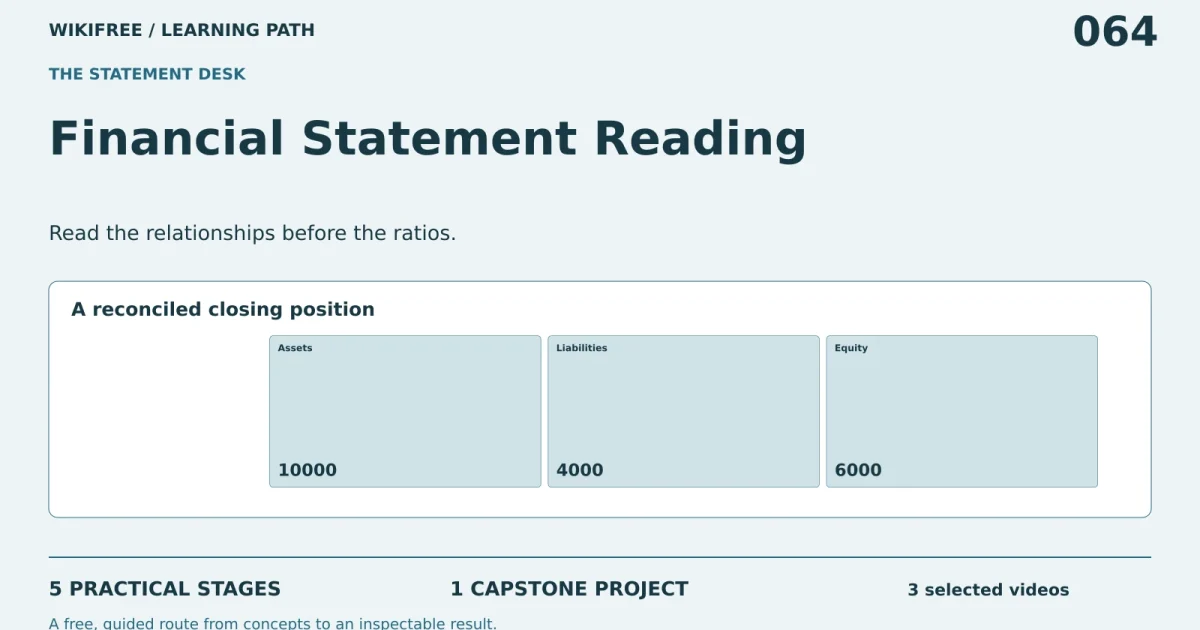
Path 64 · The statement desk · Beginner
Read the relationships before the ratios.
A guided, practical route through financial statement reading.
What you will be able to do
Reconcile a simplified income statement and balance sheet, calculate three ratios and write a cautious interpretation.
Plan about 7h 40m in total. Reading and practice are editorial estimates; video runtimes come from public provider metadata. Your pace will vary.
Before you begin
Check your starting point
What you need
Basic arithmetic. No accounting software or real company records are required.
The selected public provider lessons are free to view. The original case can be completed with paper, a text editor or freely available local tools. Paid exams, certificates, subscriptions and optional provider software are not required for this project.
Completing this WikiFree path does not award a provider certificate. Any provider assessment, account requirement or credential must be checked separately on its official page.
Three readiness questions
Does revenue mean cash received?
Not necessarily.
What must a balance sheet reconcile?
Assets equal liabilities plus equity.
Does a ratio explain its own cause?
No. It needs context and supporting detail.
Use a workable pace
At 5 hours per week, allow about 2 weeks. Start with Stage 1, continue in order and reserve 2h for the capstone. If a gate fails, use its repair step before advancing. At another weekly budget, divide 460 estimated minutes by your available weekly minutes and round up.
Keep a small evidence folder. A checked box means you reviewed your output; it is not a certificate or proof that a provider lesson was watched.
The working case
A reconciled closing position
The fictional Cedar Services case has revenue 12,000, direct costs 7,000, operating expenses 3,000 and no tax or financing items. Its closing assets are cash 2,000, receivables 3,000, inventory 1,000 and equipment 4,000. Liabilities are 4,000 and equity 6,000; current liabilities are 2,500.
| Item | Amount |
|---|---|
| Revenue | 12000 |
| Direct costs | 7000 |
| Operating expenses | 3000 |
| Cash | 2000 |
| Receivables | 3000 |
| Inventory | 1000 |
| Equipment | 4000 |
| Total liabilities | 4000 |
| Equity | 6000 |
| Current liabilities | 2500 |
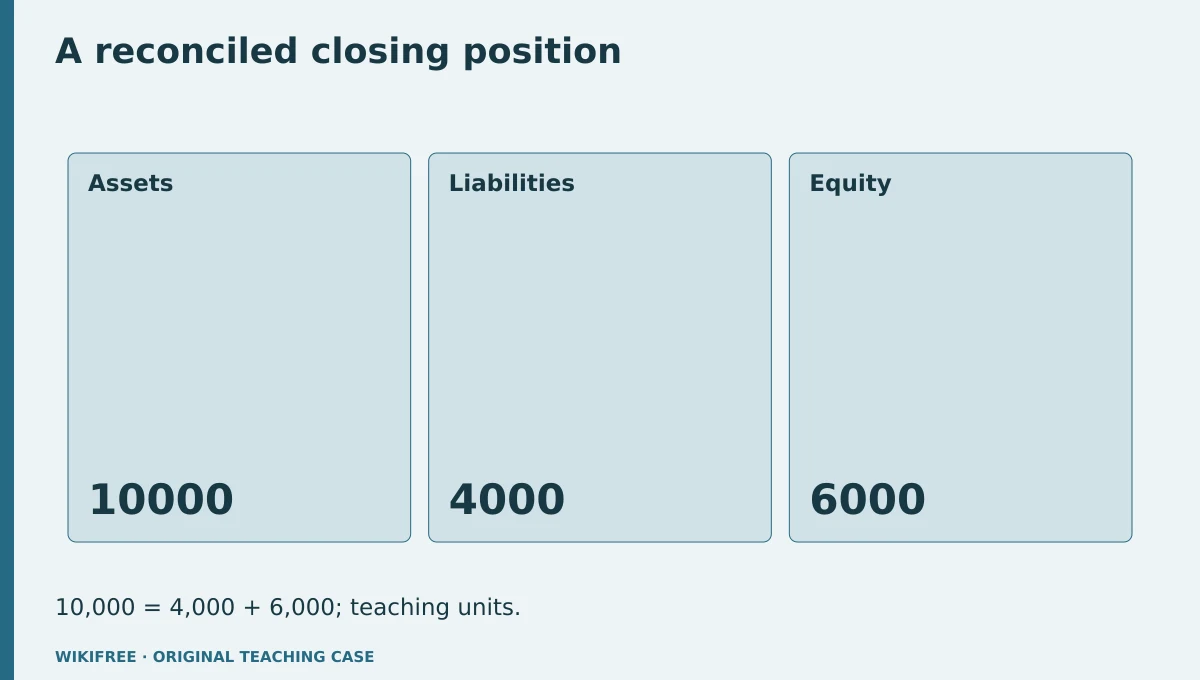
The table and explanations preserve the essential case information when the diagram is unavailable.
Your route
Five outputs, then a final handoff
- 01Orient the statementsStatement map
About 1h 12m including assigned learning and practice. - 02Reconcile the income statementIncome statement with margins
About 1h 14m including assigned learning and practice. - 03Inspect the balance sheetBalance sheet reconciliation
About 1h 20m including assigned learning and practice. - 04Compare a changed periodScenario and question list
About 1h 5m including assigned learning and practice. - 05Write a reader-friendly briefStatement-reading brief
About 50m including assigned learning and practice. - FINALCapstone reviewCombine the evidence into one inspectable handoff.
About 2h .
0 of 6 outputs checked. JavaScript adds browser-only progress saving.
The complete lesson and all downloads remain available. Use the printable project workbook to track your progress.
Use the minimum useful source material
The courses behind this route
Corporate Finance Institute
Accounting Fundamentals: Free Course
Public accounting fundamentals provide terminology and statement orientation.
Selected material only; this path does not claim completion of the entire provider course.
Corporate Finance Institute
Financial Analysis Fundamentals: Free Course
Public financial-analysis material supports careful interpretation; this path supplies its own small reconciled case.
Selected material only; this path does not claim completion of the entire provider course.
Course publication and selected public lesson metadata were checked on 13 October 2026. This is not a claim of full video playback, provider-course completion or permanent availability. Recheck the linked source if a lesson changes.
Learn, make, inspect
The five-stage workshop
Orient the statements
Video 17m · reading budget 0m · original practice about 55m.
The income statement describes activity over a period; the balance sheet describes a position at a date. Mixing those time bases creates misleading comparisons. Use the supplied case boundary and label the reporting period. This exercise is simplified and does not contain enough information to reconstruct a complete cash-flow statement.
Watch these selected lessons
Do the work
Place each supplied item in its statement and label period versus date.
Save this output
Statement map
Pass the review gate
Current liabilities are recognized as a subset, not added again to total liabilities.
If you need another attempt
Identify subtotals before summing rows.
Reconcile the income statement
Video 13m · reading budget 0m · original practice about 1h .
Subtract direct costs to obtain gross profit, then operating expenses for the simplified operating result. Keep the subtotal visible so a reader can locate the cause of a change. The original exercise supplies these definitions; the selected provider parts offer accounting foundations, not a claim that every case calculation appears in the video.
Watch these selected lessons
Do the work
Build the income statement and calculate gross and operating margins.
Save this output
Income statement with margins
Pass the review gate
Gross profit is 5,000; operating result is 2,000; margins are 41.67% and 16.67%.
If you need another attempt
Divide both margins by revenue and show the unrounded calculation.
Inspect the balance sheet
Video 14m · reading budget 0m · original practice about 1h 5m.
Reconcile assets with funding before interpreting a ratio. Separate current assets from equipment and avoid treating receivables as immediately available cash. A current ratio summarizes a relationship but does not establish when collections occur or whether inventory can be sold. Ask timing and quality questions alongside the number.
Watch these selected lessons
- Financial Analysis Fundamentals: How to Analyze Financial Statements Like a Pro Part 1 | CFI Course14:01
Do the work
Calculate total assets, working capital and the current ratio.
Save this output
Balance sheet reconciliation
Pass the review gate
Assets total 10,000, working capital is 3,500 and the current ratio is 2.4.
If you need another attempt
Use current assets 6,000 and current liabilities 2,500 for the ratio.
Compare a changed period
Video 0m · reading budget 0m · original practice about 1h 5m.
A percentage change needs a stated baseline. Consider a scenario with revenue unchanged and direct costs rising by 1,000. The operating result falls even though sales are stable. Distinguish what the figures show from possible explanations, and request evidence before blaming prices, waste or supplier performance.
Original application stage. Use your preceding outputs and the supplied case; there is no additional required provider lesson.
Do the work
Rebuild the income statement after the cost increase and list three diagnostic questions.
Save this output
Scenario and question list
Pass the review gate
Operating result falls to 1,000; no unsupported cause is asserted.
If you need another attempt
Label possible explanations as hypotheses.
Write a reader-friendly brief
Video 0m · reading budget 0m · original practice about 50m.
A short financial brief should state the reconciled facts, the interpretation and the missing information. Do not combine several ratios into a vague healthy or unhealthy verdict. Explain what each number can and cannot answer. Use consistent rounding and preserve exact values in the supporting calculation.
Original application stage. Use your preceding outputs and the supplied case; there is no additional required provider lesson.
Do the work
Write a 250-word brief with three findings and three limitations.
Save this output
Statement-reading brief
Pass the review gate
The brief distinguishes profitability, position and cash timing.
If you need another attempt
Replace a broad verdict with a specific question supported by the figures.
Make the result inspectable
Your final project
Submit both statements, ratio calculations, changed-cost scenario and brief. Include a deliberate double-counting error in a separate test copy and explain how the reconciliation detects it.
The ZIP includes synthetic input data, a project workbook, worked reference, evidence log, scoring rubric and case-specific materials. Code projects include source and clearly stated local execution requirements.
Use one consistent rubric
| Criterion | Maximum | Evidence |
|---|---|---|
| Evidence and correctness | 30 | Calculations, source use and results match the supplied case; limitations are honest. |
| Required artifacts | 30 | All five stage outputs and the capstone handoff are present and inspectable. |
| Reasoning and decisions | 20 | Choices, assumptions, alternatives and the case-specific critical condition are explained. |
| Reproducibility | 10 | A reviewer can follow the stated steps and distinguish expected from observed results. |
| Clear communication | 10 | Labels, units, structure and evidence references make the work easy to review. |
Score at least 80/100, supply every required artifact, and satisfy the path-specific critical condition. Rework missing evidence before marking complete.
The critical condition
Statements reconcile and cash availability is not inferred directly from revenue or the current ratio.
Compare with a worked reference
Assets are 2,000 + 3,000 + 1,000 + 4,000 = 10,000, matching liabilities 4,000 plus equity 6,000. Current assets are 6,000, so the current ratio is 6,000 / 2,500 = 2.4. This does not establish that 6,000 cash is available today.
Know the boundary
This is introductory financial literacy with synthetic data, not an audit, valuation or investment recommendation.
Questions before you finish
Do I need to finish every source course?
No. This path names selected lessons or reading sections. Complete the full provider course only if it supports your wider goal. The path does not claim equivalence to that course.
How do I know when to advance?
Use the output and review gate in each stage. If evidence is missing or a result conflicts with the case, follow the repair step and retry before advancing.
Can I do the project without paid software?
The selected public provider lessons are free to view. The original case can be completed with paper, a text editor or freely available local tools. Paid exams, certificates, subscriptions and optional provider software are not required for this project.
What does my checklist prove?
It records your own review in this browser only. It does not verify viewing, skill, a provider credential or a real-world deployment.
What if a lesson or tool changes?
Use the linked course and provider page to inspect current availability. Record the change and revisit the relevant assignment; do not invent a replacement lesson or claim an unavailable activity was completed.
Questions & discussion
Share a useful question or correction. Comments appear after moderation. Please avoid personal or sensitive information.