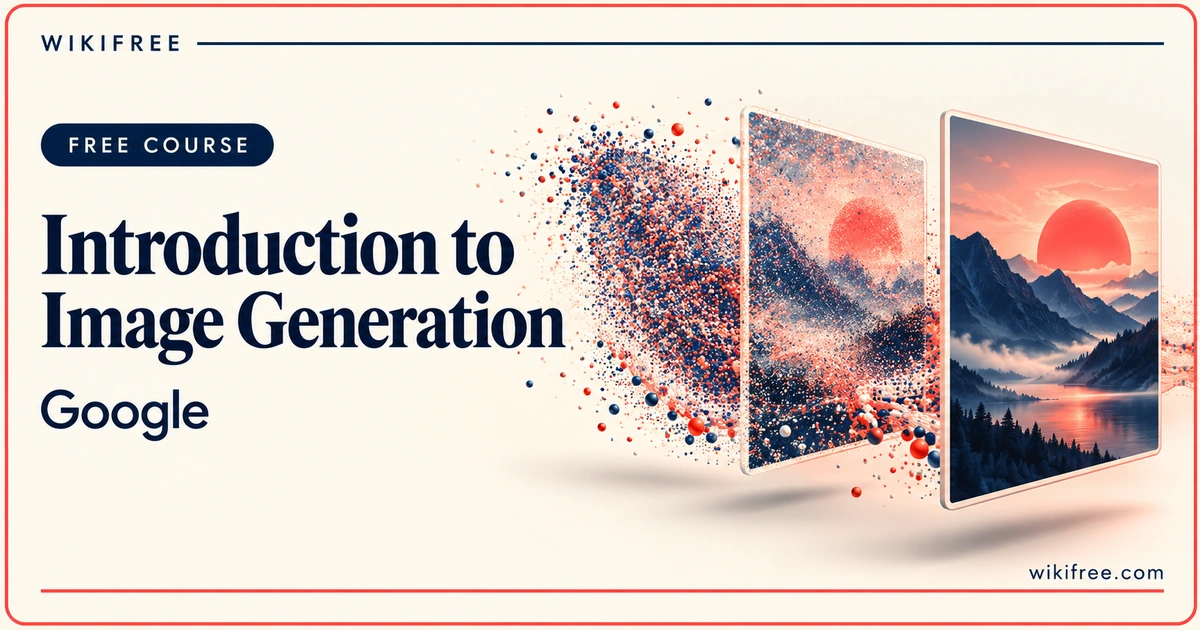
How can a model turn noise into an image? Google’s Introduction to Image Generation focuses on diffusion models, giving you a short introduction to an important approach behind image-generating systems.
This free, 30-minute course is for learners who want to understand the mechanism rather than collect prompt tricks. It introduces diffusion theory, unconditioned models, text-to-image advances and the training and deployment concepts described by Google. The listed learning route is a video and a quiz, with no hands-on Cloud lab.
Course at a glance
| Provider | |
|---|---|
| Platform | Google Skills |
| Level | Beginner |
| Language | English |
| Estimated time | 30 minutes; your study pace may vary |
| Format | Introductory video and a quiz |
| Access | Free course; Google Skills sign-in required |
| Preparation | Browser, internet and a free learner account |
| Recognition | Course completion badge advertised; no professional certification or academic credit promised |
What you’ll learn
- Explain the diffusion approach: develop a conceptual understanding of how these models generate images.
- Recognise applications: connect diffusion models with image-generation use cases.
- Understand unconditioned generation: distinguish it from generation guided by additional information.
- Follow text-to-image developments: see how the course connects diffusion concepts with more directed image generation.
Skills you’ll gain
- Diffusion-model vocabulary
- Image-generation concepts
- Conditioned versus unconditioned generation
- Text-to-image awareness
- Technical learning planning
Look beneath the finished picture
Diffusion models use a learned process for reversing noise. At a high level, training involves adding noise to examples and learning how to undo that corruption. Generation can then start from noise and use repeated denoising steps to produce an image.
That distinction between training and generation is useful when you hear someone describe an image tool as simply following a prompt. The instruction matters, but the system also depends on a model that has learned how to generate visual structure.
The course’s stated objectives include unconditioned diffusion models and text-to-image advances. Watch for what changes when additional information guides the generation process. That is a more productive first question than trying to memorise every product name mentioned in a demonstration.
A short introduction with technical ideas
Google lists this course as introductory. Its subject is still a machine-learning method, so pause and take notes if terms such as model training are new to you. Familiarity with basic machine-learning vocabulary can help you follow the explanation.
The course introduces training and deployment concepts; its current activity list does not contain a project in which you train or deploy a model yourself. Choose it to build an initial mental model and identify what you want to study next. A half-hour introduction is a starting point, not evidence of production engineering experience.
Turn the explanation into a simple study sketch
For an optional personal exercise, draw two small diagrams on paper. In the first, show an image becoming progressively noisier. In the second, show noise passing through several denoising stages. Add separate labels for training and generation, then revise them after watching the lesson.
Next, write a fictional image brief, such as a blue bicycle beside a yellow wall. List the visual details that would need to match the brief: object, colour, placement and background. Use that list to describe what conditioned generation is intended to guide. You do not need an image-generation account or GPU to complete this reflection.
This optional study sketch is not an assessed Google assignment. Add one question you would like an advanced lesson to answer.
Free course access and the deployment boundary
The current course is advertised as Free. Sign in with a free Google Skills account to access its video and quiz, save progress and qualify for the advertised completion badge. Its complete listed route contains no lab.
Studying the material does not require a subscription, card, trial, Cloud project or paid API. Operating image-generation services is a separate activity and is not advertised here as free practice. Explore the free course catalogue when you want to continue learning.
Frequently asked questions
Will I generate images or train a model in this course?
The listed route contains a video and a quiz. Training and deployment are introduced as concepts; there is no hands-on image-generation or model-training lab.
Do I need a GPU or paid Cloud service?
No. The free learning route needs a Google Skills account, browser and internet. Running a Cloud image service is separate from completing this course.
What does the completion badge mean?
It records completion of the required course activities in Google Skills. The course does not promise professional certification, academic credit or evidence of hands-on deployment experience.
Questions & discussion
Share a useful question or correction. Comments appear after moderation. Please avoid personal or sensitive information.