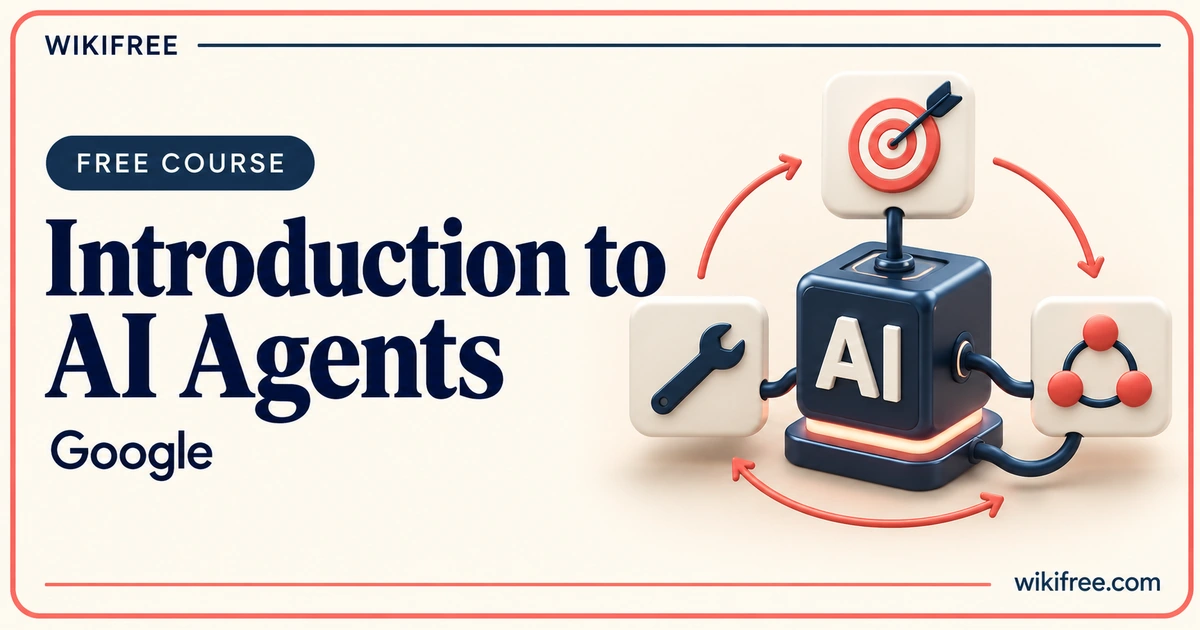
An AI agent is easier to evaluate when you can explain what it is supposed to achieve, which tools it can use and how its actions are coordinated. Google’s Introduction to AI Agents offers a short conceptual starting point for understanding those questions without setting up a cloud project.
This introductory microlearning course is useful when agent terminology appears in a product discussion and you want a clearer picture of the architecture. It introduces the ideas behind goal-oriented systems; it does not promise that a brief lesson will make you ready to build or deploy a production agent.
Course at a glance
| Provider | |
|---|---|
| Platform | Google Skills |
| Level | Beginner |
| Language | English |
| Format | Conceptual microlearning with three lesson links and a quiz |
| Estimated study time | Google estimates 30 minutes; your pace may vary |
| Access | Free course; ordinary free Google Skills account required |
| Required tools | Browser; no cloud lab or paid API required |
| Recognition | Completion badge advertised; no formal certificate or academic credit promised |
What you’ll learn
- Recognise agent capabilities such as reasoning and autonomous action.
- Distinguish goal-oriented agents from reactive, script-based chatbots.
- Identify models, tools, orchestration and runtime in agent architecture.
- Explain the purpose of collaboration between multiple agents.
Skills you’ll gain
- Agent terminology
- Architecture awareness
- Capability comparison
- Multi-agent concepts
- System-question framing
Give the architecture a clear purpose
The three lessons move from an introduction to core capabilities and architecture. Use that sequence to organise your notes around a purpose rather than a list of fashionable terms. For each component, ask what responsibility it has and what information it would need from the rest of the system.
A useful study habit is to explain a component without using the word “intelligent.” If you cannot describe what it contributes, return to the lesson and sharpen your explanation. This keeps the vocabulary connected to decisions a person can discuss with a developer or product team.
Compare a chatbot with a goal-oriented workflow
For optional personal practice, sketch two fictional ways to help someone organise a meeting. In one, a scripted assistant answers a set of questions. In the other, imagine a system pursuing a clearly stated goal through several coordinated steps. Keep the example on paper; do not connect it to an email account or calendar.
Write down the goal, the information available and the actions you would allow. Add a point where a person should review a decision. The exercise is your own way to test understanding, not a Google assignment, a working integration or evidence that an agent can safely handle real appointments.
Then revisit the sketch after the architecture lesson. Label the parts you understand and leave uncertain details as questions. A useful result is a more precise conversation, rather than a diagram that appears complete but hides assumptions.
Use the short format deliberately
Read each lesson before answering the quiz, then explain the main distinction in your own words. If an answer feels familiar only because you recognise a phrase, compare it with a concrete example. The 30-minute estimate is a guide to the course’s size, not a deadline for understanding it.
This is a focused introduction. Continue to more detailed implementation material when you have a specific project and can review its tools, costs and technical requirements separately.
Free learning without an agent deployment
The current course is offered free and uses lessons and a quiz. An ordinary free Google Skills account is required for access and progress. The advertised route has no mandatory cloud lab, paid API, subscription, trial or payment card. You can complete the conceptual learning without purchasing agent software.
Google advertises a completion badge. Treat it as course recognition rather than a formal certificate, academic qualification or proof of production engineering ability.
Frequently asked questions
Will I build a working agent in this course?
It is a conceptual introduction with lessons and a quiz. The advertised route does not include an agent-deployment lab.
Do I need paid cloud or API access?
No. The reviewed course route needs a browser and ordinary free Google Skills account, without a paid API or cloud project.
Is the badge a professional certification?
No formal certification or academic credit is promised here. The provider advertises a course-completion badge.
Questions & discussion
Share a useful question or correction. Comments appear after moderation. Please avoid personal or sensitive information.