Listed as Free on Udemy when checked on 24 October 2026. No coupon or subscription trial is required for the listed lessons. Enrollment needs a Udemy account; availability can change.
About this course
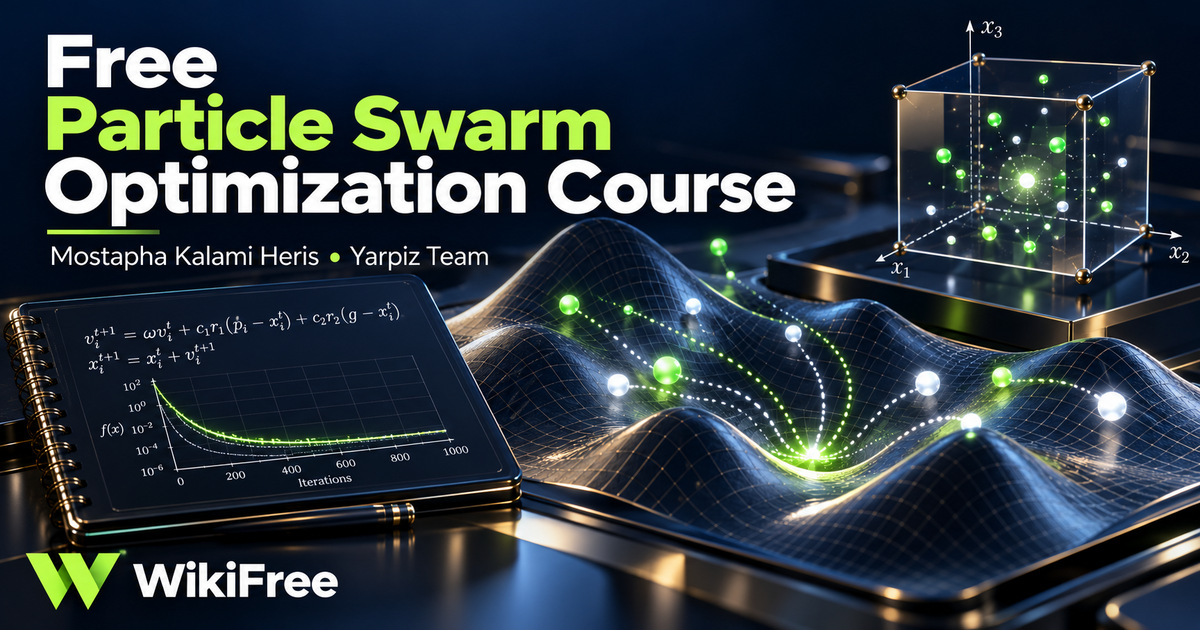
Particle swarm optimization searches through candidate solutions by updating their positions using individual and shared experience. This free course explains that mechanism and implements it step by step in MATLAB.
Mostapha Kalami Heris and Yarpiz Team connect the mathematical model with initialization, iteration, objective evaluation and reusable code. It is suitable for learners who want to understand the implementation instead of only calling an optimization function.
| Official course | Particle Swarm Optimization in MATLAB |
|---|---|
| Created by | Yarpiz Team; Mostapha Kalami Heris |
| Platform | Udemy |
| Language | English |
| Level | All Levels — Udemy listing |
| Listed duration | 81 minutes; 11 lectures across 4 sections |
| Certificate | Not included with a new free enrollment |
Skills you’ll gain
- Describe particle position, velocity and personal-best state
- Distinguish inertia, cognitive and social update terms
- Define a bounded minimization problem
- Initialize a swarm and track the best candidate
- Refactor a script into a reusable function
- Plot objective progress and recognize algorithmic limitations
The theory section introduces the simplified PSO model and its mathematical update. The implementation section defines an example objective, sets parameters, initializes particles and constructs the main loop. Each candidate’s evaluated cost updates personal and global best records.
The final section converts the code into a function, adds position and velocity bounds, and introduces constriction coefficients. A convergence plot helps inspect the search, but a decreasing best-cost curve is not proof that an arbitrary problem’s global optimum has been found.
The public syllabus lists 81 minutes across 11 lectures and requests MATLAB programming and optimization familiarity. Although the platform level is All Levels, the stated prerequisites make this more appropriate for learners with some numerical programming background.
MATLAB access is separate from the free course. GNU Octave is a free language environment with substantial MATLAB syntax compatibility and can be considered for adapting basic numerical exercises. Compatibility is not complete, and this course’s files have not been tested in Octave or on current MATLAB versions.
Frequently asked questions
Does PSO always find the global optimum?
No. It is a stochastic search method; outcomes depend on the problem, settings and run.
Is MATLAB included?
No. The lessons are free, while application licensing is separate.
Can I use Octave instead?
It may support adapting the basic numerical code, but full compatibility and execution of the supplied files have not been verified.
Checked on 24 October 2026 using the public course details and syllabus. WikiFree has not watched every lesson or tested full playback. New free enrollments do not include a Udemy completion certificate, instructor Q&A or direct messages.
Questions & discussion
Share a useful question or correction. Comments appear after moderation. Please avoid personal or sensitive information.