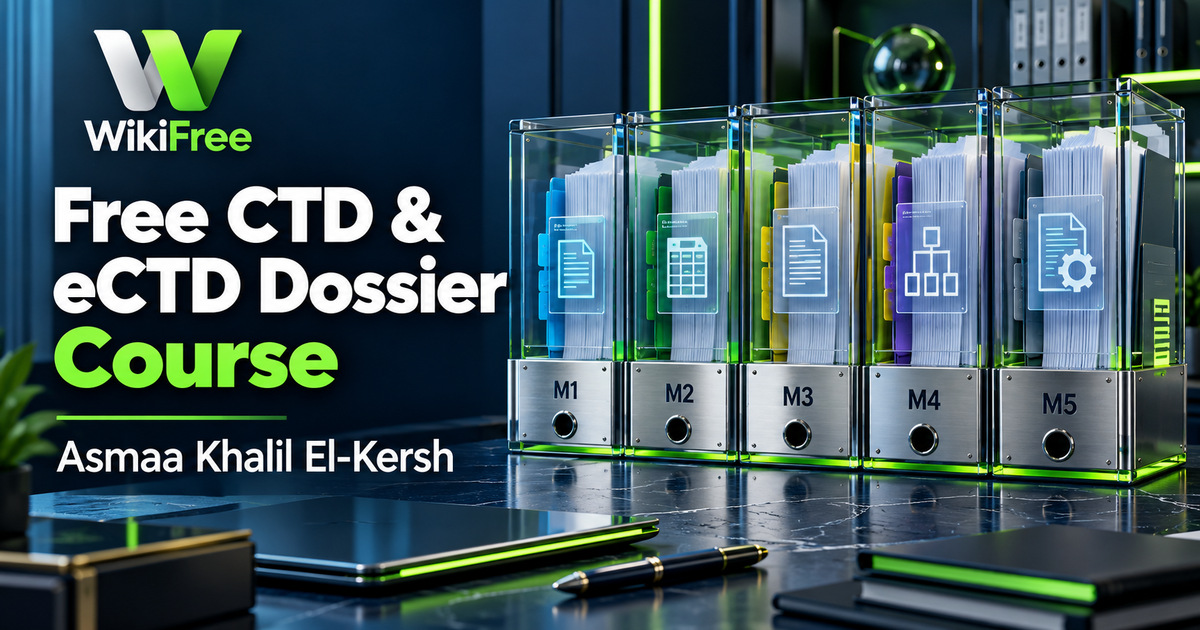
Listed as Free on Udemy when checked on 24 October 2026. No coupon or subscription trial is required for the listed lessons. Enrollment needs a Udemy account; availability can change.
About this course
Pharmaceutical registration work brings together administrative information, summaries, quality material and study documentation. Asmaa Khalil El-Kersh introduces how that information is organized through CTD, NeeS and eCTD submission formats, with attention to the role of regulatory affairs and the structure of a registration dossier.
This is a 78-minute orientation made up of five lectures in five sections. The listed audience spans regulatory affairs, research and development, quality control, quality assurance, supply chain and medical affairs. No programming experience is required, although familiarity with pharmaceutical terminology will make the material easier to follow.
| Official course | CTD NeeS & eCTD compilation and submission of the dossiers |
|---|---|
| Created by | Asmaa Khalil El-Kersh |
| Platform | Udemy |
| Language | English |
| Level | All Levels — Udemy listing |
| Listed duration | 78 minutes; 5 lectures across 5 sections |
| Certificate | Not included with a new free enrollment |
Skills you’ll gain
- Distinguish the submission-format concepts CTD, NeeS and eCTD.
- Describe how regulatory affairs coordinate dossier preparation and registration work.
- Recognize the different purposes of the five CTD modules.
- Separate regional administrative material from summaries, quality information and study evidence.
- Identify questions that require checking the receiving authority’s current technical guidance.
The course begins with regulatory-affairs responsibilities and the history and rationale of common dossier structures. It then discusses the CTD triangle, the registration cycle and the differences between paper-oriented and electronic submission forms. The public outline repeats several topic descriptions across the numbered lectures; it does not establish a separate software exercise for every topic.
Its module overview covers regional administrative information in Module 1, summaries and overviews in Module 2, quality and chemistry/manufacturing/controls material in Module 3, non-clinical studies in Module 4 and clinical studies in Module 5. The stated Module 1 discussion includes common administrative documents and compilation challenges. This is a map of the training’s scope, not a complete checklist for an actual product application.
The listing was last updated in November 2021. Its broad claims about worldwide acceptance should not be read as a current rule applying identically to every authority, product and submission type. Before using any format operationally, consult the receiving regulator’s current guidance, technical specifications and applicable process. This introductory course alone does not establish that a dossier is complete, valid or ready to submit.
No particular commercial publishing package is named as a learning requirement. For a free conceptual exercise, build a fictional folder tree and document inventory, label the intended purpose of each module and record unresolved questions. A normal document editor can support that exercise; it does not provide eCTD lifecycle management, validation or a regulator-approved publishing system.
The useful outcome is a clearer vocabulary for conversations between regulatory, scientific and quality teams. Learners seeking hands-on submission production will still need current regional guidance, appropriate tools and supervised practical experience. The public syllabus does not establish an assessed professional credential or authorization to prepare real applications independently.
Frequently asked questions
Is this a complete eCTD publishing software course?
The public syllabus describes submission concepts, dossier modules and preparation criteria. It does not identify a complete hands-on workflow in a specific publishing application.
Does it establish current requirements for every country?
No. It is an introductory course with a 2021 listing update. Actual submissions require the receiving authority’s current guidance for the relevant product and application.
Can I practice without buying specialist software?
A fictional folder structure and document inventory can support conceptual learning with a free editor. That exercise cannot validate or publish a real eCTD submission.
Checked on 24 October 2026 using the public course details and syllabus. WikiFree has not watched every lesson or tested full playback. New free enrollments do not include a Udemy completion certificate, instructor Q&A or direct messages.
Questions & discussion
Share a useful question or correction. Comments appear after moderation. Please avoid personal or sensitive information.