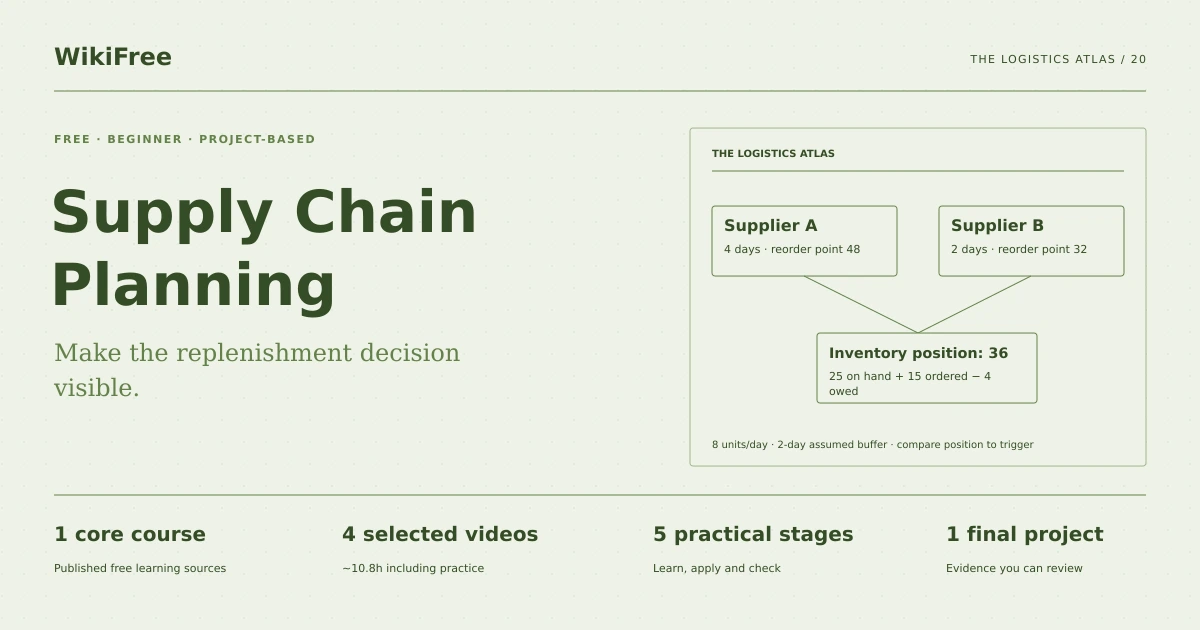
WikiFree learning path 20 · Beginner
The logistics atlas
Make the replenishment decision visible.
Build a simple replenishment and supplier-comparison plan using demand, lead time and service assumptions.
Video duration uses the selected lessons only. Reading and practice times are planning estimates; repeat difficult work as needed.
A clear starting point
Who this is for
Comfort with averages and inventory arithmetic; this route introduces planning concepts through a small case.
Your practical result
Build a simple replenishment and supplier-comparison plan using demand, lead time and service assumptions.
This is an introductory deterministic model. Demand forecasting, statistical safety stock, contracts and global logistics require further study.
Access and cost
Assigned public videos can be watched free. Complete the original case in a text editor, on paper or in a spreadsheet you already have. No paid course, exam or provider certificate is included.
The project pack contains an original workbook, case inputs, an evidence log and reference notes. Some technical paths include starter code and a runnable reference. Read the pack README before starting.
Three-minute readiness check
Answer first, then open each explanation. A missed answer identifies what to revisit; it does not stop you from starting.
Is inventory on hand the whole inventory position?
No. Add on-order stock and subtract backorders under the stated convention.
Can the cheapest unit price have a higher order cost?
Yes. Freight, batch size and other consequences matter.
Does a two-day buffer prove a service level?
No. It is a case assumption, not a quantified probability of avoiding stockouts.
The case you will work on
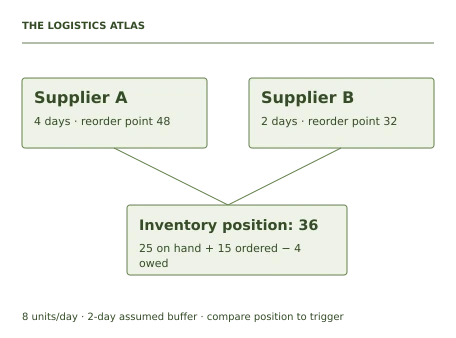
Birch Repair Shop uses a common spare part. Average demand is eight units per working day. Supplier A takes four days; Supplier B takes two. A simple case rule adds two days of demand as a buffer. This is a deterministic training model, not a statistically optimized inventory policy.
| Supplier | Lead time, days | Unit cost | Freight per order |
|---|---|---|---|
| A | 4 | 6 | 20 |
| B | 2 | 7 | 10 |
These are supplied synthetic inputs, not observations from a real organization. Label assumptions and any additional data you create.
Keep an evidence trail
Save each stage output in the project folder. In evidence_log.csv, record the decision, the artifact or test that supports it, what failed, and the revision you made.
Your route from learning to evidence
- Stage 1Draw the supply networkA supply network and responsibility map60 minutes of original practice
- Stage 2Translate demand into coverageAn inventory-position calculation60 minutes of original practice
- Stage 3Set a transparent reorder ruleTwo reorder rules and a trigger decision75 minutes of original practice
- Stage 4Compare a feasible orderA supplier comparison and evidence gaps60 minutes of original practice
- Stage 5Prepare an exception planA disruption response and policy review60 minutes of original practice
- Final projectMake the evidence reviewableConnect the five stage outputs and test a change.180 minutes estimated
Progress stays in this browser. Tick a stage only after its evidence check passes. This is a personal checklist, not a certificate.
Why these source courses
The path uses selected material from courses already published on WikiFree. The original exercises below connect that material to one practical outcome. Follow only the listed assignments; completing the full source courses is optional.
MIT
Free MIT Course: Supply Chain Strategy and Logistics
The first four published MIT lectures provide supply-chain context. The worked replenishment model is original and is not presented as a named provider lesson.
Access: Free Video
Certificate: Free video viewing; no MIT certificate or academic credit
Learn it, apply it, check it
Work in order. Every stage produces something the next stage uses. Revisit the repair instruction when a check fails.
Draw the supply network
Comfort with averages and inventory arithmetic; this route introduces planning concepts through a small case.
The idea to use
A supply plan connects the demand point, stock location and supplier. Identify the information that moves in the opposite direction to physical goods: requests, orders, confirmations and receipts. A diagram should expose a decision owner and a dependency, not imply that a supplier’s quoted lead time is guaranteed. The numbered MIT lectures provide broad context; the Birch calculations are original practice.
Watch the selected lessons
- 1. Lec 1 | Special Topics in Supply Chain Management11:18
- 2. Lec 2 | Special Topics in Supply Chain Management42:06
Selected video time: 53m. Open this course on WikiFree.
Your 60-minute lab
Map the shop, store and two suppliers. Mark who observes demand, raises an order and checks the receipt.
Save: A supply network and responsibility map.
Evidence check
Physical and information flows are distinguishable and each replenishment decision has an owner.
If it fails: If the map ends at dispatch, add receipt verification and the treatment of short deliveries.
Translate demand into coverage
Bring your previous output: A supply network and responsibility map
The idea to use
Days of cover divides usable stock by a demand-rate assumption. It is a planning view, not a promise. Inventory position includes on-order units and subtracts backorders when those definitions are consistent. Do not count damaged stock as available or ignore demand already owed. State whether the rate uses working days or calendar days.
Original practice stage. No additional video or reading assignment is required.
Your 60-minute lab
Use 25 usable units on hand, 15 on order and four backordered. Calculate inventory position and on-hand days of cover at eight units per working day.
Save: An inventory-position calculation.
Evidence check
Position is 36 units; on-hand cover is 3.125 working days.
If it fails: If cover uses 40 units, separate physical availability from goods that have not arrived.
Set a transparent reorder rule
Bring your previous output: An inventory-position calculation
The idea to use
A simple reorder point can combine demand during lead time with an explicit buffer. Here the buffer is two days of average demand. This does not model demand variability, supply variability or a target service probability. Write the assumption beside the formula so a future user does not mistake it for an optimized safety-stock calculation.
Original practice stage. No additional video or reading assignment is required.
Your 75-minute lab
Calculate reorder points for both suppliers and decide whether a position of 36 triggers ordering under each rule.
Save: Two reorder rules and a trigger decision.
Evidence check
A has a 48-unit threshold and triggers; B has a 32-unit threshold and does not.
If it fails: If the same threshold is used for both, revisit the lead-time assumption.
Compare a feasible order
Bring your previous output: Two reorder rules and a trigger decision
The idea to use
Compare options using the same order quantity and relevant boundary. For a 40-unit order, unit cost plus freight is a simple landed-order estimate. It excludes storage, shortages and quality costs, so those remain separate considerations. A faster supplier can be worth considering when lead-time uncertainty threatens service, even if its direct order cost is higher.
Watch the selected lessons
- 3. Lec 3 | Special Topics in Supply Chain Management52:28
- 4. Lec 4 | Special Topics in Supply Chain Management44:55
Selected video time: 1h 37m. Open this course on WikiFree.
Your 60-minute lab
Compare a 40-unit order from A and B. Add one service risk and one quality question that the arithmetic alone cannot resolve.
Save: A supplier comparison and evidence gaps.
Evidence check
Direct order costs are 260 and 290; the 30-unit difference is not treated as the whole decision.
If it fails: If an option wins only on price, state the operational consequence of its lead time.
Prepare an exception plan
Bring your previous output: A supplier comparison and evidence gaps
The idea to use
A replenishment policy needs an exception route for late deliveries, changed demand and inaccurate stock records. Set an observable trigger and name the decision owner. Keep emergency orders visible because repeated expedites may indicate a broken baseline process. Review the policy after new evidence; do not silently update the demand rate to justify an earlier decision.
Original practice stage. No additional video or reading assignment is required.
Your 60-minute lab
Simulate Supplier A slipping from four to six days. Recalculate its threshold under the case rule and draft a response with a record-review action.
Save: A disruption response and policy review.
Evidence check
The revised threshold is 64 units and the reason for changing it is recorded.
If it fails: If the response is only order more, explain delivery timing, existing commitments and the stock-record check.
A worked reference to compare
Inventory position is 25+15−4=36. A’s reorder point is 8×4+8×2=48; B’s is 8×2+16=32. Forty units cost 40×6+20=260 from A or 40×7+10=290 from B. These are case calculations; a real policy needs measured variability and operational constraints.
Compare your reasoning as well as the result. If your answer differs, state the assumption or input that explains the difference. Reference notes are for checking after an attempt; copying them is not evidence of independent work.
Your final project
Your brief
Build the Birch planning pack: network, inventory definitions, reorder rules, supplier comparison and a late-delivery exception plan.
Time box: 3h 00m estimated. Extend it if a gate needs repair.
Hand in these artifacts
- A supply network and responsibility map
- An inventory-position calculation
- Two reorder rules and a trigger decision
- A supplier comparison and evidence gaps
- A disruption response and policy review
- A short README: outcome, how to inspect or run the work, assumptions and limitations.
- A before-and-after change test and the completed evidence log.
Run a final review
- Use the supplied reference to reconcile the baseline result.
- Choose one relevant input or constraint to change. Write your expected effect before testing it.
- Run the calculation, walkthrough or test again and save the actual result.
- Ask a peer to inspect the evidence, or perform a separate self-review. Label which review you used.
- Score the work using the rubric and repair every critical failure.
Review rubric · 100 points
| Criterion | Points | Evidence to inspect |
|---|---|---|
| Practical outcome and case reasoning | 25 | Build a simple replenishment and supplier-comparison plan using demand, lead time and service assumptions. |
| Five stage checks | 30 | Award 6 points for each stage only when its stated gate is demonstrably met. |
| Traceable evidence | 20 | Artifacts, inputs and calculations or tests are reproducible; synthetic and simulated evidence is labelled. |
| Revision after a changed condition | 15 | Change one input or constraint, predict the effect, test it and record the result. |
| Handoff quality | 10 | A reviewer can find the files, follow the instructions and understand the remaining limitations. |
Completion target: at least 80/100, all five stage gates passed, and every critical issue below corrected. This is a learning benchmark, not an accredited qualification.
Critical issue: Do not label the case buffer as a guaranteed service level or treat on-order stock as physically available.
Before you go further
What will I be able to produce?
Build a simple replenishment and supplier-comparison plan using demand, lead time and service assumptions.
Is the whole path free?
Assigned public videos can be watched free. Complete the original case in a text editor, on paper or in a spreadsheet you already have. No paid course, exam or provider certificate is included.
Do I need to finish every source course?
No. Follow the selected assignments at each stage. Source courses provide context, while the original case, labs and final review build the practical result. Extra study is optional.
What counts as completion?
Complete all five stage checks, earn at least 80/100 on the final rubric and correct every critical issue. This is an introductory deterministic model. Demand forecasting, statistical safety stock, contracts and global logistics require further study.
Questions & discussion
Share a useful question or correction. Comments appear after moderation. Please avoid personal or sensitive information.