Path 57 · The observation notebook · Beginner
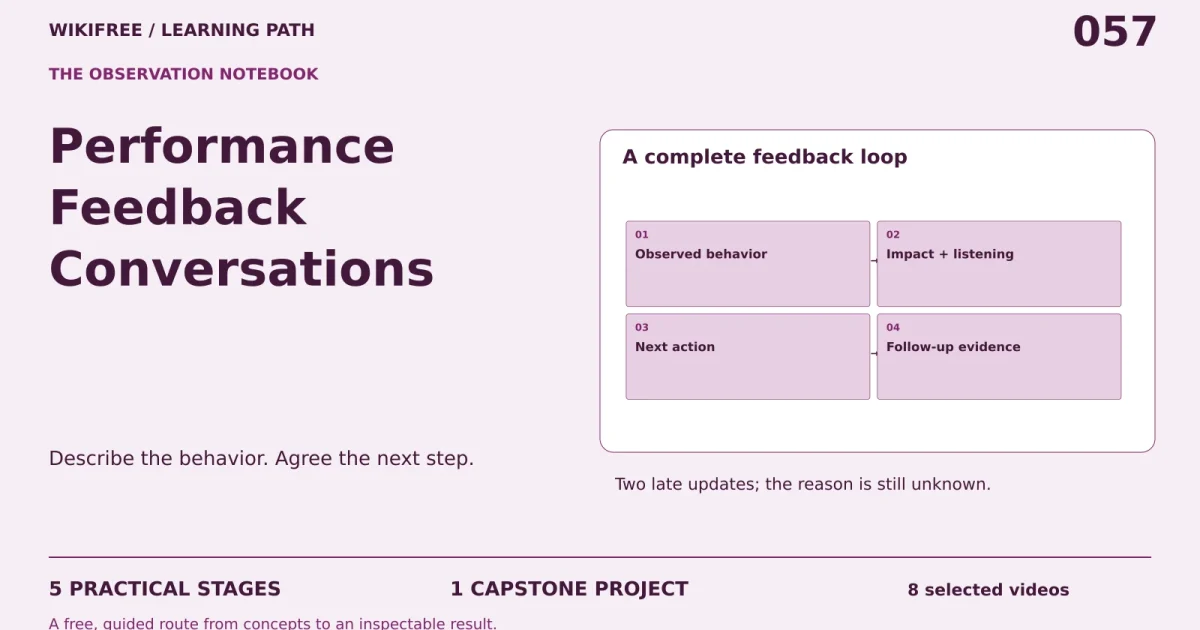
Describe the behavior. Agree the next step.
A guided, practical route through performance feedback conversations.
What you will be able to do
Prepare and rehearse an evidence-based feedback conversation with a clear request, listening prompts and a follow-up check.
Plan about 7h 35m in total. Reading and practice are editorial estimates; video runtimes come from public provider metadata. Your pace will vary.
Before you begin
Check your starting point
What you need
Basic workplace English. Use a solo role-play or a willing practice partner; no real employee assessment is required.
The selected public provider lessons are free to view. The original case can be completed with paper, a text editor or freely available local tools. Paid exams, certificates, subscriptions and optional provider software are not required for this project.
Completing this WikiFree path does not award a provider certificate. Any provider assessment, account requirement or credential must be checked separately on its official page.
Three readiness questions
Is careless an observation?
No. It is an interpretation of a person.
Can feedback include a genuine question?
Yes. Missing context can change the understanding.
What makes follow-up checkable?
An agreed behavior, date and evidence of whether it happened.
Use a workable pace
At 5 hours per week, allow about 2 weeks. Start with Stage 1, continue in order and reserve 2h for the capstone. If a gate fails, use its repair step before advancing. At another weekly budget, divide 455 estimated minutes by your available weekly minutes and round up.
Keep a small evidence folder. A checked box means you reviewed your output; it is not a certificate or proof that a provider lesson was watched.
The working case
A complete feedback loop
In a fictional volunteer team, Morgan sent two workshop updates after the agreed Wednesday deadline. One arrived Thursday and one Friday. Registration staff then had to answer questions without confirmed details. The reason for the delays is unknown. The learner must discuss the observed pattern without inventing motives or a medical or personality explanation.
| Update | Agreed day | Observed day |
|---|---|---|
| Week 1 | Wednesday | Thursday |
| Week 2 | Wednesday | Friday |
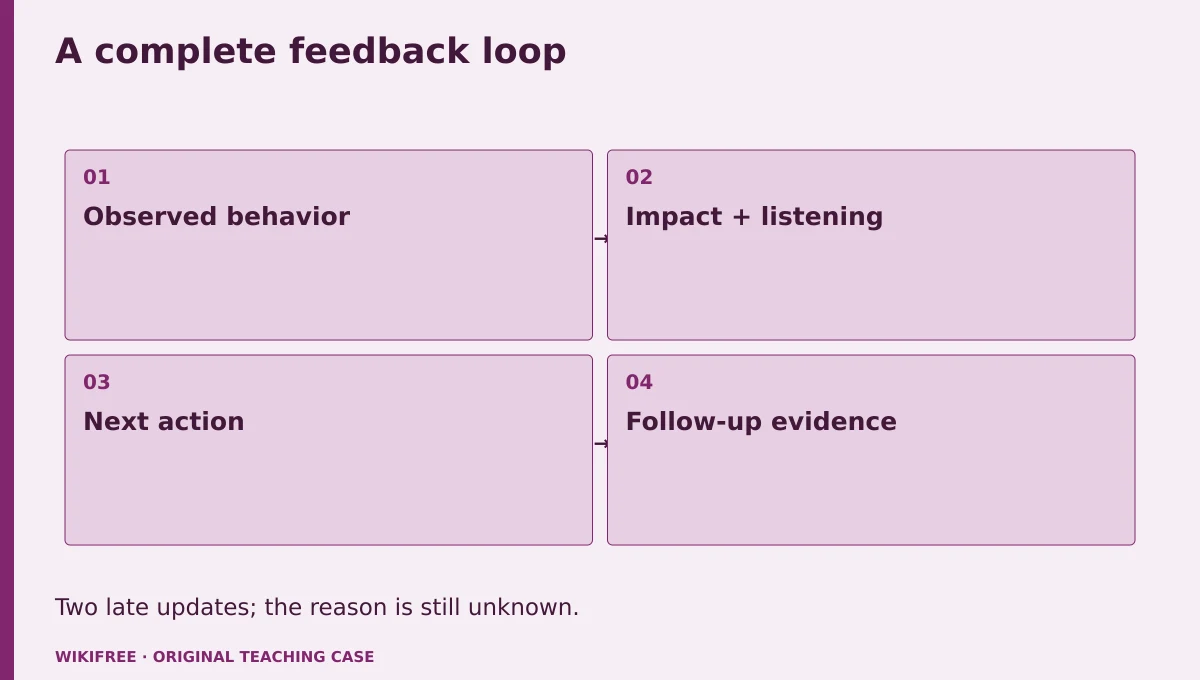
The table and explanations preserve the essential case information when the diagram is unavailable.
Your route
Five outputs, then a final handoff
- 01Separate fact from interpretationObservation brief
About 1h 1m including assigned learning and practice. - 02Choose setting and purposeConversation preparation sheet
About 1h including assigned learning and practice. - 03Practise the conversationLabelled practice transcript
About 1h 15m including assigned learning and practice. - 04Handle disagreement and biasTwo challenge-response notes
About 1h 22m including assigned learning and practice. - 05Follow up on behaviorFollow-up agreement and blank evidence log
About 1h including assigned learning and practice. - FINALCapstone reviewCombine the evidence into one inspectable handoff.
About 2h .
0 of 6 outputs checked. JavaScript adds browser-only progress saving.
The complete lesson and all downloads remain available. Use the printable project workbook to track your progress.
Use the minimum useful source material
The courses behind this route
Management Courses
Performance Feedback: Free Course
The published feedback course offers specific lessons on preparation, delivery, bias, difficulty and follow-through.
Selected material only; this path does not claim completion of the entire provider course.
Course publication and selected public lesson metadata were checked on 13 October 2026. This is not a claim of full video playback, provider-course completion or permanent availability. Recheck the linked source if a lesson changes.
Learn, make, inspect
The five-stage workshop
Separate fact from interpretation
Video 11m · reading budget 0m · original practice about 50m.
Useful feedback begins with an observable behavior and its work context. State what happened and the known impact without turning an assumption into a fact. Two late updates justify a conversation, but they do not establish a character trait. Keep the scope narrow enough that the person can understand and respond to the concern.
Watch these selected lessons
- What is Feedback? And Why Does it Matter?3:43
- The Principles of Performance Feedback: Feedback Principles that set the BAR high6:58
Do the work
Write a facts column and an interpretations column for the two updates. Remove unsupported motives from the opening.
Save this output
Observation brief
Pass the review gate
The brief preserves Wednesday/Thursday/Friday facts and does not label Morgan lazy or careless.
If you need another attempt
Replace a personality claim with a specific action and date.
Choose setting and purpose
Video 9m · reading budget 0m · original practice about 50m.
Plan feedback around a constructive work purpose and an appropriate private setting. Decide what change is needed and what information you still lack. An ambush during a public meeting can make listening harder. The plan should leave room for explanation rather than scripting the other person’s answer in advance.
Watch these selected lessons
Do the work
Prepare an invitation, purpose statement and three neutral questions about the update workflow.
Save this output
Conversation preparation sheet
Pass the review gate
Questions can reveal workload or process problems and do not presuppose blame.
If you need another attempt
Rewrite why do you always as a question about what happened in these two instances.
Practise the conversation
Video 5m · reading budget 0m · original practice about 1h 10m.
A conversation combines a concise observation, the impact, a request and listening. Pause after asking for the other person’s view. Summarize what you heard and check whether the summary is accurate. A role-play can demonstrate the sequence, but it cannot establish that a real employee accepted or changed anything.
Watch these selected lessons
Do the work
Rehearse a 5-minute conversation and save a transcript or notes. Include one plausible explanation that changes your initial assumption.
Save this output
Labelled practice transcript
Pass the review gate
The transcript includes listening, a checked summary and an agreed next-step proposal.
If you need another attempt
Shorten the opening if it leaves no time for the other person to respond.
Handle disagreement and bias
Video 16m · reading budget 0m · original practice about 1h 5m.
Disagreement can concern the facts, the impact or the proposed change. Identify which is disputed and inspect the relevant evidence. Check whether you are applying the same standard across comparable situations. If evidence remains incomplete, record the uncertainty and a next check rather than forcing a confession or pretending the discussion resolved everything.
Watch these selected lessons
- Feedback Failure: What if Your Feedback Doesn't go to Plan?8:13
- Feedback Challenges: Bias in Feedback7:53
Do the work
Write responses to a disputed deadline and a claim of unequal workload. Identify the evidence needed for each.
Save this output
Two challenge-response notes
Pass the review gate
Neither response invents evidence or treats disagreement itself as misconduct.
If you need another attempt
Separate the disputed fact from the future working agreement.
Follow up on behavior
Video 4m · reading budget 0m · original practice about 55m.
Follow-up connects the conversation to a small, observable change. Agree when updates are due, what happens if information is missing and when both parties will review the result. Recognition of improvement should be as specific as the original concern. A planned review is not a completed outcome; leave its result blank until observed.
Watch these selected lessons
Do the work
Create a two-week follow-up card with a Tuesday risk flag and Wednesday update commitment.
Save this output
Follow-up agreement and blank evidence log
Pass the review gate
The card states the behavior and review date, and unobserved results remain empty.
If you need another attempt
Avoid vague commitments such as improve communication without a checkable action.
Make the result inspectable
Your final project
Deliver the observation brief, preparation sheet, practice transcript, challenge responses and follow-up card. Review the transcript for unsupported judgments and revise at least one question after the first rehearsal.
The ZIP includes synthetic input data, a project workbook, worked reference, evidence log, scoring rubric and case-specific materials. Code projects include source and clearly stated local execution requirements.
Use one consistent rubric
| Criterion | Maximum | Evidence |
|---|---|---|
| Evidence and correctness | 30 | Calculations, source use and results match the supplied case; limitations are honest. |
| Required artifacts | 30 | All five stage outputs and the capstone handoff are present and inspectable. |
| Reasoning and decisions | 20 | Choices, assumptions, alternatives and the case-specific critical condition are explained. |
| Reproducibility | 10 | A reviewer can follow the stated steps and distinguish expected from observed results. |
| Clear communication | 10 | Labels, units, structure and evidence references make the work easy to review. |
Score at least 80/100, supply every required artifact, and satisfy the path-specific critical condition. Rework missing evidence before marking complete.
The critical condition
The conversation distinguishes evidence from interpretation and never presents a role-play as a real personnel outcome.
Compare with a worked reference
A grounded opening is: The last two updates were due Wednesday and arrived Thursday and Friday. Registration staff lacked confirmed details when answering questions. What made those deadlines difficult? The wording states the pattern and impact while leaving the explanation open.
Know the boundary
This is communication practice, not legal, disciplinary or mental-health guidance.
Questions before you finish
Do I need to finish every source course?
No. This path names selected lessons or reading sections. Complete the full provider course only if it supports your wider goal. The path does not claim equivalence to that course.
How do I know when to advance?
Use the output and review gate in each stage. If evidence is missing or a result conflicts with the case, follow the repair step and retry before advancing.
Can I do the project without paid software?
The selected public provider lessons are free to view. The original case can be completed with paper, a text editor or freely available local tools. Paid exams, certificates, subscriptions and optional provider software are not required for this project.
What does my checklist prove?
It records your own review in this browser only. It does not verify viewing, skill, a provider credential or a real-world deployment.
What if a lesson or tool changes?
Use the linked course and provider page to inspect current availability. Record the change and revisit the relevant assignment; do not invent a replacement lesson or claim an unavailable activity was completed.
Questions & discussion
Share a useful question or correction. Comments appear after moderation. Please avoid personal or sensitive information.