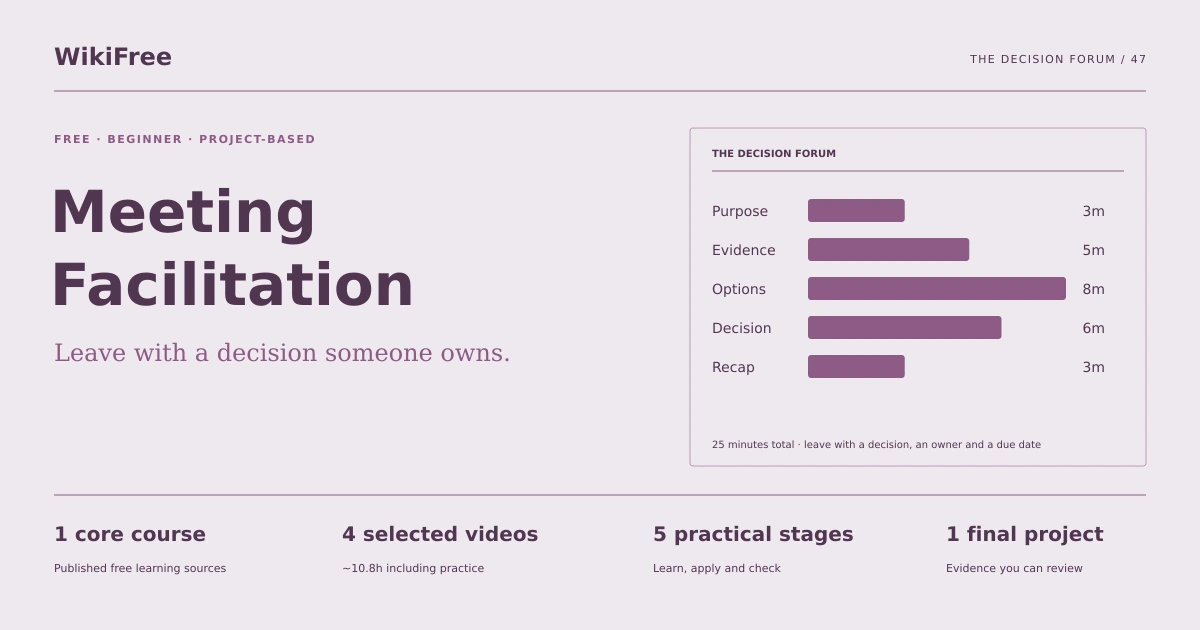
WikiFree learning path 47 · Beginner
The decision forum
Leave with a decision someone owns.
Design and facilitate a short practice decision meeting with inclusive participation, a decision record and clear follow-up.
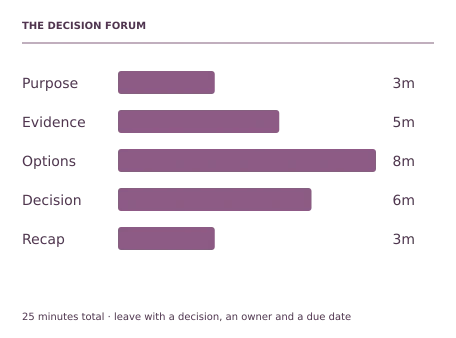
Video duration uses the selected lessons only. Reading and practice times are planning estimates; repeat difficult work as needed.
A clear starting point
Who this is for
Basic workplace communication. A solo simulation or a small willing practice group; no paid meeting tool.
Your practical result
Design and facilitate a short practice decision meeting with inclusive participation, a decision record and clear follow-up.
This is facilitation practice, not formal mediation certification or a guarantee of consensus.
Access and cost
Assigned public videos can be watched free. Complete the original case in a text editor, on paper or in a spreadsheet you already have. No paid course, exam or provider certificate is included.
The project pack contains an original workbook, case inputs, an evidence log and reference notes. Some technical paths include starter code and a runnable reference. Read the pack README before starting.
Three-minute readiness check
Answer first, then open each explanation. A missed answer identifies what to revisit; it does not stop you from starting.
Is an agenda just a list of topics?
A useful agenda also states outcomes, time and responsibility.
Does silence always mean agreement?
No.
What makes a follow-up actionable?
An owner, action and due date.
The case you will work on
The fictional Maple Volunteer Team must choose one of two workshop dates. Six volunteers have different availability, the room has a fixed booking deadline and the meeting lasts 25 minutes. The facilitator does not own the decision alone.
| Agenda item | Minutes |
|---|---|
| Purpose and decision rule | 3 |
| Evidence and constraints | 5 |
| Options and concerns | 8 |
| Decision and owners | 6 |
| Recap and feedback | 3 |
These are supplied synthetic inputs, not observations from a real organization. Label assumptions and any additional data you create.
Keep an evidence trail
Save each stage output in the project folder. In evidence_log.csv, record the decision, the artifact or test that supports it, what failed, and the revision you made.
Your route from learning to evidence
- Stage 1Define the meeting outcomeA meeting brief with decision authority.55 minutes of original practice
- Stage 2Build a timed agendaA timed, outcome-based agenda.65 minutes of original practice
- Stage 3Make participation easierA facilitation prompt and participation plan.70 minutes of original practice
- Stage 4Handle a disagreement and decideA decision record with rationale and dissent.75 minutes of original practice
- Stage 5Close the loop and reflectAn action log and facilitation reflection.60 minutes of original practice
- Final projectMake the evidence reviewableConnect the five stage outputs and test a change.180 minutes estimated
Progress stays in this browser. Tick a stage only after its evidence check passes. This is a personal checklist, not a certificate.
Why these source courses
The path uses selected material from courses already published on WikiFree. The original exercises below connect that material to one practical outcome. Follow only the listed assignments; completing the full source courses is optional.
MIT
Free MIT Course: Facilitative Leadership in the Public Sector
MIT public facilitation lessons cover concepts, scenarios, micro-skills and reflection, followed by an original volunteer-team simulation.
Access: Free Video
Certificate: Free video viewing; no MIT certificate or academic credit
Learn it, apply it, check it
Work in order. Every stage produces something the next stage uses. Revisit the repair instruction when a check fails.
Define the meeting outcome
Basic workplace communication. A solo simulation or a small willing practice group; no paid meeting tool.
The idea to use
A meeting earns its time when the needed interaction is clear. State the decision, constraints, participants and decision rule before inviting discussion. The facilitator manages the process; the designated decision owner makes the final choice according to the agreed rule. Some information can be read beforehand, leaving meeting time for resolving differences.
Watch the selected lessons
Selected video time: 33m. Open this course on WikiFree.
Your 55-minute lab
Write the purpose, desired decision, participants and a pre-read for the date choice.
Save: A meeting brief with decision authority..
Evidence check
The brief names who decides and what evidence must be considered.
If it fails: Do not invite a discussion when the decision has already been made without saying so.
Build a timed agenda
Bring your previous output: A meeting brief with decision authority.
The idea to use
Allocate time to the work needed for the decision, not equally to every speaker by habit. Put constraints before option debate and reserve time to record the outcome. A parking list keeps unrelated topics from consuming the decision window, but each parked issue still needs a later owner or disposition.
Watch the selected lessons
Selected video time: 43m. Open this course on WikiFree.
Your 65-minute lab
Adapt the 25-minute agenda and add expected outputs and facilitation prompts for each item.
Save: A timed, outcome-based agenda..
Evidence check
The times total 25 minutes and decision recording is explicitly allocated.
If it fails: If all time is spent presenting, shorten the pre-read discussion and protect decision time.
Make participation easier
Bring your previous output: A timed, outcome-based agenda.
The idea to use
Use a neutral question, a short quiet thinking period and a round of contributions to surface different views. Summarize positions without endorsing one prematurely. Invite concerns about the proposal rather than treating quiet participants as automatic agreement. Participation methods should fit the group and accessibility needs, not become a rigid performance.
Watch the selected lessons
Selected video time: 40m. Open this course on WikiFree.
Your 70-minute lab
Write three neutral prompts and practice summarizing two opposing date preferences.
Save: A facilitation prompt and participation plan..
Evidence check
Both preferences are represented accurately and the plan includes a way to contribute without interruption.
If it fails: Replace leading questions with prompts that allow more than one legitimate answer.
Handle a disagreement and decide
Bring your previous output: A facilitation prompt and participation plan.
The idea to use
Separate the underlying constraint from the proposed solution. A volunteer may prefer a date because of transport availability, not resistance to the event. Restate the shared goal, compare options against agreed criteria and apply the decision rule. If essential evidence is missing, record a bounded follow-up instead of manufacturing consensus.
Original practice stage. No additional video or reading assignment is required.
Your 75-minute lab
Run the supplied disagreement role-play and record a decision or a clearly owned evidence request.
Save: A decision record with rationale and dissent..
Evidence check
The record names the chosen option, owner, rationale and any unresolved concern.
If it fails: Do not write everyone agreed when the group actually used a designated decision owner.
Close the loop and reflect
Bring your previous output: A decision record with rationale and dissent.
The idea to use
End by reading back actions, owners and due dates. A decision note should be concise enough to use and specific enough to prevent conflicting interpretations. Reflect on whether the process produced the needed outcome, who had difficulty participating and what to change next time. A solo simulation offers practice evidence, not proof of real team consensus.
Watch the selected lessons
Selected video time: 28m. Open this course on WikiFree.
Your 60-minute lab
Create the follow-up note and a three-question reflection. Verify each action with its intended owner in a real practice session, if one occurred.
Save: An action log and facilitation reflection..
Evidence check
Every action has an owner and due date, and the session type is labeled honestly.
If it fails: Do not send a follow-up to real participants as part of a solo exercise.
A worked reference to compare
The agenda totals 25 minutes. A valid outcome may be a date decision with one named booking owner, or a short evidence request with a deadline. Both are clearer than ending with an unowned statement that the team should discuss it later.
Compare your reasoning as well as the result. If your answer differs, state the assumption or input that explains the difference. Reference notes are for checking after an attempt; copying them is not evidence of independent work.
Your final project
Your brief
Deliver the brief, agenda, prompts, decision record, action log and reflection. Replan the meeting for 15 minutes while preserving the essential decision and close-out steps.
Time box: 3h 00m estimated. Extend it if a gate needs repair.
Hand in these artifacts
- A meeting brief with decision authority.
- A timed, outcome-based agenda.
- A facilitation prompt and participation plan.
- A decision record with rationale and dissent.
- An action log and facilitation reflection.
- A short README: outcome, how to inspect or run the work, assumptions and limitations.
- A before-and-after change test and the completed evidence log.
Run a final review
- Use the supplied reference to reconcile the baseline result.
- Choose one relevant input or constraint to change. Write your expected effect before testing it.
- Run the calculation, walkthrough or test again and save the actual result.
- Ask a peer to inspect the evidence, or perform a separate self-review. Label which review you used.
- Score the work using the rubric and repair every critical failure.
Review rubric · 100 points
| Criterion | Points | Evidence to inspect |
|---|---|---|
| Practical outcome and case reasoning | 25 | Design and facilitate a short practice decision meeting with inclusive participation, a decision record and clear follow-up. |
| Five stage checks | 30 | Award 6 points for each stage only when its stated gate is demonstrably met. |
| Traceable evidence | 20 | Artifacts, inputs and calculations or tests are reproducible; synthetic and simulated evidence is labelled. |
| Revision after a changed condition | 15 | Change one input or constraint, predict the effect, test it and record the result. |
| Handoff quality | 10 | A reviewer can find the files, follow the instructions and understand the remaining limitations. |
Completion target: at least 80/100, all five stage gates passed, and every critical issue below corrected. This is a learning benchmark, not an accredited qualification.
Critical issue: Decision authority is explicit and the final record accurately distinguishes agreement, dissent and unresolved work.
Before you go further
What will I be able to produce?
Design and facilitate a short practice decision meeting with inclusive participation, a decision record and clear follow-up.
Is the whole path free?
Assigned public videos can be watched free. Complete the original case in a text editor, on paper or in a spreadsheet you already have. No paid course, exam or provider certificate is included.
Do I need to finish every source course?
No. Follow the selected assignments at each stage. Source courses provide context, while the original case, labs and final review build the practical result. Extra study is optional.
What counts as completion?
Complete all five stage checks, earn at least 80/100 on the final rubric and correct every critical issue. This is facilitation practice, not formal mediation certification or a guarantee of consensus.
Questions & discussion
Share a useful question or correction. Comments appear after moderation. Please avoid personal or sensitive information.