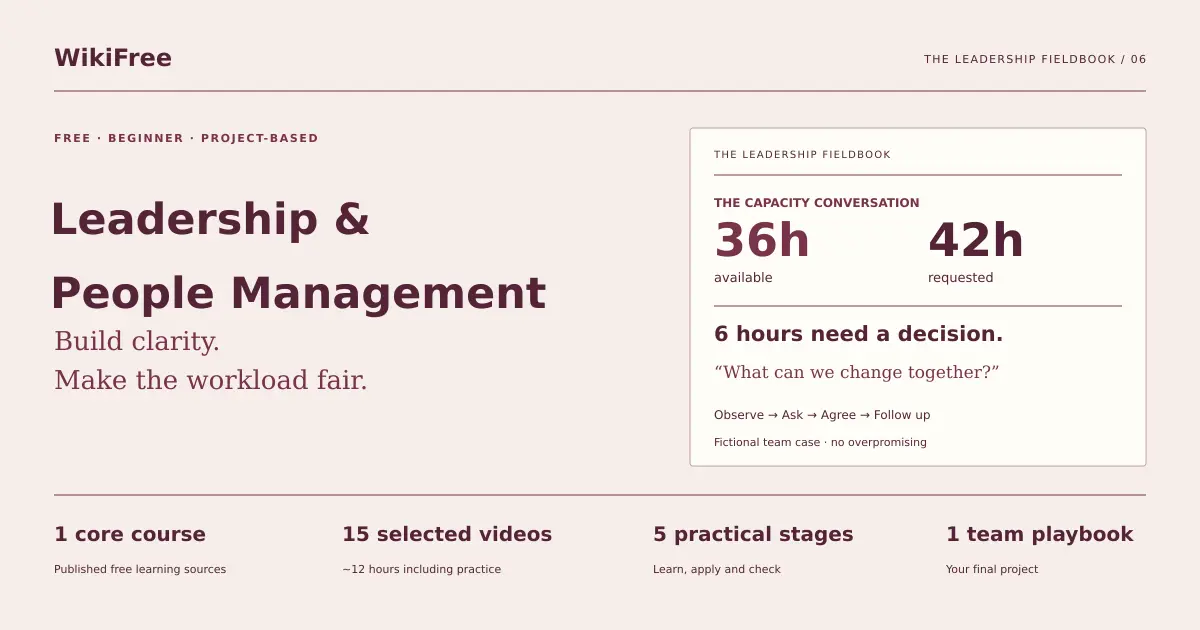
WikiFree learning paths / 06 · The leadership fieldbook
The leadership fieldbook
Make expectations clear. Leave room to listen.
Create a practical team operating plan with realistic commitments, a coaching conversation, factual feedback and a review rhythm.
A note from the fieldbook
Observe. Ask. Agree.
What happened from your perspective?
- Beginner
- starting level
- 1
- core course
- ≈12h
- learning + practice estimate
- 5 + 1
- stages + final project
The practical outcome
What you will be able to show
Create a practical team operating plan with realistic commitments, a coaching conversation, factual feedback and a review rhythm.
For: New team leads and people preparing for their first management responsibilities.
Before you begin: A notebook or document editor and a peer for an optional role-play. You can complete all case exercises without managing real employees.
Original pathway and exercises by WikiFree Editorial. Course pages and official source metadata reviewed on 12 October 2026. Version 1.0.
A ten-minute starting check
Try these before opening a lesson
Answer in your own words, then reveal the guidance. If you can already demonstrate a stage’s completion gate with evidence, skim its lesson assignment and move to the next stage.
Rewrite “be more proactive” as an observable expectation.
Example: flag a likely missed handoff before the agreed check-in, with a proposed next step.
What would you ask before giving advice to someone who missed a deadline?
Ask what happened, what constraints they encountered and what support they need.
Can a team promise 42 hours of work with 36 hours available?
Only by changing scope, timing or capacity; optimism does not close the six-hour gap.
Sequence with a purpose
Build one layer at a time
- 01Set the team’s purpose and commitmentsA one-page team charter.
- 02Allocate work within real capacityA workload board with owners, hours and deferred scope.
- 03Coach before solvingA coaching note with the learner’s own proposed next step.
- 04Give specific feedback and hear the responseA feedback conversation map.
- 05Build a learning rhythmA team operating rhythm and personal reflection.
Finish with the capstone. Progress means a reviewable output, not simply a watched video.
A deliberately short course list
Use these courses for these reasons
Free People Management Course: Coaching and Team Leadership
Google · Beginner · English
One concise beginner course connects goals, work allocation, coaching and feedback. Selected lessons are paired with progressively harder conversations rather than more passive viewing.
Assigned viewing: 1h 4m 23s. The full source course contains additional material.
Open the WikiFree course and official learning route ↗Free learning, clearly defined
Google’s selected videos are free to view. Exercises need only a document editor or paper. No Google certification is included, and role-play results are learning evidence rather than workplace performance ratings.
Skills and evidence
| Stage / skill | Learning support | Evidence to produce |
|---|---|---|
| 01 · Set the team’s purpose and commitments | Google selected lessons | A one-page team charter. |
| 02 · Allocate work within real capacity | Google selected lessons | A workload board with owners, hours and deferred scope. |
| 03 · Coach before solving | Google selected lessons | A coaching note with the learner’s own proposed next step. |
| 04 · Give specific feedback and hear the response | Google selected lessons | A feedback conversation map. |
| 05 · Build a learning rhythm | Google selected lessons | A team operating rhythm and personal reflection. |
Stage 1 / The leadership fieldbook
Set the team’s purpose and commitments
You will: Translate an intention into observable outcomes.
Assigned learning
Free People Management Course: Coaching and Team Leadership
- Lesson 1 · Develop a manager mindset
- Lesson 5 · The importance of setting clear goals
- Lesson 12 · Learn to manage your team by making SMART goals
Use the names if the provider later changes the order. Only these assignments enter the core estimate.
Describe the result the team serves before allocating tasks. A goal needs an owner, a measure and a review date. “Improve teamwork” gives nobody a clear next action; “Every handoff includes owner, next step and due date for the next two weeks” can be checked.
Ask the team to challenge the measure. A narrow target can reward speed while quality suffers, so pair delivery with one quality signal and a way to raise concerns.
Make something reviewable
Write a team purpose in one sentence and two weekly commitments. Add an owner, measure, deadline and quality check to each.
Deliver: A one-page team charter.
Completion gate
A teammate can explain what success looks like and when the agreement will be revisited.
If you get stuck: If the goal describes a personality trait, replace it with a behavior or output. If nobody owns the measure, assign responsibility for reviewing it.
Stage 2 / The leadership fieldbook
Allocate work within real capacity
You will: Negotiate scope before promising delivery.
Assigned learning
Free People Management Course: Coaching and Team Leadership
- Lesson 3 · Increase your team's effectiveness
- Lesson 16 · How to distribute work effectively as a manager
Use the names if the provider later changes the order. Only these assignments enter the core estimate.
Available time is a constraint, not a judgment about effort. The case has 36 hours available and 42 requested: six hours must be removed, delayed or supported through a genuine capacity change. Protect time for support and coordination rather than scheduling every minute as production.
Discuss skills and development needs alongside capacity. Fair allocation does not always mean identical tasks, but the reasoning should be visible and open to correction.
Make something reviewable
Use the five work packages in the case pack. Produce a feasible allocation and explicitly defer six hours. Then reserve two hours for coaching and replan the remaining commitments.
Deliver: A workload board with owners, hours and deferred scope.
Completion gate
No person exceeds available time; total committed delivery drops to 34 hours when two hours are reserved for coaching.
If you get stuck: If the plan requires everyone to work faster without evidence, revisit scope. Record the trade-off instead of hiding overtime in the estimate.
Stage 3 / The leadership fieldbook
Coach before solving
You will: Use questions to support another person’s thinking.
Assigned learning
Free People Management Course: Coaching and Team Leadership
- Lesson 6 · Learn about the power of coaching and feedback
- Lesson 7 · Learn how to develop people through coaching
- Lesson 8 · Unlock your team’s potential with coaching
Use the names if the provider later changes the order. Only these assignments enter the core estimate.
A coaching conversation begins with the person’s goal and understanding of the problem. Ask one open question, listen, and summarize what you heard before offering options. Advice can be useful, but ask permission and avoid turning every discussion into your own solution.
End with a small next action, an owner and a follow-up. “We had a good talk” is not an action plan. A commitment should be chosen with the person, not extracted through pressure.
Make something reviewable
Role-play a teammate unsure how to prepare a handoff. Write five open questions, a listening summary and one agreed experiment. Repeat with the teammate explaining a constraint you initially missed.
Deliver: A coaching note with the learner’s own proposed next step.
Completion gate
The note distinguishes the teammate’s words from your interpretation and includes a realistic follow-up.
If you get stuck: If your questions contain the answer you want, rewrite them. If you speak for most of the role-play, pause and ask the peer to summarize their own plan.
Stage 4 / The leadership fieldbook
Give specific feedback and hear the response
You will: Discuss behavior and impact without labeling the person.
Assigned learning
Free People Management Course: Coaching and Team Leadership
- Lesson 9 · Learn how to give feedback that drives change
- Lesson 13 · Simple framework for effective manager feedback: The SBI model
- Lesson 17 · How to lead difficult conversations with confidence
Use the names if the provider later changes the order. Only these assignments enter the core estimate.
Anchor feedback in a specific situation and observed behavior, then explain the impact. In the case, the Tuesday handoff lacked an owner and due date; the next person spent time finding clarification. “You are careless” adds a judgment that the observation cannot support.
Invite the other account of events. The missing fields may reflect an unclear template or competing instruction. Agree on a next step after hearing that information, not before.
Make something reviewable
Draft a 90-second opening, then add two possible responses: misunderstanding and disagreement. Rehearse a calm follow-up question for each. Close with an agreed change and review date.
Deliver: A feedback conversation map.
Completion gate
The opening includes situation, behavior and impact; it contains no mind-reading; the plan changes if new facts emerge.
If you get stuck: If the discussion becomes a debate about intent, return to the observed event. If there is no agreement, document the unresolved point and a next conversation rather than fabricating consensus.
Stage 5 / The leadership fieldbook
Build a learning rhythm
You will: Review results while remaining open to correction.
Assigned learning
Free People Management Course: Coaching and Team Leadership
- Lesson 10 · Create a learning culture on your team
- Lesson 18 · How to support your team to success as a manager
- Lesson 19 · Build self-awareness to become a stronger manager
- Lesson 20 · Learn how to build a strong and positive team culture
Use the names if the provider later changes the order. Only these assignments enter the core estimate.
A short weekly review can ask what was committed, what happened, what helped and what to change. Include a question about your own behavior as lead. Make it possible to report bad news early without punishment for the act of reporting.
Use learning evidence carefully. One role-play score is feedback about that practice, not proof that you are an effective manager. Observe patterns across time and ask the team whether the routine is useful.
Make something reviewable
Create a 20-minute weekly agenda and a two-week review log. Include a private route for concerns and one question inviting feedback on your leadership.
Deliver: A team operating rhythm and personal reflection.
Completion gate
The agenda produces decisions and owners, not only updates; it asks what to stop or simplify.
If you get stuck: If meetings multiply without changing work, remove a ritual and test a shorter one. If people agree silently, ask for examples and provide time to respond later.
Original practice material
Your case pack and reference checks
Download the editable plain-text workbook, or open the full copy below. It contains the case inputs, templates and reference guidance. Try the exercises before reading the answers.
Download the practice workbook ↓ Download project files (ZIP) ↓Open the complete workbook in this page
WIKIFREE / THE LEADERSHIP FIELDBOOK
Original fictional case. Version 1.0 — 12 October 2026.

CAPACITY
Alex 10h | Sam 8h | Jordan 12h | Riley 6h = 36h total.
Requests: inbox 10h; event guide 8h; source review 12h; handover redesign 6h;
archive tidy-up 6h = 42h. Work may be split if handoff overhead is acknowledged.
First decision: defer archive tidy-up (6h), or justify another explicit 6h cut.
Then reserve 2h for coaching: deliverable commitments must fall to 34h.
One feasible example: Alex inbox 8h + coaching 1h + handover 1h; Sam event guide
7h + coaching 1h; Jordan source review 12h; Riley inbox 2h + handover 4h.
Delivery = 34h, coaching = 2h. Event guide has 1h deferred and handover 1h deferred,
in addition to archive tidy-up. Check each person's total independently.

OBSERVATION, NOT A PERSONALITY LABEL
On Tuesday, the handoff note lacked an owner and due date. The receiving teammate
spent 20 minutes asking for clarification. This is fictional case evidence.
Opening example: “In Tuesday's handoff, the owner and date fields were empty.
The next person needed 20 minutes to clarify the work. What happened from your
perspective?” Invite the answer before proposing a remedy.
Possible new fact: the teammate used an outdated template with no such fields.
Possible disagreement: the teammate believes those fields were supplied elsewhere.
Do not claim consensus. Check the record together and agree on a usable next step.

TEAM CHARTER TEMPLATE
Purpose:
Commitment | Owner | Measure | Due date | Quality check
Capacity and deferred work:
How to raise a risk early:

COACHING TEMPLATE
Their goal, in their words:
Open questions:
What I heard (check this summary):
Options they considered:
Agreed action, owner and review date:

FEEDBACK MAP
Situation -> Observed behavior -> Impact -> Their perspective -> Agreed next step
If new information appears:
If agreement is not reached:

20-MINUTE WEEKLY REVIEW
3m commitments and results; 5m blockers; 5m learning; 5m next trade-offs;
2m owner/date recap. Ask: “What did I do as lead that made your work harder?”
Offer a private way to respond. Record decisions rather than a transcript.

REFLECTION
What did I assume? What changed when I listened? What will I try next time?
Role-play evidence is practice evidence, not a real colleague's evaluation.
Case data, exercises and reference examples: WikiFree Editorial, original training material. Provider lessons are linked, not reproduced.
Final project / 3h practice estimate
The Harbor team operating plan
Combine the charter, feasible workload, coaching approach and feedback practice into a plan a four-person team could try for two weeks. Label every fictional observation as case evidence.
Your handover package
- Team purpose and two measurable commitments
- A capacity-aware work plan with explicit deferred scope
- Coaching and feedback conversation notes with alternative responses
- A two-week review rhythm and personal learning reflection
| Criterion | Points | Evidence expected |
|---|---|---|
| Clarity and feasibility | 30 | Commitments fit capacity and make trade-offs visible. |
| Coaching and listening | 25 | Questions, summaries and chosen actions support the teammate’s agency. |
| Feedback quality | 25 | Specific observations and impact replace labels; disagreement is handled constructively. |
| Review and reflection | 20 | The plan includes follow-up and a mechanism to improve the lead’s own behavior. |
Completion standard: aim for at least 80/100, with all critical gates met. A reviewer awards each row’s points in proportion to the evidence shown. This is a learning rubric, not a provider credential.
A plan that exceeds capacity without an agreed change, or invents agreement from a teammate, must be revised.
A pace that leaves room to practice
Plan the next few weeks
Assigned viewing: 1h 4m 23s. Practice and capstone: 10.75 hours, editorial estimate. Budget about 12 hours overall. Replays and personal adaptations can take longer.
| Available time | Flexible estimate | How to use it |
|---|---|---|
| 2 hours/week | 6 weeks | Reserve time to make the output and pass its gate; split a long lesson across sessions. |
| 5 hours/week | 3 weeks | Reserve time to make the output and pass its gate; split a long lesson across sessions. |
| 10 hours/week | 2 weeks | Reserve time to make the output and pass its gate; split a long lesson across sessions. |
The calculation stays in your browser. The estimates above remain usable without JavaScript.
Checkbox progress is saved only in this browser when local storage is available. It is not sent to WikiFree or synchronized to an account.
Questions before you continue
Can I take this path without direct reports?
Yes. Use the fictional case, a peer role-play or a volunteer project. Be explicit about which experience you actually have.
Should I record a real colleague for practice?
Only with their informed agreement and a suitable purpose. The path works with fictional notes and does not require recording anyone.
Sources and honest boundaries
What was checked, and what comes next
Case exercises cannot prove leadership effectiveness in a real team. Hiring, employment law, disciplinary action and clinical counseling are outside this path. Follow your organization’s relevant processes for real situations.
The complete published WikiFree course catalog was checked on 12 October 2026: 815 courses across nine API pages. Course pages and official playlist metadata or module headings were inspected. This does not mean every video was played to completion, every geographic region was tested, or a provider credential was earned.
Keep the published course pages as your route into provider material. Access, lesson order and tool interfaces can change. Report a broken route through WikiFree’s correction page.
Questions & discussion
Share a useful question or correction. Comments appear after moderation. Please avoid personal or sensitive information.