Path 100 · The living handbook · Beginner
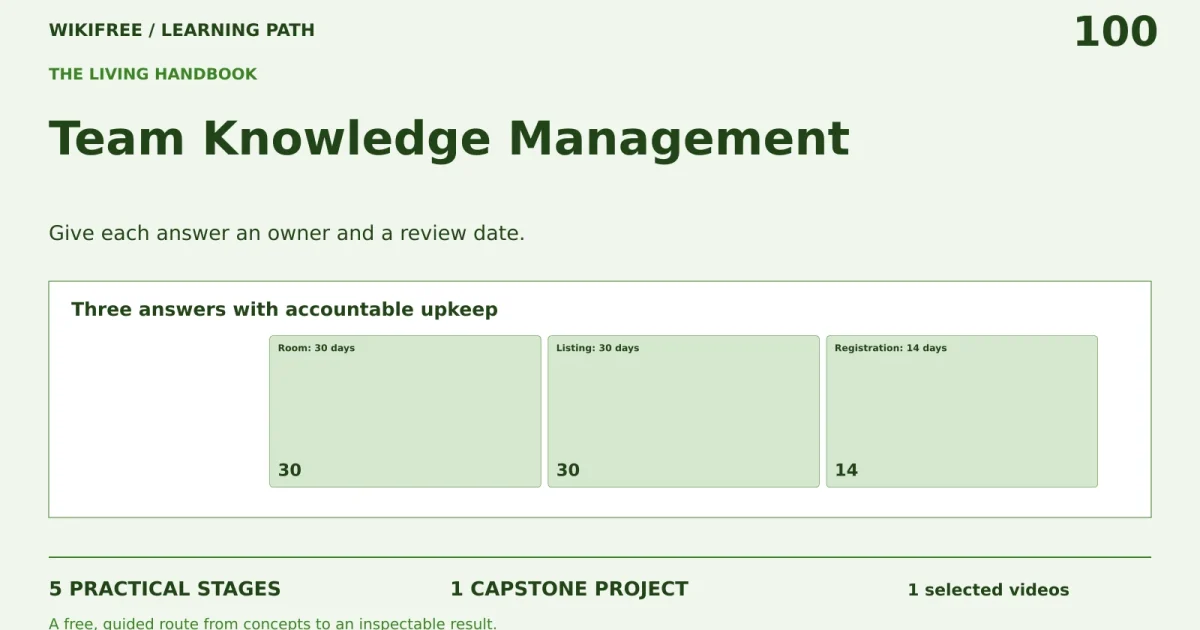
Give each answer an owner and a review date.
A guided, practical route through team knowledge management.
What you will be able to do
Create a small searchable team handbook with consistent article structure, ownership and a stale-content review process.
Plan about 10h 6m in total. Reading and practice are editorial estimates; video runtimes come from public provider metadata. Your pace will vary.
Before you begin
Check your starting point
What you need
Basic writing and folders. Use Markdown or HTML locally; OneNote is optional and no paid collaboration account is required.
The selected public provider lessons are free to view. The original case can be completed with paper, a text editor or freely available local tools. Paid exams, certificates, subscriptions and optional provider software are not required for this project.
Completing this WikiFree path does not award a provider certificate. Any provider assessment, account requirement or credential must be checked separately on its official page.
Three readiness questions
Is a folder of notes automatically a usable handbook?
No. Structure, findability and ownership matter.
Should a stale article be silently trusted?
No. Review or clearly mark its status.
Does this package create a real recurring task?
No. It supplies the review process and registry.
Use a workable pace
At 5 hours per week, allow about 3 weeks. Start with Stage 1, continue in order and reserve 2h for the capstone. If a gate fails, use its repair step before advancing. At another weekly budget, divide 606 estimated minutes by your available weekly minutes and round up.
Keep a small evidence folder. A checked box means you reviewed your output; it is not a certificate or proof that a provider lesson was watched.
The working case
Three answers with accountable upkeep
A fictional workshop team repeatedly asks how to prepare a room, update an event listing and close registration. Three handbook articles should answer those tasks. Each needs an owner, review date, prerequisites, steps and completion check. The project uses no real staff contacts or internal records.
| Article | Owner role | Review interval days |
|---|---|---|
| Prepare a room | Operations coordinator | 30 |
| Update an event listing | Content editor | 30 |
| Close registration | Event lead | 14 |
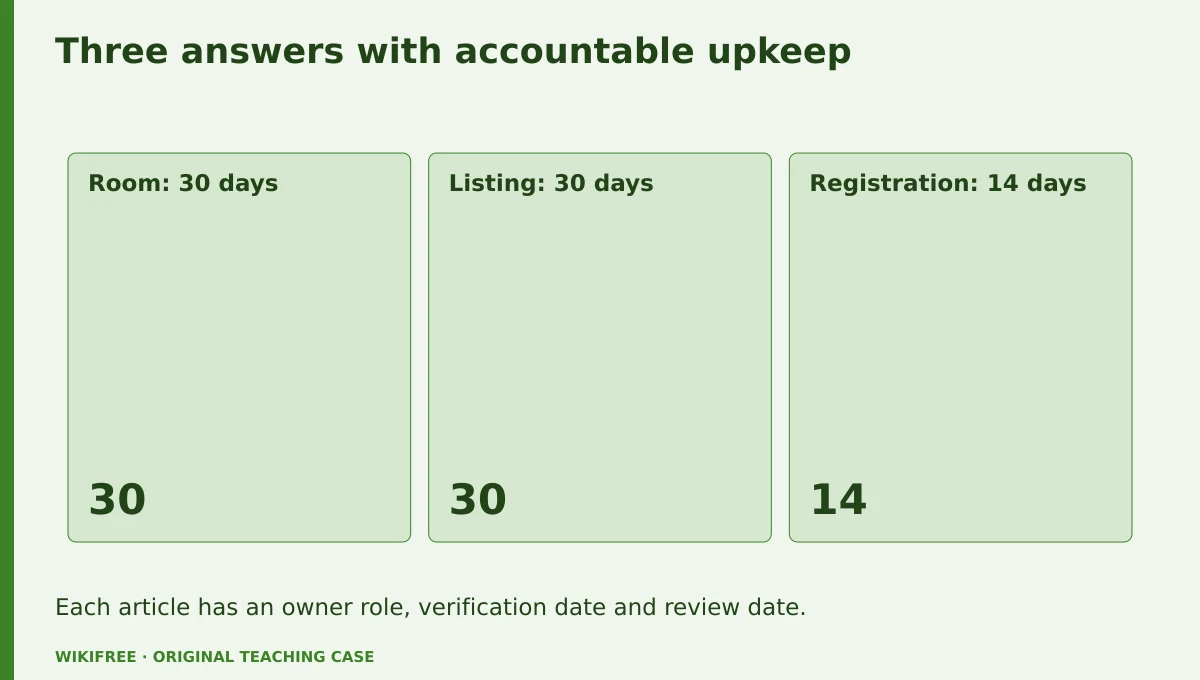
The table and explanations preserve the essential case information when the diagram is unavailable.
Your route
Five outputs, then a final handoff
- 01Organize around recurring tasksHandbook information structure
About 2h 26m including assigned learning and practice. - 02Write a reusable article structureFirst complete handbook article
About 2h 20m including assigned learning and practice. - 03Add ownership and review metadataKnowledge registry
About 1h 5m including assigned learning and practice. - 04Check findability and linksThree-article handbook
About 1h 15m including assigned learning and practice. - 05Rehearse a stale-content reviewReview and revision log
About 1h including assigned learning and practice. - FINALCapstone reviewCombine the evidence into one inspectable handoff.
About 2h .
0 of 6 outputs checked. JavaScript adds browser-only progress saving.
The complete lesson and all downloads remain available. Use the printable project workbook to track your progress.
Use the minimum useful source material
The courses behind this route
Learn Skills Daily
OneNote, Forms and Planner: Free Course
The published OneNote lesson offers an optional organization example.
Selected material only; this path does not claim completion of the entire provider course.
Google Technical Writing One: Free Self-Paced Lessons
The existing Google writing course supports clear, audience-focused procedures; the handbook and review registry are original.
Selected material only; this path does not claim completion of the entire provider course.
Course publication and selected public lesson metadata were checked on 13 October 2026. This is not a claim of full video playback, provider-course completion or permanent availability. Recheck the linked source if a lesson changes.
Learn, make, inspect
The five-stage workshop
Organize around recurring tasks
Video 1h 25m · reading budget 0m · original practice about 1h .
Group knowledge by the work a reader needs to complete rather than by the author’s filing habits. The OneNote lesson provides an example of organizing notes, but the required project uses plain local files so no specific subscription is necessary. Keep names and navigation consistent across formats.
Watch these selected lessons
- OneNote Tutorial1:25:18
Do the work
Create a three-article index with task-based titles.
Save this output
Handbook information structure
Pass the review gate
A reader can choose the relevant article from the task name.
If you need another attempt
Replace vague titles such as General information with the actual task.
Write a reusable article structure
Video 0m · reading budget 1h · original practice about 1h 20m.
A procedure needs an audience, prerequisites, ordered actions and a completion check. Put warnings or conditions before the action they affect. Keep one main action per step where practical. The template should help writers produce useful instructions, not merely repeat the same decorative sections.
Assigned reading
Google Technical Writing One: Free Self-Paced Lessons: Technical Writing One: audience, clear sentences, lists and document organization.
Use the named provider navigation sections. Editorial reading budget for the named public material; not a verified completion duration
Do the work
Write the room-preparation article using the supplied template.
Save this output
First complete handbook article
Pass the review gate
The completion check is observable and prerequisites appear before the steps.
If you need another attempt
Ask a reader what they need before step one.
Add ownership and review metadata
Video 0m · reading budget 0m · original practice about 1h 5m.
An owner is responsible for keeping the article useful, not necessarily for performing every task. Record the last verified date and the next review date. A review interval is an editorial policy, not proof that a future review already happened. Keep missing or overdue dates visible.
Original application stage. Use your preceding outputs and the supplied case; there is no additional required provider lesson.
Do the work
Create a registry for the three articles and calculate next review dates from a chosen baseline.
Save this output
Knowledge registry
Pass the review gate
Each article has an owner role and an explicit review interval.
If you need another attempt
Use ISO dates and retain the baseline used for calculation.
Check findability and links
Video 0m · reading budget 0m · original practice about 1h 15m.
A small handbook needs a clear index and links that stay valid when files move. Test whether task names and a few common synonyms lead to the right article. A search mechanism should expose its limits; a local browser find is not a full enterprise search engine. Keep broken-link checks part of the review.
Original application stage. Use your preceding outputs and the supplied case; there is no additional required provider lesson.
Do the work
Write the other two articles and test the index links.
Save this output
Three-article handbook
Pass the review gate
Every index link opens the intended article and each page links back.
If you need another attempt
Use stable relative filenames and test from the packaged folder.
Rehearse a stale-content review
Video 0m · reading budget 0m · original practice about 1h .
A review checks whether the procedure still matches the work and whether its evidence is current. Mark a changed step, record the reason and update the verified date only after checking it. The exercise can simulate a change without claiming that real organizational procedures were validated.
Original application stage. Use your preceding outputs and the supplied case; there is no additional required provider lesson.
Do the work
Simulate a changed registration deadline rule and update the relevant article with a revision note.
Save this output
Review and revision log
Pass the review gate
Only the affected article’s verification date changes after the simulated review.
If you need another attempt
Do not mass-update dates to make a registry look current.
Make the result inspectable
Your final project
Deliver the index, three complete articles, template, owner registry, link check and revision log. Ask a reviewer to find one procedure using a task description and record the actual result if performed.
The ZIP includes synthetic input data, a project workbook, worked reference, evidence log, scoring rubric and case-specific materials. Code projects include source and clearly stated local execution requirements.
Use one consistent rubric
| Criterion | Maximum | Evidence |
|---|---|---|
| Evidence and correctness | 30 | Calculations, source use and results match the supplied case; limitations are honest. |
| Required artifacts | 30 | All five stage outputs and the capstone handoff are present and inspectable. |
| Reasoning and decisions | 20 | Choices, assumptions, alternatives and the case-specific critical condition are explained. |
| Reproducibility | 10 | A reviewer can follow the stated steps and distinguish expected from observed results. |
| Clear communication | 10 | Labels, units, structure and evidence references make the work easy to review. |
Score at least 80/100, supply every required artifact, and satisfy the path-specific critical condition. Rework missing evidence before marking complete.
The critical condition
Verification dates reflect actual review status and no external scheduling or organizational validation is invented.
Compare with a worked reference
The registry has three articles. With a chosen baseline of 2026-10-13, the 30-day reviews fall on 2026-11-12 and the 14-day review on 2026-10-27. These are planned review dates for the fictional handbook, not external scheduled reminders.
Know the boundary
This is a local handbook and review process, not a deployed knowledge platform or an automated team workflow.
Questions before you finish
Do I need to finish every source course?
No. This path names selected lessons or reading sections. Complete the full provider course only if it supports your wider goal. The path does not claim equivalence to that course.
How do I know when to advance?
Use the output and review gate in each stage. If evidence is missing or a result conflicts with the case, follow the repair step and retry before advancing.
Can I do the project without paid software?
The selected public provider lessons are free to view. The original case can be completed with paper, a text editor or freely available local tools. Paid exams, certificates, subscriptions and optional provider software are not required for this project.
What does my checklist prove?
It records your own review in this browser only. It does not verify viewing, skill, a provider credential or a real-world deployment.
What if a lesson or tool changes?
Use the linked course and provider page to inspect current availability. Record the change and revisit the relevant assignment; do not invent a replacement lesson or claim an unavailable activity was completed.
Questions & discussion
Share a useful question or correction. Comments appear after moderation. Please avoid personal or sensitive information.