WikiFree learning path 45 · Beginner
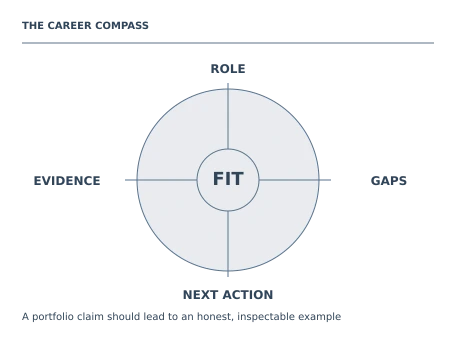
The career compass
Make the evidence easy for a reviewer to find.
Build a targeted job-search pack with a role evidence matrix, honest resume bullets, one portfolio case study and a weekly application tracker.
Video duration uses the selected lessons only. Reading and practice times are planning estimates; repeat difficult work as needed.
A clear starting point
Who this is for
A target role you can describe and one real learning or work project. A fictional sample is provided for practice; do not claim it as personal experience.
Your practical result
Build a targeted job-search pack with a role evidence matrix, honest resume bullets, one portfolio case study and a weekly application tracker.
This builds a job-search pack, not a job placement promise, credential or automated application service.
Access and cost
Assigned public videos can be watched free. Complete the original case in a text editor, on paper or in a spreadsheet you already have. No paid course, exam or provider certificate is included.
The project pack contains an original workbook, case inputs, an evidence log and reference notes. Some technical paths include starter code and a runnable reference. Read the pack README before starting.
Three-minute readiness check
Answer first, then open each explanation. A missed answer identifies what to revisit; it does not stop you from starting.
Can a course title replace evidence of a skill?
It can support learning context, but a concrete example is stronger.
May you invent a metric to improve a resume bullet?
No.
Should every application use an unchanged generic summary?
Tailor it honestly to the role requirements.
The case you will work on
The fictional candidate Sam completed a volunteer event-registration project. The sample evidence includes a 40-row attendance tracker, documented checks and a handover guide. These are teaching facts about Sam, not accomplishments the learner may present as their own.
| Target requirement | Sample evidence |
|---|---|
| Organize information | 40-row registration tracker |
| Check accuracy | Recorded duplicate and missing-field checks |
| Communicate clearly | A short handover guide |
| Collaborate | Documented reviewer feedback |
These are supplied synthetic inputs, not observations from a real organization. Label assumptions and any additional data you create.
Keep an evidence trail
Save each stage output in the project folder. In evidence_log.csv, record the decision, the artifact or test that supports it, what failed, and the revision you made.
Your route from learning to evidence
- Stage 1Choose a target and map evidenceA role evidence matrix.60 minutes of original practice
- Stage 2Write accurate accomplishment bulletsA targeted resume section.80 minutes of original practice
- Stage 3Build one portfolio case studyAn honest portfolio case study.110 minutes of original practice
- Stage 4Organize applications and follow-upAn application tracker and weekly plan.60 minutes of original practice
- Stage 5Prepare to discuss the evidenceA portfolio discussion and interview practice sheet.75 minutes of original practice
- Final projectMake the evidence reviewableConnect the five stage outputs and test a change.210 minutes estimated
Progress stays in this browser. Tick a stage only after its evidence check passes. This is a personal checklist, not a certificate.
Why these source courses
The path uses selected material from courses already published on WikiFree. The original exercises below connect that material to one practical outcome. Follow only the listed assignments; completing the full source courses is optional.
Free Career Planning Course: Goals, Networking and Job Search
Google public career lessons support goal setting, job research, resumes, portfolios, tracking and interview preparation.
Access: Free Video
Certificate: Free video viewing; Google certification is not included
Learn it, apply it, check it
Work in order. Every stage produces something the next stage uses. Revisit the repair instruction when a check fails.
Choose a target and map evidence
A target role you can describe and one real learning or work project. A fictional sample is provided for practice; do not claim it as personal experience.
The idea to use
Read a role description as a set of tasks and requirements. Map each important requirement to a real example, a learning artifact or an acknowledged gap. Separate required from preferred qualifications. The aim is an honest fit assessment, not copying every keyword regardless of experience. Use the supplied fictional role only for practice if you have no selected vacancy yet.
Watch the selected lessons
Selected video time: 14m. Open this course on WikiFree.
Your 60-minute lab
Create a five-row requirement/evidence/gap matrix for one target role.
Save: A role evidence matrix..
Evidence check
Every claimed skill points to actual evidence or is explicitly marked as a gap.
If it fails: Do not describe a planned project as completed experience.
Write accurate accomplishment bullets
Bring your previous output: A role evidence matrix.
The idea to use
A useful bullet names the action, the work context and a supported result. Numbers help when measured, but invented percentages weaken credibility. For the sample candidate, built a 40-row tracker is supportable; increased efficiency by 70% is not. Keep the learner own experience separate from the fictional demonstration.
Watch the selected lessons
- 7. How To Write A Resume That Stands Out12:33
- 8. Tips for your Resume, Cover Letter, and Job Interview9:41
Selected video time: 22m. Open this course on WikiFree.
Your 80-minute lab
Draft five bullets from your actual evidence or label them as fictional practice. Remove claims you cannot substantiate.
Save: A targeted resume section..
Evidence check
Every number and outcome can be traced to a source or is removed.
If it fails: Replace unsupported impact with a precise description of the artifact and its use.
Build one portfolio case study
Bring your previous output: A targeted resume section.
The idea to use
A case study should explain the problem, your role, constraints, decisions, artifact and what you learned. Show only material you have permission to share and use synthetic data where necessary. A polished screenshot without explanation makes it hard to judge your contribution. Link the artifact to the role requirement it demonstrates.
Watch the selected lessons
- 15. Highlight Jobs and Work Experience On Your Resume5:10
- 16. How a Personal Brand Can Help Your Career5:37
Selected video time: 11m. Open this course on WikiFree.
Your 110-minute lab
Write a 500–700 word case study with one artifact image or link and a limitations/reflection section.
Save: An honest portfolio case study..
Evidence check
The case separates your contribution from team work and avoids exposing private data.
If it fails: Do not imply sole ownership of work performed by others.
Organize applications and follow-up
Bring your previous output: An honest portfolio case study.
The idea to use
A tracker makes next actions visible: role, source, date, status, evidence version and follow-up date. Avoid measuring success only by application volume. Track fit and the quality of the submitted evidence. Draft follow-ups for review but do not send them as part of this exercise. Use realistic weekly capacity so the plan can be sustained.
Watch the selected lessons
Selected video time: 10m. Open this course on WikiFree.
Your 60-minute lab
Create a tracker with five sample rows and a weekly review routine. Add a status definition for each stage.
Save: An application tracker and weekly plan..
Evidence check
Every active row has a next action and date, and fictional rows are clearly marked.
If it fails: Do not mark an application submitted when only a draft exists.
Prepare to discuss the evidence
Bring your previous output: An application tracker and weekly plan.
The idea to use
An interview answer should connect a relevant example to the question, explain your action and describe the supported result. Prepare to discuss trade-offs and mistakes, not just the polished artifact. If you lack a direct example, say so and explain a related learning exercise without presenting it as employment experience.
Watch the selected lessons
- 9. How to Research and Prepare for Your Next Job Interview6:58
- 10. How to Make a Great Impression During a Job Interview7:09
Selected video time: 14m. Open this course on WikiFree.
Your 75-minute lab
Write three evidence-based answer outlines and rehearse one aloud. Record one revision after self-review.
Save: A portfolio discussion and interview practice sheet..
Evidence check
Answers remain consistent with the resume and accurately describe the source of experience.
If it fails: Do not turn a hypothetical answer into a claimed past achievement.
A worked reference to compare
A supportable sample bullet is: Built and checked a 40-row event-registration tracker and wrote a handover guide for volunteers. It describes evidence without inventing a percentage improvement or paid employment history.
Compare your reasoning as well as the result. If your answer differs, state the assumption or input that explains the difference. Reference notes are for checking after an attempt; copying them is not evidence of independent work.
Your final project
Your brief
Deliver the role matrix, resume section, case study, tracker and answer outlines. Run a consistency check so dates, role descriptions and results agree across all five artifacts.
Time box: 3h 30m estimated. Extend it if a gate needs repair.
Hand in these artifacts
- A role evidence matrix.
- A targeted resume section.
- An honest portfolio case study.
- An application tracker and weekly plan.
- A portfolio discussion and interview practice sheet.
- A short README: outcome, how to inspect or run the work, assumptions and limitations.
- A before-and-after change test and the completed evidence log.
Run a final review
- Use the supplied reference to reconcile the baseline result.
- Choose one relevant input or constraint to change. Write your expected effect before testing it.
- Run the calculation, walkthrough or test again and save the actual result.
- Ask a peer to inspect the evidence, or perform a separate self-review. Label which review you used.
- Score the work using the rubric and repair every critical failure.
Review rubric · 100 points
| Criterion | Points | Evidence to inspect |
|---|---|---|
| Practical outcome and case reasoning | 25 | Build a targeted job-search pack with a role evidence matrix, honest resume bullets, one portfolio case study and a weekly application tracker. |
| Five stage checks | 30 | Award 6 points for each stage only when its stated gate is demonstrably met. |
| Traceable evidence | 20 | Artifacts, inputs and calculations or tests are reproducible; synthetic and simulated evidence is labelled. |
| Revision after a changed condition | 15 | Change one input or constraint, predict the effect, test it and record the result. |
| Handoff quality | 10 | A reviewer can find the files, follow the instructions and understand the remaining limitations. |
Completion target: at least 80/100, all five stage gates passed, and every critical issue below corrected. This is a learning benchmark, not an accredited qualification.
Critical issue: All accomplishments are truthful, and the fictional sample is never presented as the learner own experience.
Before you go further
What will I be able to produce?
Build a targeted job-search pack with a role evidence matrix, honest resume bullets, one portfolio case study and a weekly application tracker.
Is the whole path free?
Assigned public videos can be watched free. Complete the original case in a text editor, on paper or in a spreadsheet you already have. No paid course, exam or provider certificate is included.
Do I need to finish every source course?
No. Follow the selected assignments at each stage. Source courses provide context, while the original case, labs and final review build the practical result. Extra study is optional.
What counts as completion?
Complete all five stage checks, earn at least 80/100 on the final rubric and correct every critical issue. This builds a job-search pack, not a job placement promise, credential or automated application service.
Questions & discussion
Share a useful question or correction. Comments appear after moderation. Please avoid personal or sensitive information.