Path 63 · The break-even workshop · Beginner
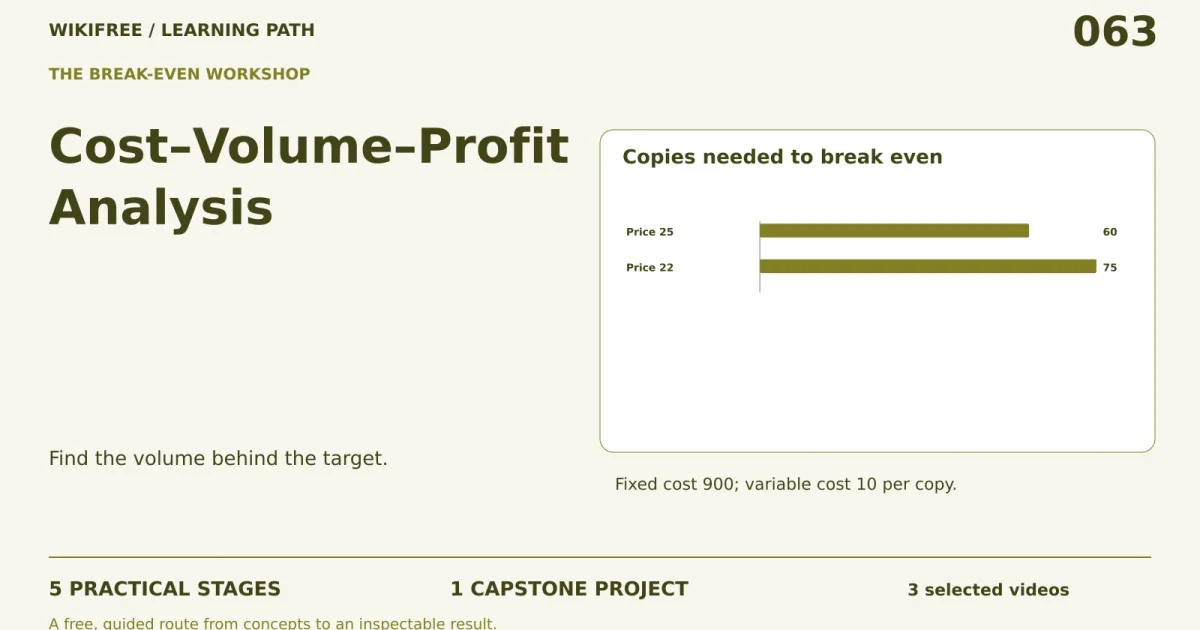
Find the volume behind the target.
A guided, practical route through cost–volume–profit analysis.
What you will be able to do
Calculate contribution, break-even volume and margin of safety, then test a price reduction without confusing revenue and profit.
Plan about 8h 10m in total. Reading and practice are editorial estimates; video runtimes come from public provider metadata. Your pace will vary.
Before you begin
Check your starting point
What you need
Percentages and multiplication. Use a calculator or spreadsheet; this is a fictional single-product case.
The selected public provider lessons are free to view. The original case can be completed with paper, a text editor or freely available local tools. Paid exams, certificates, subscriptions and optional provider software are not required for this project.
Completing this WikiFree path does not award a provider certificate. Any provider assessment, account requirement or credential must be checked separately on its official page.
Three readiness questions
What is unit contribution?
25 − 10 = 15.
Is fixed cost divided by revenue the break-even quantity?
No. Divide fixed cost by unit contribution.
Can fractional physical copies be sold?
No. Round a required whole-copy quantity upward.
Use a workable pace
At 5 hours per week, allow about 2 weeks. Start with Stage 1, continue in order and reserve 2h for the capstone. If a gate fails, use its repair step before advancing. At another weekly budget, divide 490 estimated minutes by your available weekly minutes and round up.
Keep a small evidence folder. A checked box means you reviewed your output; it is not a certificate or proof that a provider lesson was watched.
The working case
Copies needed to break even
A learning club sells a workbook for 25 teaching units. Variable cost is 10 per copy and monthly fixed cost is 900. The planning case is 80 copies. Capacity, tax and mixed products are excluded so the relationship can be inspected clearly.
| Assumption | Value |
|---|---|
| Price per copy | 25 |
| Variable cost per copy | 10 |
| Fixed monthly cost | 900 |
| Planned copies | 80 |
| Alternative price | 22 |
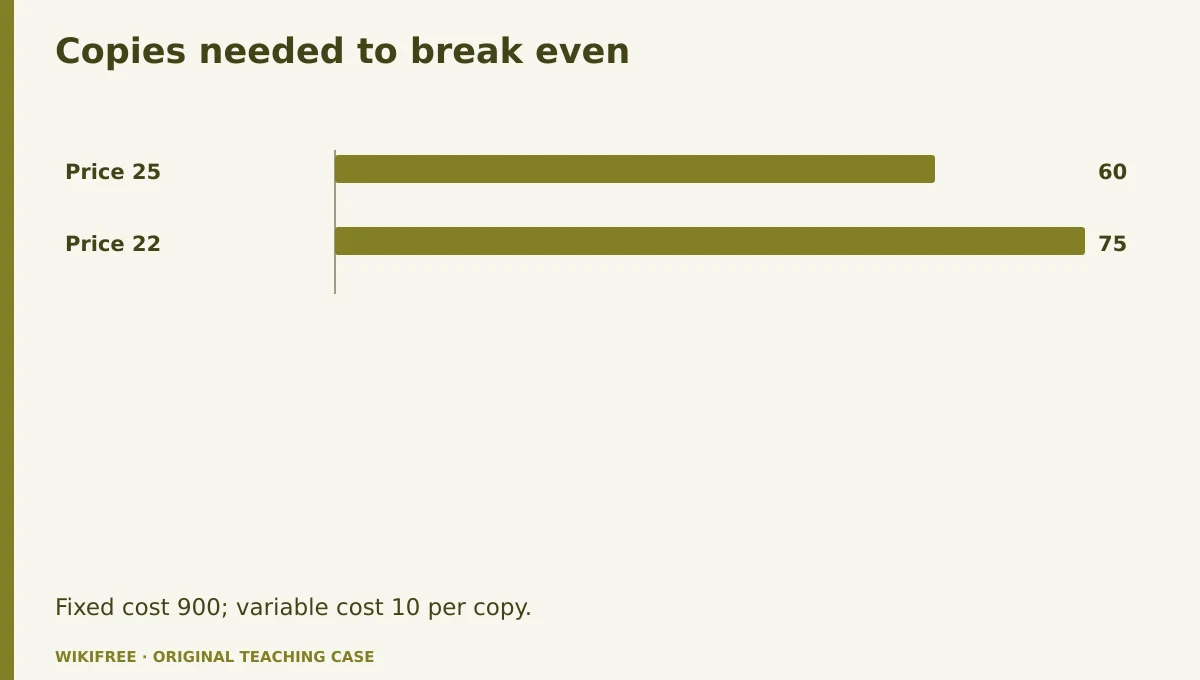
The table and explanations preserve the essential case information when the diagram is unavailable.
Your route
Five outputs, then a final handoff
- 01Separate cost behaviorAssumption and cost table
About 1h 4m including assigned learning and practice. - 02Calculate break-evenBreak-even calculation
About 1h 45m including assigned learning and practice. - 03Evaluate the planned volumeVolume sensitivity table
About 55m including assigned learning and practice. - 04Challenge a discountDiscount decision sheet
About 1h 32m including assigned learning and practice. - 05Explain the decision boundaryConditional pricing memo
About 55m including assigned learning and practice. - FINALCapstone reviewCombine the evidence into one inspectable handoff.
About 2h .
0 of 6 outputs checked. JavaScript adds browser-only progress saving.
The complete lesson and all downloads remain available. Use the printable project workbook to track your progress.
Use the minimum useful source material
The courses behind this route
OpenTuition
CIMA P1 Management Accounting: Free Course
The existing CIMA course contains explicit cost classification, cost–volume–profit and sensitivity lessons.
Selected material only; this path does not claim completion of the entire provider course.
Course publication and selected public lesson metadata were checked on 13 October 2026. This is not a claim of full video playback, provider-course completion or permanent availability. Recheck the linked source if a lesson changes.
Learn, make, inspect
The five-stage workshop
Separate cost behavior
Video 14m · reading budget 0m · original practice about 50m.
Classify costs by how they behave within the stated range. Fixed does not mean permanent, and variable does not mean uncertain. The model assumes a constant price and unit cost over a relevant range. State these assumptions before calculating so a neat result is not applied outside its conditions.
Watch these selected lessons
Do the work
Classify the case inputs and identify two omitted real-world costs.
Save this output
Assumption and cost table
Pass the review gate
The 900 monthly amount is not multiplied by copies.
If you need another attempt
Label each number with its unit and period.
Calculate break-even
Video 29m · reading budget 0m · original practice about 1h 15m.
Contribution first covers fixed cost; only the remainder is operating surplus in this simplified model. Break-even quantity is fixed cost divided by unit contribution when contribution is positive. Check the result by rebuilding revenue and total cost at that quantity. A zero or negative contribution requires a different decision.
Watch these selected lessons
Do the work
Calculate contribution and verify break-even with a revenue-cost table.
Save this output
Break-even calculation
Pass the review gate
Break-even is 60 copies and both revenue and total cost are 1,500 there.
If you need another attempt
Substitute the answer into the original revenue and cost equations.
Evaluate the planned volume
Video 0m · reading budget 0m · original practice about 55m.
Margin of safety compares planned volume with break-even volume. It is not a probability of success. Express it in copies and as a percentage of planned volume, naming that denominator. A plan with a positive margin can still fail if demand, cost or capacity assumptions are wrong.
Original application stage. Use your preceding outputs and the supplied case; there is no additional required provider lesson.
Do the work
Calculate surplus and margin of safety at 80 copies.
Save this output
Volume sensitivity table
Pass the review gate
Surplus is 300, margin is 20 copies or 25% of planned volume.
If you need another attempt
Use planned volume, not break-even volume, for the stated percentage.
Challenge a discount
Video 22m · reading budget 0m · original practice about 1h 10m.
A lower price reduces contribution unless cost changes too. Extra sales may compensate, but the required increase must be calculated. Compare the volume needed to break even and the volume needed to retain the original surplus. Do not assume that a discount automatically creates enough demand.
Watch these selected lessons
Do the work
At price 22, calculate whole-copy break-even and volume needed for a 300 surplus.
Save this output
Discount decision sheet
Pass the review gate
Break-even requires 75 copies; retaining 300 surplus requires 100 copies.
If you need another attempt
Round upward only after calculating the target quantity.
Explain the decision boundary
Video 0m · reading budget 0m · original practice about 55m.
A clear recommendation shows which assumptions would make the proposal acceptable. Present a small range of volumes rather than one optimistic estimate. The result is a decision aid for this simplified teaching case. A real pricing decision also needs evidence about customers, competitors, capacity and costs not included here.
Original application stage. Use your preceding outputs and the supplied case; there is no additional required provider lesson.
Do the work
Write a 200-word memo comparing prices 25 and 22 at 60, 80 and 100 copies.
Save this output
Conditional pricing memo
Pass the review gate
The memo identifies the extra 20 copies required to retain the original surplus.
If you need another attempt
Separate calculated requirements from evidence of achievable demand.
Make the result inspectable
Your final project
Deliver the cost classification, equations, volume table, discount comparison and conditional memo. Add a variable-cost increase from 10 to 11 and explain its separate effect.
The ZIP includes synthetic input data, a project workbook, worked reference, evidence log, scoring rubric and case-specific materials. Code projects include source and clearly stated local execution requirements.
Use one consistent rubric
| Criterion | Maximum | Evidence |
|---|---|---|
| Evidence and correctness | 30 | Calculations, source use and results match the supplied case; limitations are honest. |
| Required artifacts | 30 | All five stage outputs and the capstone handoff are present and inspectable. |
| Reasoning and decisions | 20 | Choices, assumptions, alternatives and the case-specific critical condition are explained. |
| Reproducibility | 10 | A reviewer can follow the stated steps and distinguish expected from observed results. |
| Clear communication | 10 | Labels, units, structure and evidence references make the work easy to review. |
Score at least 80/100, supply every required artifact, and satisfy the path-specific critical condition. Rework missing evidence before marking complete.
The critical condition
Every break-even quantity is verified against revenue and total cost, with whole-copy rounding made explicit.
Compare with a worked reference
At price 25, contribution is 15 and break-even is 900 / 15 = 60 copies. At 80 copies, surplus is 300. At price 22, contribution is 12: 75 copies break even and (900 + 300) / 12 = 100 copies retain the 300 surplus.
Know the boundary
The model assumes one product and constant unit economics; it is not a forecast or investment recommendation.
Questions before you finish
Do I need to finish every source course?
No. This path names selected lessons or reading sections. Complete the full provider course only if it supports your wider goal. The path does not claim equivalence to that course.
How do I know when to advance?
Use the output and review gate in each stage. If evidence is missing or a result conflicts with the case, follow the repair step and retry before advancing.
Can I do the project without paid software?
The selected public provider lessons are free to view. The original case can be completed with paper, a text editor or freely available local tools. Paid exams, certificates, subscriptions and optional provider software are not required for this project.
What does my checklist prove?
It records your own review in this browser only. It does not verify viewing, skill, a provider credential or a real-world deployment.
What if a lesson or tool changes?
Use the linked course and provider page to inspect current availability. Record the change and revisit the relevant assignment; do not invent a replacement lesson or claim an unavailable activity was completed.
Questions & discussion
Share a useful question or correction. Comments appear after moderation. Please avoid personal or sensitive information.