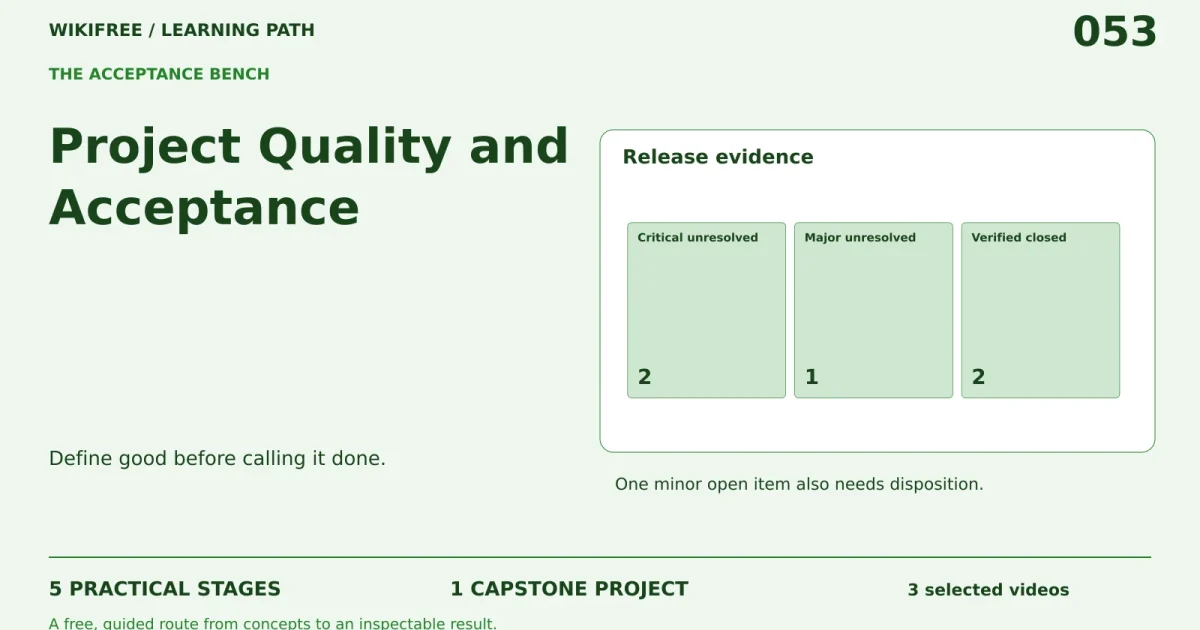
Path 53 · The acceptance bench · Beginner
Define good before calling it done.
A guided, practical route through project quality and acceptance.
What you will be able to do
Turn a workbook-delivery brief into measurable quality criteria, a defect log and a release decision supported by observed checks.
Plan about 7h 55m in total. Reading and practice are editorial estimates; video runtimes come from public provider metadata. Your pace will vary.
Before you begin
Check your starting point
What you need
Basic project knowledge and a text editor. Use the supplied synthetic review records; no paid quality tool is needed.
The selected public provider lessons are free to view. The original case can be completed with paper, a text editor or freely available local tools. Paid exams, certificates, subscriptions and optional provider software are not required for this project.
Completing this WikiFree path does not award a provider certificate. Any provider assessment, account requirement or credential must be checked separately on its official page.
Three readiness questions
Is fixed the same as verified?
No. The correction still needs a relevant retest.
Does QA mean inspecting only the final file?
No. Quality assurance also concerns how work is planned and controlled.
Can a high overall score excuse a wrong total?
Not when that defect violates a critical acceptance rule.
Use a workable pace
At 5 hours per week, allow about 2 weeks. Start with Stage 1, continue in order and reserve 2h for the capstone. If a gate fails, use its repair step before advancing. At another weekly budget, divide 475 estimated minutes by your available weekly minutes and round up.
Keep a small evidence folder. A checked box means you reviewed your output; it is not a certificate or proof that a provider lesson was watched.
The working case
Release evidence
Aster Club is preparing a 20-page learner workbook. The agreed checks are readable text, working links, correct example totals and complete page order. A practice review finds six defects. Severity labels are local learning rules, not a universal quality standard.
| Defect | Severity | State |
|---|---|---|
| Wrong example total | critical | open |
| Broken download link | critical | fixed; retest pending |
| Missing page number | minor | open |
| Typo in heading | minor | fixed; retest passed |
| Low-contrast note | major | open |
| Duplicate page | major | fixed; retest passed |
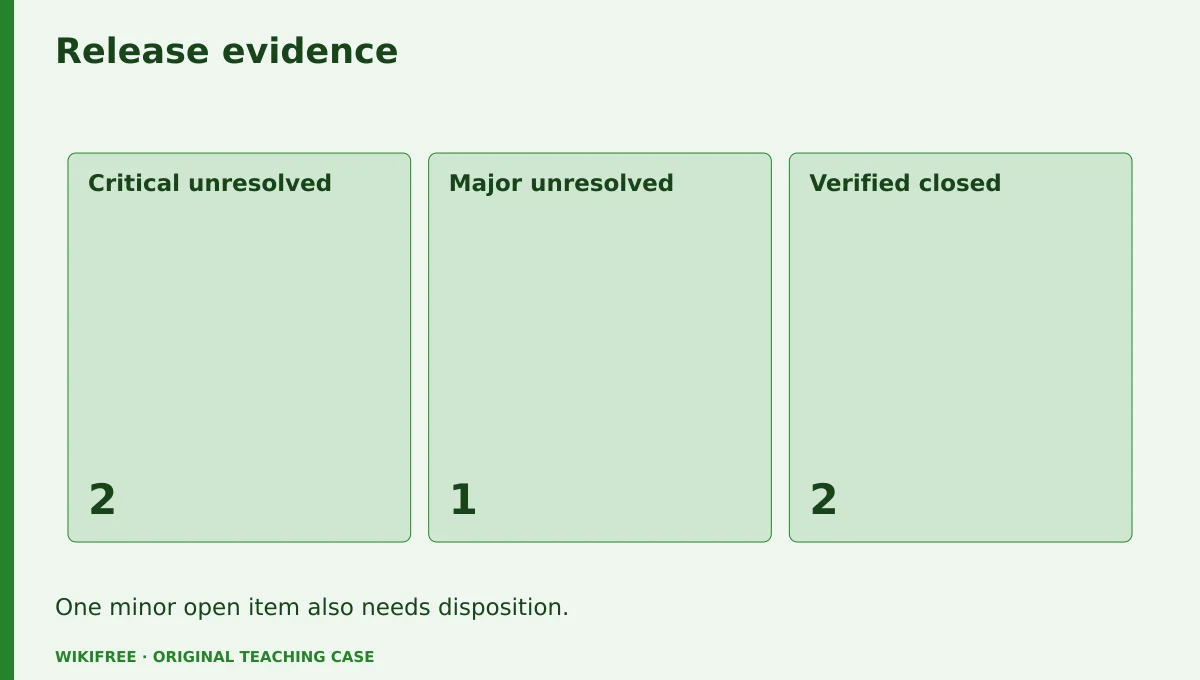
The table and explanations preserve the essential case information when the diagram is unavailable.
Your route
Five outputs, then a final handoff
- 01Write measurable criteriaAcceptance matrix
About 1h 3m including assigned learning and practice. - 02Prevent avoidable errorsQuality assurance plan
About 1h 4m including assigned learning and practice. - 03Classify the defect evidenceSix-row defect register
About 1h 39m including assigned learning and practice. - 04Retest and decideRetest sheet and hold decision
About 1h 10m including assigned learning and practice. - 05Make acceptance reviewableVersioned acceptance record
About 1h including assigned learning and practice. - FINALCapstone reviewCombine the evidence into one inspectable handoff.
About 2h .
0 of 6 outputs checked. JavaScript adds browser-only progress saving.
The complete lesson and all downloads remain available. Use the printable project workbook to track your progress.
Use the minimum useful source material
The courses behind this route
OnlinePMCourses
Project Quality Management: Free Course
Published project-quality lessons support the distinction between quality planning, assurance and control.
Selected material only; this path does not claim completion of the entire provider course.
Course publication and selected public lesson metadata were checked on 13 October 2026. This is not a claim of full video playback, provider-course completion or permanent availability. Recheck the linked source if a lesson changes.
Learn, make, inspect
The five-stage workshop
Write measurable criteria
Video 8m · reading budget 0m · original practice about 55m.
A quality criterion translates a user need into evidence. Correct examples require reconciled calculations; usable links require the intended destination; complete order requires all expected pages. Avoid a single looks professional checkbox. Specify who checks what and which failures prevent release so the team does not negotiate the meaning of done at the deadline.
Watch these selected lessons
Do the work
Write four acceptance criteria with a method, expected result and evidence location.
Save this output
Acceptance matrix
Pass the review gate
Each criterion can fail for a stated reason and has an observable pass condition.
If you need another attempt
Replace a subjective label with a concrete review question or measurement.
Prevent avoidable errors
Video 8m · reading budget 0m · original practice about 55m.
Quality assurance improves the process that produces the deliverable. A reusable calculation sheet, link review and controlled source file can reduce recurring errors. These practices support inspection but do not prove that the final workbook passes. Assign checkpoints while revision is still affordable, and record the document version reviewed at each one.
Watch these selected lessons
Do the work
Design three early checkpoints and name the defect each is intended to prevent.
Save this output
Quality assurance plan
Pass the review gate
Each checkpoint has a purpose, owner and version reference.
If you need another attempt
Do not list final acceptance checks again without showing an earlier prevention activity.
Classify the defect evidence
Video 28m · reading budget 0m · original practice about 1h 10m.
A defect record needs location, expected behavior, observed behavior, severity, owner and status. Severity concerns impact; priority concerns the order of work. A critical defect may be fixed quickly yet remain unverified. Keep fixed, retested and accepted states distinct to prevent a status label from overstating the evidence.
Watch these selected lessons
Do the work
Expand the six supplied rows into complete records. Count open and unverified critical defects separately.
Save this output
Six-row defect register
Pass the review gate
One critical defect is open and one critical fix still needs retesting.
If you need another attempt
Do not count a promised fix as a passed retest.
Retest and decide
Video 0m · reading budget 0m · original practice about 1h 10m.
A retest checks whether the original failure was corrected; a nearby regression check asks whether the fix broke something else. Apply the release rule consistently. For this case, every critical and major defect must be verified closed, and any accepted minor defect must have an explicit owner and disposition.
Original application stage. Use your preceding outputs and the supplied case; there is no additional required provider lesson.
Do the work
Write a retest for the example total and download link, then make the release decision from the supplied states.
Save this output
Retest sheet and hold decision
Pass the review gate
The current workbook is held because critical and major issues remain unresolved.
If you need another attempt
Trace the decision to individual defects rather than a vague percentage complete.
Make acceptance reviewable
Video 0m · reading budget 0m · original practice about 1h .
Acceptance is a recorded decision about a particular version and set of conditions. Preserve the evidence trail, including accepted limitations. A later edit can invalidate earlier checks, so identify which checks must be repeated when a calculation, URL or page is changed. This protects both the learner and the delivery team from stale sign-off.
Original application stage. Use your preceding outputs and the supplied case; there is no additional required provider lesson.
Do the work
Create a release record template and apply a change that modifies one calculation page. Identify the affected retests.
Save this output
Versioned acceptance record
Pass the review gate
The record names the version and does not carry forward an invalidated calculation check.
If you need another attempt
Add a change-impact column so a new version cannot inherit every old pass automatically.
Make the result inspectable
Your final project
Deliver the acceptance matrix, prevention plan, defect register, retest instructions and versioned release decision. Simulate one corrected build and record exactly which new evidence permits release.
The ZIP includes synthetic input data, a project workbook, worked reference, evidence log, scoring rubric and case-specific materials. Code projects include source and clearly stated local execution requirements.
Use one consistent rubric
| Criterion | Maximum | Evidence |
|---|---|---|
| Evidence and correctness | 30 | Calculations, source use and results match the supplied case; limitations are honest. |
| Required artifacts | 30 | All five stage outputs and the capstone handoff are present and inspectable. |
| Reasoning and decisions | 20 | Choices, assumptions, alternatives and the case-specific critical condition are explained. |
| Reproducibility | 10 | A reviewer can follow the stated steps and distinguish expected from observed results. |
| Clear communication | 10 | Labels, units, structure and evidence references make the work easy to review. |
Score at least 80/100, supply every required artifact, and satisfy the path-specific critical condition. Rework missing evidence before marking complete.
The critical condition
No release is marked accepted while a critical or major defect lacks the required verified closure.
Compare with a worked reference
The baseline is not releasable: two critical items lack verified closure, and one major contrast defect is open. A minor typo already passed retest, but that success does not cancel the unresolved issues. The release decision must change only after the required evidence changes.
Know the boundary
This is a document-quality practice case; it is not certification, regulatory compliance testing or a universal severity scheme.
Questions before you finish
Do I need to finish every source course?
No. This path names selected lessons or reading sections. Complete the full provider course only if it supports your wider goal. The path does not claim equivalence to that course.
How do I know when to advance?
Use the output and review gate in each stage. If evidence is missing or a result conflicts with the case, follow the repair step and retry before advancing.
Can I do the project without paid software?
The selected public provider lessons are free to view. The original case can be completed with paper, a text editor or freely available local tools. Paid exams, certificates, subscriptions and optional provider software are not required for this project.
What does my checklist prove?
It records your own review in this browser only. It does not verify viewing, skill, a provider credential or a real-world deployment.
What if a lesson or tool changes?
Use the linked course and provider page to inspect current availability. Record the change and revisit the relevant assignment; do not invent a replacement lesson or claim an unavailable activity was completed.
Questions & discussion
Share a useful question or correction. Comments appear after moderation. Please avoid personal or sensitive information.