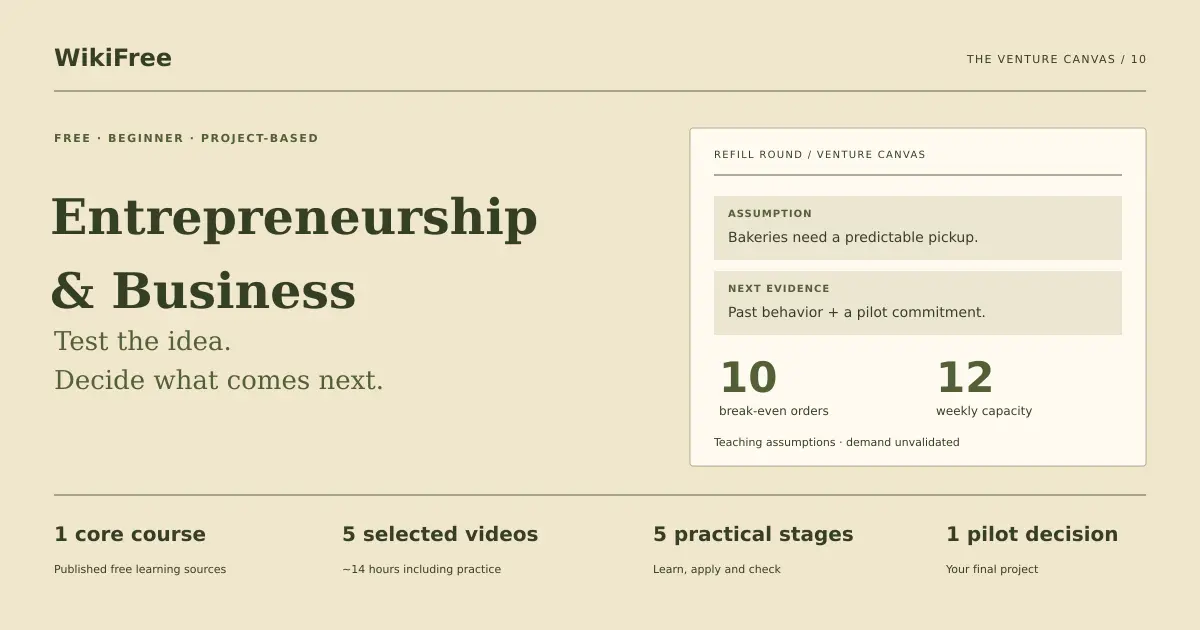
WikiFree learning paths / 10 · The venture canvas
The venture canvas
Make the assumption visible. Earn the next step.
Turn an idea into a testable business hypothesis, an interview plan, a small experiment and a reasoned continue-or-change decision.
Refill Round / assumption board
Evidence before expansion.
- Beginner
- starting level
- 1
- core course
- ≈15h
- learning + practice estimate
- 5 + 1
- stages + final project
The practical outcome
What you will be able to show
Turn an idea into a testable business hypothesis, an interview plan, a small experiment and a reasoned continue-or-change decision.
For: Beginners exploring a small venture before committing substantial money or building a full product.
Before you begin: A notebook or document editor and a calculator. Real customer conversations are optional for the training version and require the participants’ agreement.
Original pathway and exercises by WikiFree Editorial. Course pages and official source metadata reviewed on 12 October 2026. Version 1.0.
A ten-minute starting check
Try these before opening a lesson
Answer in your own words, then reveal the guidance. If you can already demonstrate a stage’s completion gate with evidence, skim its lesson assignment and move to the next stage.
Is “people will love this” a testable assumption?
Not yet. Name the audience, behavior, situation and evidence threshold.
Is a positive interview comment the same as a purchase?
No. Record what the person said separately from what they actually committed to do.
With price 12 and variable cost 7, what is contribution per order?
5 illustrative currency units before fixed costs and other excluded costs.
Sequence with a purpose
Build one layer at a time
- 01Choose a narrow problem and customerAn assumption canvas with a clear first question.
- 02Learn from past behaviorAn interview guide and evidence table.
- 03Design the smallest useful experimentAn experiment card and an observation log template.
- 04Check simple economics and capacityA transparent unit-economics worksheet.
- 05Decide whether to continue, change or stopA continue/change/stop memo.
Finish with the capstone. Progress means a reviewable output, not simply a watched video.
A deliberately short course list
Use these courses for these reasons
Startup School: Free Entrepreneurship Course
Y Combinator · Beginner · English
Five foundational Startup School lessons cover ideas, user conversations, MVPs, business models and goals. Fundraising, AI tooling and specialist sales topics are left out of the first validation cycle.
Assigned viewing: 2h 6m 57s. The full source course contains additional material.
Open the WikiFree course and official learning route ↗Free MIT Course: Entrepreneurship: Building and Launching New Enterprises
MIT · Beginner · English
Optional clarification if your audience is too broad: the MIT course’s market segmentation and beachhead-market lessons provide a compact additional perspective. They are not required or included in the core estimate.
Outside the core estimate. 44m video · self-paced.
Open the WikiFree course and official learning route ↗Free learning, clearly defined
Selected YouTube lessons are free to view. The training version uses fictional evidence and requires no company registration, paid software or advertising spend. No YC or MIT certificate, admission or academic credit is included.
Skills and evidence
| Stage / skill | Learning support | Evidence to produce |
|---|---|---|
| 01 · Choose a narrow problem and customer | Y Combinator selected lessons | An assumption canvas with a clear first question. |
| 02 · Learn from past behavior | Y Combinator selected lessons | An interview guide and evidence table. |
| 03 · Design the smallest useful experiment | Y Combinator selected lessons | An experiment card and an observation log template. |
| 04 · Check simple economics and capacity | Y Combinator selected lessons | A transparent unit-economics worksheet. |
| 05 · Decide whether to continue, change or stop | Y Combinator selected lessons | A continue/change/stop memo. |
Stage 1 / The venture canvas
Choose a narrow problem and customer
You will: Write a falsifiable opportunity hypothesis.
Assigned learning
Startup School: Free Entrepreneurship Course
- Lesson 30 · How to Get and Evaluate Startup Ideas | Startup School
Use the names if the provider later changes the order. Only these assignments enter the core estimate.
Define the situation in which a particular customer struggles. “Reduce waste” is a broad mission; “help a small bakery arrange a predictable container pickup without interrupting morning service” describes a specific problem context.
List assumptions in three groups: problem, solution and delivery. Prioritize the assumption that could invalidate the idea if wrong. A polished logo does not answer whether the customer experiences the problem often enough to act.
Make something reviewable
Write a customer/problem statement and six assumptions. Rank them by uncertainty and consequence, then choose one to test first.
Deliver: An assumption canvas with a clear first question.
Completion gate
The chosen assumption can be contradicted by observable evidence and is tied to a specific customer segment.
If you get stuck: If every assumption says “customers want,” replace it with a behavior or constraint. If you are already building features, return to the evidence you still need.
Stage 2 / The venture canvas
Learn from past behavior
You will: Ask useful questions without steering the answer.
Assigned learning
Startup School: Free Entrepreneurship Course
- Lesson 29 · How To Talk To Users | Startup School
Use the names if the provider later changes the order. Only these assignments enter the core estimate.
Ask about the last time the problem occurred: what happened, what the person did, what it cost in time or effort and what alternative they used. Avoid asking people to predict whether they would buy your imagined product.
Record observation, quotation and interpretation separately. The provided fictional notes are examples for practice, not customer research. If you conduct real interviews, obtain agreement, minimize personal information and accurately preserve contradictory evidence.
Make something reviewable
Create a six-question interview guide and rehearse it with a peer. Analyze the three fictional notes in the pack, then list what remains unknown. Optional: conduct five agreed real conversations and clearly separate them from practice.
Deliver: An interview guide and evidence table.
Completion gate
Questions invite specific past examples; the evidence table includes disconfirming observations.
If you get stuck: If a question starts “Wouldn’t it be useful if,” rewrite it. If every answer supports the idea, inspect whether your prompts discouraged disagreement.
Stage 3 / The venture canvas
Design the smallest useful experiment
You will: Test the riskiest assumption with limited commitment.
Assigned learning
Startup School: Free Entrepreneurship Course
- Lesson 24 · How to Build An MVP | Startup School
Use the names if the provider later changes the order. Only these assignments enter the core estimate.
A small experiment should produce evidence, not merely demonstrate effort. A manual scheduling walkthrough could test whether the pickup process fits a bakery’s morning routine before building an app.
Write the hypothesis, target participants, procedure, measure, threshold, time limit and decision rule in advance. A practice threshold such as three of five participants agreeing to a next-step pilot is an editorial test design, not an industry benchmark or proof of demand.
Make something reviewable
Design a one-week manual pilot proposal with a reversible scope. State exactly what a participant would agree to, how you would record it and what result would make you change the idea.
Deliver: An experiment card and an observation log template.
Completion gate
The outcome can be measured without interpreting polite interest as a commitment; the stop condition is explicit.
If you get stuck: If success is defined after seeing the result, rewrite the protocol before a new test. If the experiment requires a full app, remove features until it tests only the chosen assumption.
Stage 4 / The venture canvas
Check simple economics and capacity
You will: Make unit assumptions and constraints visible.
Assigned learning
Startup School: Free Entrepreneurship Course
- Lesson 28 · Startup Business Models and Pricing | Startup School
Use the names if the provider later changes the order. Only these assignments enter the core estimate.
Using the fictional assumptions, contribution per order is 12 − 7 = 5. Covering weekly fixed cost of 50 would require 10 orders before other excluded costs. That fits under capacity 12 only narrowly; it says nothing about whether customers will actually order.
Now test a price of 9 with the same variable cost. Contribution becomes 2 and the fixed-cost break-even becomes 25 orders, beyond capacity. The model exposes a constraint; it does not prescribe a real price or predict profit.
Make something reviewable
Create a base and lower-price scenario. Show price, variable cost, contribution, fixed-cost break-even and capacity. List three omitted costs or operational uncertainties that require investigation.
Deliver: A transparent unit-economics worksheet.
Completion gate
Both scenarios calculate correctly; demand is labeled unknown; capacity is checked separately from financial arithmetic.
If you get stuck: If contribution is zero or negative, do not divide by it to report a meaningful break-even. Revisit the assumptions and describe the constraint plainly.
Stage 5 / The venture canvas
Decide whether to continue, change or stop
You will: Make a next-step decision proportional to evidence.
Assigned learning
Startup School: Free Entrepreneurship Course
- Lesson 20 · Setting KPIs and Goals | Startup School
Use the names if the provider later changes the order. Only these assignments enter the core estimate.
Pick one learning goal and one operating measure for the next cycle. Keep interviews, pilot commitments and completed paid orders as distinct evidence types. A sample of five conversations can reveal questions; it cannot establish the whole market.
Your final memo can responsibly say “continue testing” or “change the customer segment.” Stopping an unsupported idea can be a successful learning outcome. Do not convert fictional case notes into a claim that demand was validated.
Make something reviewable
Write a one-page decision memo with evidence, counterevidence, economics constraints and the next action. State what result would reverse your decision.
Deliver: A continue/change/stop memo.
Completion gate
The decision is justified by the actual evidence available and names the next uncertainty to reduce.
If you get stuck: If your memo mainly sells the idea, add the strongest opposing observation. If evidence is only fictional, conclude with a test plan rather than a real-market validation claim.
Original practice material
Your case pack and reference checks
Download the editable plain-text workbook, or open the full copy below. It contains the case inputs, templates and reference guidance. Try the exercises before reading the answers.
Download the practice workbook ↓ Download project files (ZIP) ↓Open the complete workbook in this page
WIKIFREE / THE VENTURE CANVAS
Original fictional case. Version 1.0 — 12 October 2026.
Refill Round: an unvalidated reusable-container pickup idea for small bakeries.

FICTIONAL INTERVIEW NOTES FOR ANALYSIS PRACTICE
A: “Last week we used a staff member's car for returns. It took about 40 minutes.
We have no separate budget for it yet.”
B: “Our supplier already collects containers with deliveries. I would not want
another collection time during the morning rush.”
C: “We tried a pickup once, but timing was unreliable. I would need to see a
specific schedule before discussing a trial.”
These are invented notes, not research. No participant has committed to pay.
Example interpretation: A suggests a time-cost problem; B is counterevidence for
this segment; C identifies reliability as a condition. Do not count these as sales.

INTERVIEW GUIDE
Tell me about the last container return. What triggered it? What did you do?
Who was involved? What time or effort did it take? What alternatives have you tried?
Ask follow-up questions without pitching. Obtain agreement for any real interview.

EVIDENCE TABLE
Source/type | Observation or exact quote | Interpretation | Confidence | Unknown
Keep practice notes and real evidence in separate sections.

ASSUMPTION CANVAS
Customer / recurring situation / existing alternative:
Problem assumptions:
Solution assumptions:
Delivery assumptions:
Most consequential uncertainty:

EXPERIMENT CARD
Hypothesis / segment / recruitment agreement / procedure / measure / threshold:
Time limit / maximum commitment / stop rule / what would change the decision:
Example threshold: three of five agreeing to a clearly described next pilot step.
This is a chosen learning threshold, not proof of market demand.

ILLUSTRATIVE ECONOMICS
Base: price 12, variable cost 7, contribution 5, fixed cost 50/week.
Fixed-cost break-even: 50/5 = 10 orders. Capacity: 12 orders/week.
Lower price: 9 - 7 = 2 contribution; 50/2 = 25 orders, beyond capacity.
Demand unknown. Taxes, owner pay, failed pickups and other costs are not modeled.
At zero/negative contribution, do not report a finite operating break-even.

DECISION MEMO
Continue testing / change / stop:
Evidence and strongest counterevidence:
Economics and capacity constraints:
Next action, owner and review date:
What would reverse this decision:
For the training version, conclude with a test proposal rather than claiming
real validation, revenue, customers, funding or product-market fit.
Case data, exercises and reference examples: WikiFree Editorial, original training material. Provider lessons are linked, not reproduced.
Final project / 3h practice estimate
The Refill Round validation dossier
Assemble a small venture dossier that makes uncertainty visible. Complete either the training version using explicitly fictional notes or an authorized real-research version with documented evidence; label the version clearly.
Your handover package
- Customer/problem statement and ranked assumption canvas
- Interview guide and evidence table with counterevidence
- A bounded experiment protocol and observation log
- Two economic scenarios and a reasoned next-step decision
| Criterion | Points | Evidence expected |
|---|---|---|
| Problem and assumptions | 25 | A specific customer situation and falsifiable assumptions. |
| Evidence quality | 30 | Past behavior, commitments and interpretation remain distinct. |
| Experiment and constraints | 30 | The test is bounded, measurable and consistent with economic capacity. |
| Decision clarity | 15 | The recommendation is proportionate to evidence and includes a reversal condition. |
Completion standard: aim for at least 80/100, with all critical gates met. A reviewer awards each row’s points in proportion to the evidence shown. This is a learning rubric, not a provider credential.
Presenting fictional interviews as real evidence or treating an arithmetic scenario as verified demand blocks completion.
A pace that leaves room to practice
Plan the next few weeks
Assigned viewing: 2h 6m 57s. Practice and capstone: 12.0 hours, editorial estimate. Budget about 15 hours overall. Replays and personal adaptations can take longer.
| Available time | Flexible estimate | How to use it |
|---|---|---|
| 2 hours/week | 8 weeks | Reserve time to make the output and pass its gate; split a long lesson across sessions. |
| 5 hours/week | 3 weeks | Reserve time to make the output and pass its gate; split a long lesson across sessions. |
| 10 hours/week | 2 weeks | Reserve time to make the output and pass its gate; split a long lesson across sessions. |
The calculation stays in your browser. The estimates above remain usable without JavaScript.
Checkbox progress is saved only in this browser when local storage is available. It is not sent to WikiFree or synchronized to an account.
Questions before you continue
Do I need to launch a company to finish?
No. The training version ends with a rigorous test proposal and decision memo. A real pilot is a separate, optional application.
Does completing Startup School guarantee funding?
No. This path uses publicly available learning material and has no relationship to admission or investment decisions.
Sources and honest boundaries
What was checked, and what comes next
A training case cannot validate real demand. This path ends with an evidence plan or a documented small test, not proof of product-market fit. It does not provide legal, tax, investment or fundraising advice.
The complete published WikiFree course catalog was checked on 12 October 2026: 815 courses across nine API pages. Course pages and official playlist metadata or module headings were inspected. This does not mean every video was played to completion, every geographic region was tested, or a provider credential was earned.
- Y Combinator · official source for Startup School: Free Entrepreneurship Course
- MIT · official source for Free MIT Course: Entrepreneurship: Building and Launching New Enterprises
Keep the published course pages as your route into provider material. Access, lesson order and tool interfaces can change. Report a broken route through WikiFree’s correction page.
Questions & discussion
Share a useful question or correction. Comments appear after moderation. Please avoid personal or sensitive information.