Listed as Free on Udemy when checked on 24 October 2026. No coupon or subscription trial is required for the listed lessons. Enrollment needs a Udemy account; availability can change.
About this course
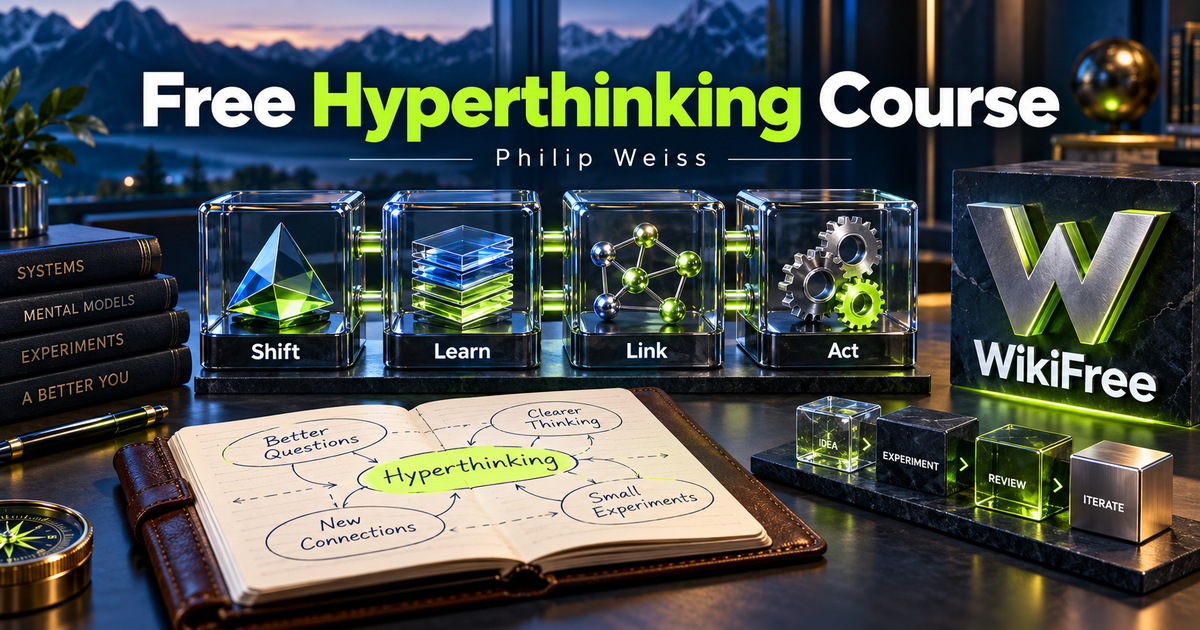
Learning, creativity and execution are often taught separately. This free Hyperthinking course connects them through four named dimensions: shifting perspectives, directing your own learning, building knowledge connections and acting on ideas.
Philip Weiss and Digital Masterclass – Online Series present a toolkit for professionals who want to question assumptions and keep learning through change. The framework is the instructor’s model, rather than a guarantee of improved performance.
| Official course | Hyperthinking: improve your day to day learning & creativity |
|---|---|
| Created by | Digital Masterclass – Online Series; Philip Weiss |
| Platform | Udemy |
| Language | English |
| Level | All Levels — Udemy listing |
| Listed duration | 67 minutes; 23 lectures across 7 sections |
| Certificate | Not included with a new free enrollment |
Skills you’ll gain
- Examine an assumption from an opposing perspective
- Choose specific skills for a self-directed learning plan
- Use mind mapping and related ideation techniques
- Connect information from several learning sources
- Turn an idea into a small exploratory action
- Reflect on what an experiment changes in your understanding
HyperShift begins with paradigms and assumptions, including an assignment to investigate a position the learner disagrees with. HyperLearn then combines learning habits, course selection and creativity techniques. The practical emphasis is deliberate engagement rather than simply accumulating information.
HyperLink discusses knowledge connections and social networks. HyperAct moves into execution, including task capture and lean-startup ideas, before asking learners to try an idea over several weeks. The public syllabus also lists bonus talks and networking material.
The listing reports 67 minutes across 23 lectures, while individual section and bonus times do not align neatly with that headline total. Treat 67 minutes as the provider’s listed duration, not an independently timed playback total. Older network invitations and named applications may also have changed.
No prerequisites are specified. A free notes application, a spreadsheet and paper sketches can support the core activities; you do not need to buy a named task-management tool. Examples of earlier roles and events in the biography should be read as source history, not verified current appointments.
Frequently asked questions
Is Hyperthinking a professional credential?
The course teaches a named thinking framework; it does not establish a professional qualification.
Is the runtime independently verified?
No. The provider lists 67 minutes, but section and bonus timings are not fully consistent with that figure.
Are social accounts or paid tools compulsory?
They are not needed for the central reflection and planning exercises; an older community assignment can be replaced by private notes.
Checked on 24 October 2026 using the public course details and syllabus. WikiFree has not watched every lesson or tested full playback. New free enrollments do not include a Udemy completion certificate, instructor Q&A or direct messages.
Questions & discussion
Share a useful question or correction. Comments appear after moderation. Please avoid personal or sensitive information.