Listed as Free on Udemy when checked on 24 October 2026. No coupon or subscription trial is required for the listed lessons. Enrollment needs a Udemy account; availability can change.
About this course
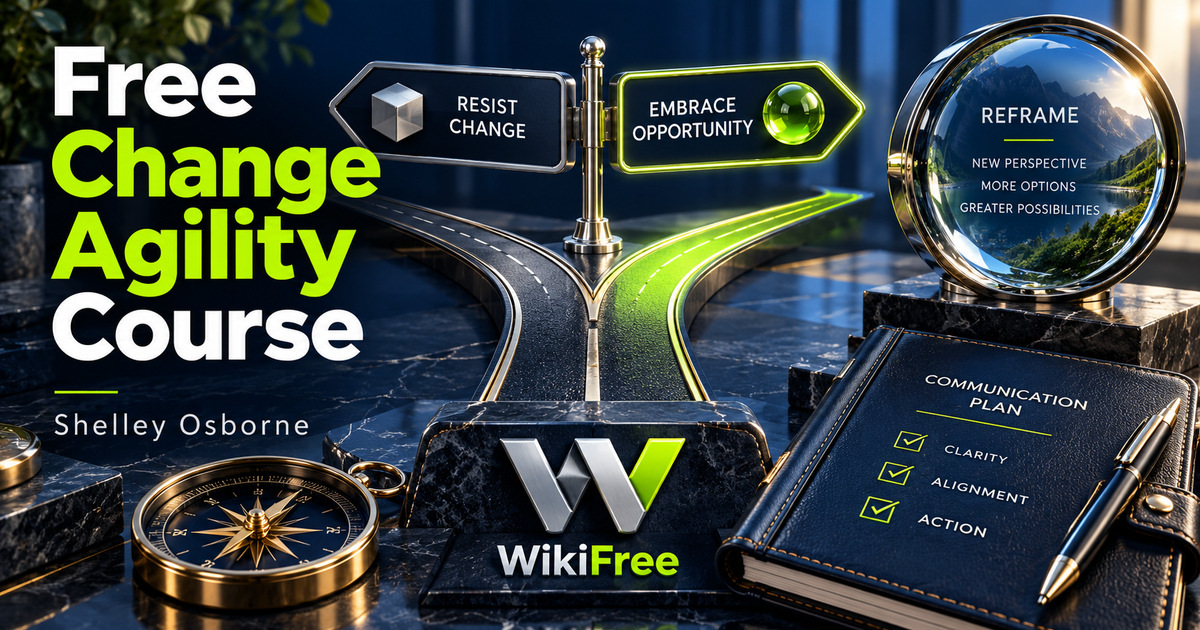
Workplace change creates practical questions as well as emotional reactions. This free course helps individual employees examine both, using situational awareness, option generation, reframing and communication.
Shelley Osborne organizes the material around five change-focused mindsets. The focus is personal adaptability and supporting colleagues, rather than designing a corporate change program from the top down.
| Official course | Change Agility in the Workplace: Become a Change Agent |
|---|---|
| Created by | Shelley Osborne |
| Platform | Udemy |
| Language | English |
| Level | All Levels — Udemy listing |
| Listed duration | 50 minutes; 27 lectures across 8 sections |
| Certificate | Not included with a new free enrollment |
Skills you’ll gain
- Observe a change before deciding how to respond
- Generate several options instead of defaulting to one reaction
- Challenge assumptions through a structured reframe
- Consider personal and business resource needs together
- Make a provisional decision with incomplete information
- Ask useful questions about a change and its outcomes
The opening activities ask learners to choose a change goal and reflect on how change feels. Examples of organizational change provide context before the course introduces situational awareness and a five-stage model of reactions. Treat that model as a reflection aid, not a fixed emotional sequence that every person must follow.
The middle lessons develop alternatives through obstacle analysis, an ideal future and reverse brainstorming. They then connect resources and perspectives with business needs. The participant guide supports applying these ideas to a change the learner actually faces.
Later sections address ambiguity and communication. The syllabus names decision tools such as a day-one hypothesis and asks what must be believed before moving forward. The final communication questions connect the purpose of a change with what improves and how progress could be measured.
There are no prerequisites. The listing reports 50 minutes across 27 lectures, including short activities and downloads. It originated during the COVID-19 period; those circumstances are historical context. A notebook or free document editor can support the exercises without relying on an old external class-sharing board.
Frequently asked questions
Is this a full organizational change-management course?
No. The instructor explicitly focuses on personal change agility rather than a corporate top-down program.
Must everyone experience five emotional stages?
No. Use the model as a prompt for reflection, not a diagnosis or a required sequence.
Do I need paid tools?
No paid application is necessary for reflection, options lists or a communication plan.
Checked on 24 October 2026 using the public course details and syllabus. WikiFree has not watched every lesson or tested full playback. New free enrollments do not include a Udemy completion certificate, instructor Q&A or direct messages.
Questions & discussion
Share a useful question or correction. Comments appear after moderation. Please avoid personal or sensitive information.