Listed as Free on Udemy when checked on 23 October 2026. No coupon or subscription trial is required for the listed lessons. Enrollment needs a Udemy account; availability can change.
About this course
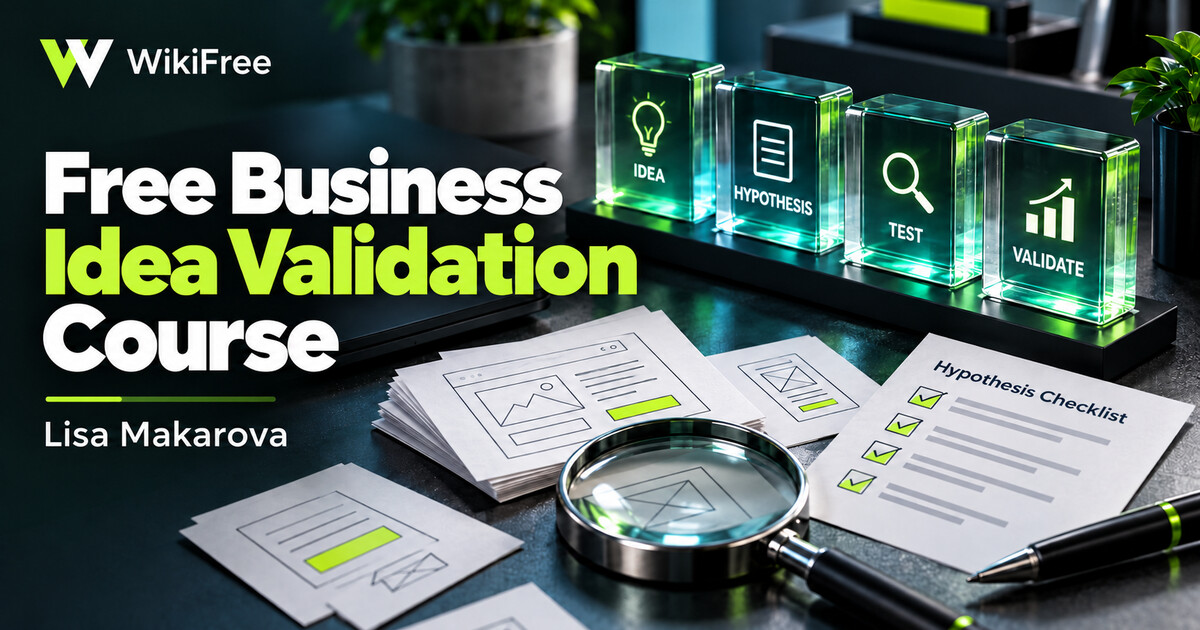
An attractive business idea still contains assumptions about customers and the problem they will pay attention to. Lisa Makarova presents a four-step validation approach that moves from those assumptions toward interviews, a value proposition and early traction tests.
Seven lectures total 50 minutes. The course includes a rapid-validation case and supporting templates, giving the learner a compact way to organize research before committing to a full build.
| Official course | Validate Your Business Idea in 4 Steps |
|---|---|
| Created by | Lisa Makarova |
| Platform | Udemy |
| Language | English |
| Level | Beginner — Udemy listing |
| Listed duration | 50 minutes; 7 lectures across 1 sections |
| Certificate | Not included with a new free enrollment |
Skills you’ll gain
- Identifying assumptions that deserve testing first
- Preparing customer interviews around a problem
- Connecting interview evidence with a value proposition
- Choosing an early test that addresses a clear uncertainty
Bring a business idea to examine; that is the stated starting point. The course is particularly relevant before spending heavily on development, because it asks what still needs to be learned.
The case describes a short validation period, but that example is not a universal deadline for proving demand. Different products require different access to customers, evidence and follow-up. Positive comments in an interview should also be distinguished from a demonstrated willingness to use or buy a solution.
The toolkit refers to Miro. Paper or a free document can capture assumptions and interview notes if a paid collaboration plan would otherwise be needed. Record only information participants agree to share, and keep the proposed test honest about what has already been built. No funding outcome or guaranteed customer acquisition is implied.
Frequently asked questions
Do I need an idea before starting?
Yes. The method is intended to be applied to a business idea.
Is a paid Miro plan essential?
No. The underlying notes and mapping can be created on paper or in a free document.
Does the rapid case prove every idea in the same time?
No. The time required depends on the uncertainty and evidence available.
Checked on 23 October 2026 using the public course details and syllabus. WikiFree has not watched every lesson or tested full playback. New free enrollments do not include a Udemy completion certificate, instructor Q&A or direct messages.
Questions & discussion
Share a useful question or correction. Comments appear after moderation. Please avoid personal or sensitive information.