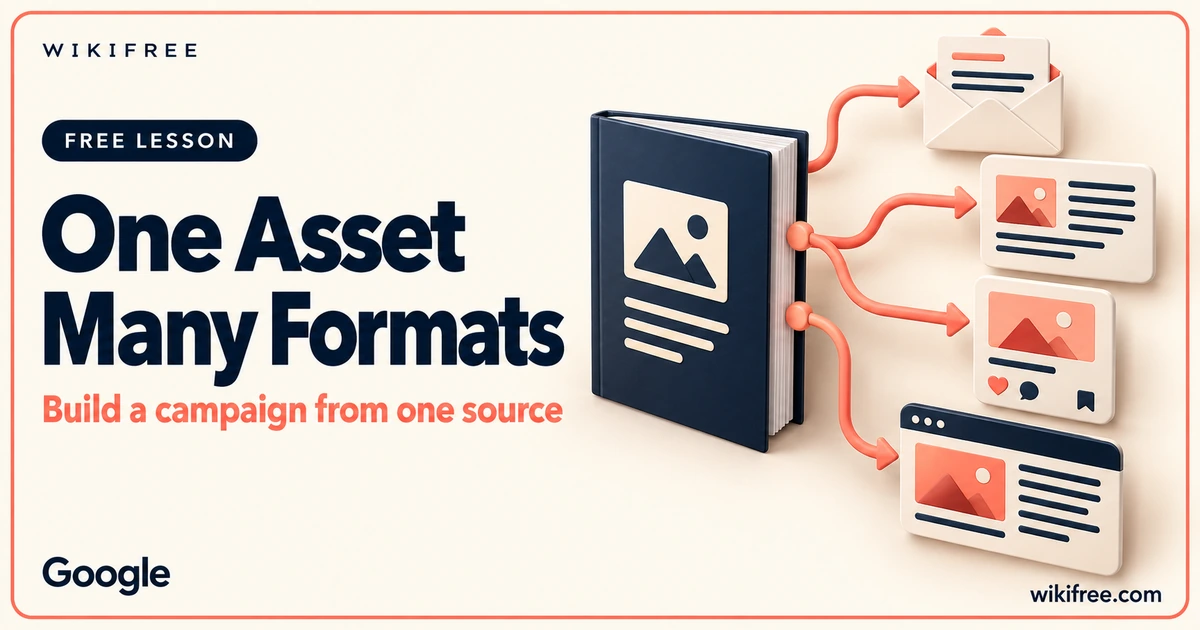
A useful source document can support several pieces of content when each is adapted for its audience and channel. Google’s Turn One Asset into a Campaign demonstrates using Gemini in Docs to repurpose a whitepaper or PDF.
This free AI Boost Bites micro-lesson shows one content-multiplication workflow with a knowledge check. Its advertised output examples include a landing page, LinkedIn posts and email nurtures. It is useful for understanding adaptation, rather than assuming that the same paragraph should be pasted everywhere.
Course at a glance
| Provider | |
|---|---|
| Platform | Google Skills |
| Level | Beginner |
| Language | English |
| Estimated study time | 10–15 minutes; public card and structured estimates differ; individual pace varies. |
| Format | One topical demonstration and one knowledge check |
| Access | Free instruction; free Google Skills account required. Product and practical access are separate. |
| Recognition | Course completion badge advertised after required activities; no professional certification or academic credit. |
What you’ll learn
- Explore repurposing a whitepaper or PDF in the demonstrated workflow.
- Examine the landing-page, LinkedIn and email examples named in the lesson.
- Connect a shared source with different communication purposes.
Skills you’ll gain
- Content-repurposing planning
- Channel adaptation
- Source-claim consistency
Preserve the source while changing the format
The lesson’s starting point is one asset and its destination is several marketing formats. That makes the distinction between the underlying information and the channel-specific expression important. A change in format should not silently become a new product claim.
A landing page, a social post and an email can ask different things of the reader. Use the demonstration to examine how the purpose of each output influences what it emphasizes. This is an editorial consideration, not a claim that the micro-lesson provides a full campaign strategy.
The workflow can introduce content reuse, but it does not guarantee performance, originality of every generated phrase or approval to republish someone else’s document. The article does not fabricate conversion metrics.
Give each output a reason to exist
For optional reflection, write a short fictional source note about a public event. Identify the main fact a landing page should explain, the point a social post should introduce and the purpose of a follow-up email. This is independent study guidance, not a provider assignment.
Now compare those purposes. Which information needs to remain consistent across all three? Which detail is useful only in one format? That exercise makes channel adaptation more concrete without using a paid tool or private source material.
Before independently publishing a derived asset, compare its important claims with the source and consider its audience. A larger number of outputs is not automatically a stronger campaign if each one repeats the same unclear message.
The course is introductory and short, with one demonstration and an embedded knowledge check. It illustrates a repurposing approach. Creating, reviewing and publishing a real suite of assets remains separate from completing the free learning activity.
Free learning and practical access
The complete instruction is advertised as Free on Google Skills, using a free learner account. Its actual learning route is one demonstration and a knowledge check, without a provisioned cloud lab. Independent access to the demonstrated product, premium features or organizational integrations is separate and may involve costs. Google advertises a course completion badge after the required activities. It is not a professional certification or academic credit.
Explore more learning options in the free course catalogue.
Frequently asked questions
Which output channels are named?
The example repurposes a whitepaper or PDF into material such as a landing page, LinkedIn posts and email nurtures. It is one content-repurposing demonstration.
Is every output supposed to use identical wording?
The example concerns adapting one source into different formats. This article encourages distinguishing the communication purposes rather than treating repetition as the goal.
Does the lesson guarantee campaign results?
No. It demonstrates a content workflow. No traffic, conversion, engagement or commercial outcome is promised.
Questions & discussion
Share a useful question or correction. Comments appear after moderation. Please avoid personal or sensitive information.