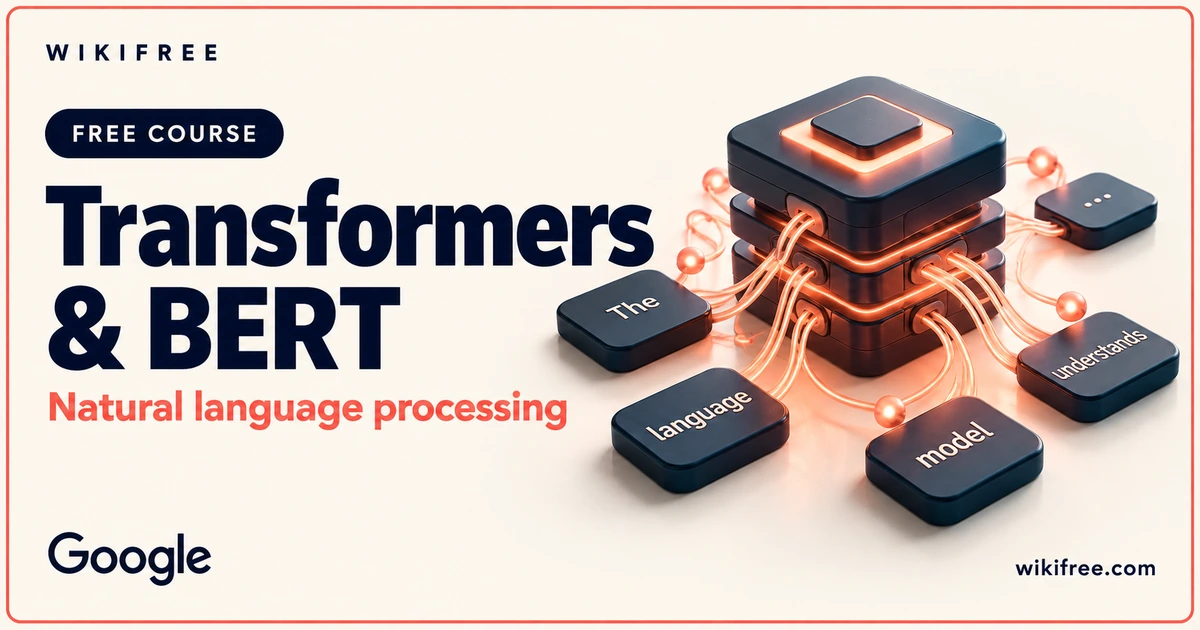
Many text AI applications depend on a model understanding how words relate to the surrounding sentence. Google’s Transformer Models and BERT Model offers a focused way to explore that idea and connect an important neural network architecture with recognizable language tasks.
This free Intermediate course is useful when you have heard about Transformers but want a clearer picture of what BERT does. Its overview, recorded lab walkthrough and quiz make it a compact learning stop before a larger natural language processing project. Expect an introduction to the architecture and its applications, rather than a complete NLP engineering program.
Course at a glance
| Provider | |
|---|---|
| Platform | Google Skills |
| Level | Intermediate |
| Language | English |
| Estimated time | Roughly 30–45 minutes; the official header and overview give different estimates |
| Format | Short self-paced course: overview, recorded walkthrough, resources and quiz |
| Access | Free instruction; sign in with a free learner account |
| Recognition | Completion badge advertised; no professional certification promised |
What you’ll learn
- Recognize the main components of Transformer architecture, including self-attention.
- Understand how the Transformer architecture is used to build BERT.
- Connect BERT with text classification, question answering and natural language inference.
- Follow the recorded walkthrough and use the quiz to check your understanding.
Skills you’ll gain
- Transformer architecture literacy
- Self-attention concepts
- BERT model understanding
- NLP task selection
- Technical model communication
From individual words to context
Start by asking a simple question: what information does a model need to interpret a word in a sentence? The answer often depends on other words nearby. The course introduces self-attention and the architectural components behind BERT, helping you replace a collection of familiar AI terms with a more connected explanation.
BERT uses the Transformer encoder architecture to represent text in context. That gives you a useful distinction to keep in mind while studying: understanding language for a classification or question-answering task is a specific objective, not a promise that every text model behaves like a conversational assistant.
The named applications make the material easier to connect with real work. A text classifier, a question-answering system and a natural language inference task ask different questions of the input. As you watch, note what each task needs the model to produce and which part of the architecture helps make that possible.
Build a clearer explanation before building a larger model
For an optional study exercise, sketch three boxes labelled input text, model and task output. Choose a fictional text-classification example, then explain each box in one or two sentences. This is an independent reflection activity, not an assignment advertised by Google.
Return to the same sketch after the walkthrough. Add the terms you can now explain and mark those that still need study. A good result is an explanation that another learner can follow, rather than a page of architecture names without clear relationships.
Google labels the course Intermediate. Some familiarity with machine learning and neural networks will help you get more from the short presentation; that is preparation advice, not a new admission requirement. If the terminology feels compressed, pause and revisit the overview before using the quiz.
Free instruction and completion details
The course is currently advertised as Free on Google Skills. Sign in with a free learner account to access activities and record progress. The listed curriculum includes two videos, a quiz and a resources link; the item called “Lab Walkthrough” is a recorded video, not a separately listed hands-on lab.
The page advertises a completion badge, with the quiz marked as required in the curriculum. This is course recognition, not an academic qualification or a professional certification. Running your own model experiments or using cloud computing is separate from watching the free instruction and may involve costs.
Allow approximately 30–45 minutes for a first pass: the course header shows 30 minutes while its overview mentions 45. Pausing for notes or replaying a section can take longer.
Explore the free course catalogue to continue learning in the areas that fit your goals.
Frequently asked questions
Is this a free course or a paid cloud lab?
The course instruction is advertised as Free. The curriculum lists an overview video, a recorded lab walkthrough, a quiz and resources, with no hands-on lab activity. Independent cloud experiments are separate.
Who will find the course most useful?
It is an Intermediate introduction for learners connecting neural network concepts with NLP. Familiarity with basic machine learning terminology is useful preparation, rather than an invented entry requirement.
What recognition is advertised?
Google Skills advertises a completion badge. The required quiz appears in the public curriculum. No professional certification, university credit or employment outcome is promised.
Questions & discussion
Share a useful question or correction. Comments appear after moderation. Please avoid personal or sensitive information.