Path 82 · The worker station · Intermediate
Bound the work and close the right channel.
A guided, practical route through go concurrency.
What you will be able to do
Create a bounded Go worker-pool example that processes four jobs and collects every result without depending on completion order.
Plan about 8h 43m in total. Reading and practice are editorial estimates; video runtimes come from public provider metadata. Your pace will vary.
Before you begin
Check your starting point
What you need
Basic programming and a local Go toolchain for execution. No remote jobs or network calls are used.
The selected public provider lessons are free to view. The original case can be completed with paper, a text editor or freely available local tools. Paid exams, certificates, subscriptions and optional provider software are not required for this project.
Completing this WikiFree path does not award a provider certificate. Any provider assessment, account requirement or credential must be checked separately on its official page.
Three readiness questions
Does concurrency guarantee result order?
No.
Who should close the results channel?
A coordinator after all workers finish.
Does more workers always mean faster work?
No. Workload and overhead matter.
Use a workable pace
At 5 hours per week, allow about 2 weeks. Start with Stage 1, continue in order and reserve 2h for the capstone. If a gate fails, use its repair step before advancing. At another weekly budget, divide 523 estimated minutes by your available weekly minutes and round up.
Keep a small evidence folder. A checked box means you reviewed your output; it is not a certificate or proof that a provider lesson was watched.
The working case
Four jobs through two workers
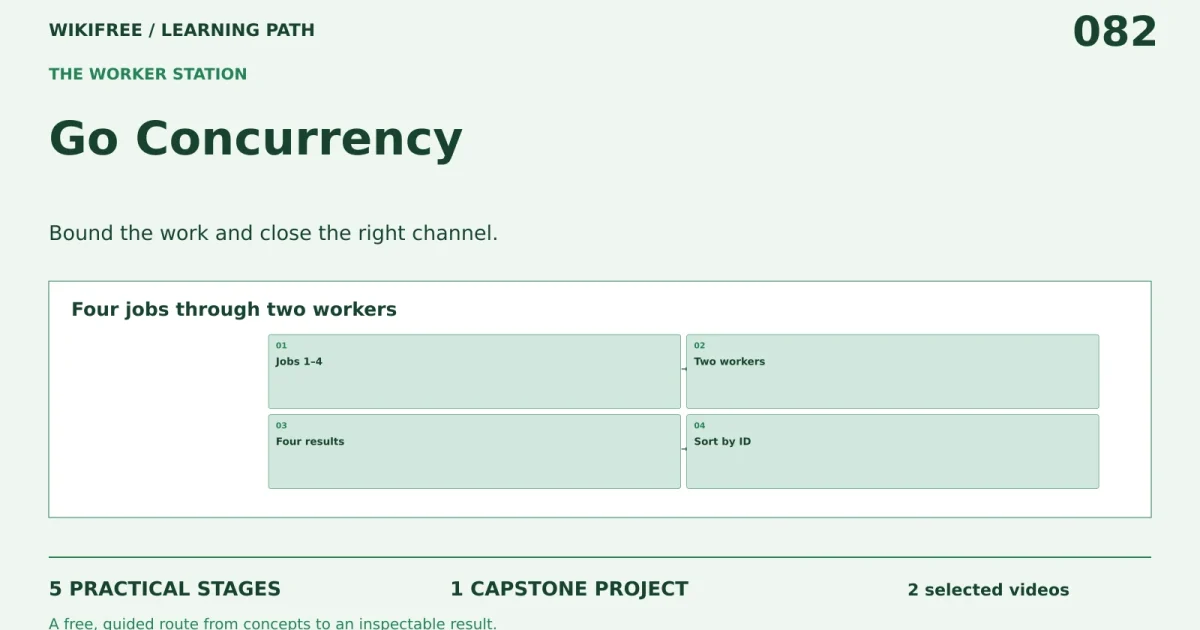
Four synthetic jobs contain values 2, 3, 4 and 5. Two workers square each value. Completion order is unspecified; the final report sorts by job ID. Each submitted job must produce exactly one result.
| Job ID | Input | Expected square |
|---|---|---|
| 1 | 2 | 4 |
| 2 | 3 | 9 |
| 3 | 4 | 16 |
| 4 | 5 | 25 |
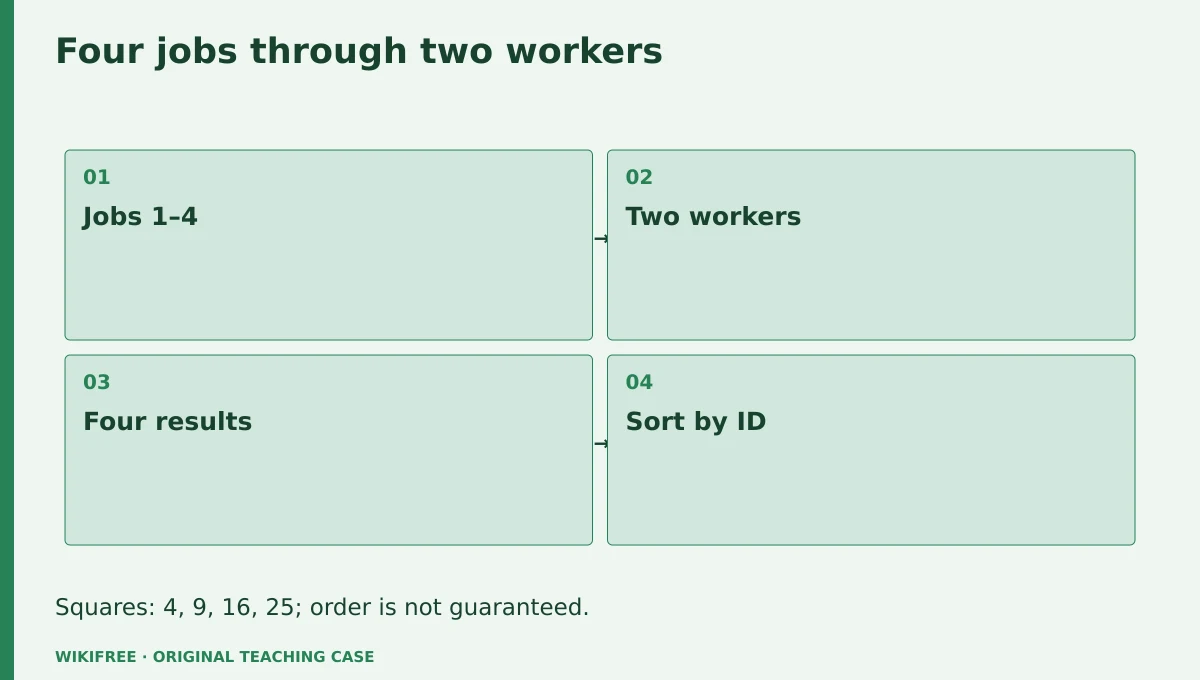
The table and explanations preserve the essential case information when the diagram is unavailable.
Your route
Five outputs, then a final handoff
- 01Review Go values and functionsSequential baseline
About 1h 38m including assigned learning and practice. - 02Bound the worker poolWorker-pool source
About 1h 36m including assigned learning and practice. - 03Coordinate completionCompletion-safe collector
About 1h 20m including assigned learning and practice. - 04Test order-independent correctnessConcurrency test record
About 1h 15m including assigned learning and practice. - 05Explain limits and shutdownGo handoff
About 55m including assigned learning and practice. - FINALCapstone reviewCombine the evidence into one inspectable handoff.
About 2h .
0 of 6 outputs checked. JavaScript adds browser-only progress saving.
The complete lesson and all downloads remain available. Use the printable project workbook to track your progress.
Use the minimum useful source material
The courses behind this route
Simplilearn
Free Simplilearn Course: Go Programming, Concurrency and Interfaces
The existing Go basics and concurrency lessons support the worker-pool concepts; official Go channel guidance supplements the implementation.
Selected material only; this path does not claim completion of the entire provider course.
Course publication and selected public lesson metadata were checked on 13 October 2026. This is not a claim of full video playback, provider-course completion or permanent availability. Recheck the linked source if a lesson changes.
Learn, make, inspect
The five-stage workshop
Review Go values and functions
Video 32m · reading budget 0m · original practice about 1h 5m.
Start with a sequential function that maps one job to one result. Keep the transformation deterministic so concurrency can be tested against a simple baseline. Use a struct with an ID instead of relying on slice position after results arrive. The case does no external work and has no sensitive input.
Watch these selected lessons
Do the work
Write job and result types plus the square function.
Save this output
Sequential baseline
Pass the review gate
The four expected values are 4, 9, 16 and 25.
If you need another attempt
Verify the sequential result before introducing goroutines.
Bound the worker pool
Video 10m · reading budget 0m · original practice about 1h 25m.
A fixed number of workers limits simultaneous processing. Workers read jobs until the jobs channel is closed. The producer closes that channel after sending every job. Avoid creating a goroutine for every unbounded input without considering resource use; this exercise intentionally uses exactly two workers.
Watch these selected lessons
Do the work
Implement two workers consuming a jobs channel.
Save this output
Worker-pool source
Pass the review gate
Every job is submitted once and processed once.
If you need another attempt
Track job IDs rather than counting log messages.
Coordinate completion
Video 0m · reading budget 0m · original practice about 1h 20m.
Use a wait group to know when all workers have finished sending results. A separate coordinator closes the results channel only then. Closing it from an individual worker can make another worker send to a closed channel. Collect results concurrently so a small channel buffer does not cause a deadlock.
Original application stage. Use your preceding outputs and the supplied case; there is no additional required provider lesson.
Do the work
Add completion coordination and range over the result channel.
Save this output
Completion-safe collector
Pass the review gate
Collection terminates after all four results without an arbitrary sleep.
If you need another attempt
Use synchronization rather than a guessed waiting time.
Test order-independent correctness
Video 0m · reading budget 0m · original practice about 1h 15m.
Compare results by ID, not arrival order. Check for missing and duplicate IDs as well as correct values. A race detector can help inspect a real run, but it is not available here because the preparation environment lacks Go. The package includes source and local commands without claiming they executed.
Original application stage. Use your preceding outputs and the supplied case; there is no additional required provider lesson.
Do the work
Run go test and the race check locally when available.
Save this output
Concurrency test record
Pass the review gate
All four IDs appear once; ordering differences do not fail a valid run.
If you need another attempt
Sort or map results before comparison.
Explain limits and shutdown
Video 0m · reading budget 0m · original practice about 55m.
A finite fixture can finish without cancellation, but a real service needs timeouts, cancellation and error handling. State those gaps rather than adding an untested production wrapper. Explain channel ownership and what would need to change for slow or failing jobs. The example is educational and does not promise throughput gains.
Original application stage. Use your preceding outputs and the supplied case; there is no additional required provider lesson.
Do the work
Write a channel-ownership diagram and an extension plan.
Save this output
Go handoff
Pass the review gate
The README identifies producer, workers and results closer.
If you need another attempt
Name one owner for each close operation.
Make the result inspectable
Your final project
Deliver the sequential baseline, worker pool, result checks and channel-ownership explanation. Add an empty-job case and demonstrate clean termination in a local Go environment.
The ZIP includes synthetic input data, a project workbook, worked reference, evidence log, scoring rubric and case-specific materials. Code projects include source and clearly stated local execution requirements.
Use one consistent rubric
| Criterion | Maximum | Evidence |
|---|---|---|
| Evidence and correctness | 30 | Calculations, source use and results match the supplied case; limitations are honest. |
| Required artifacts | 30 | All five stage outputs and the capstone handoff are present and inspectable. |
| Reasoning and decisions | 20 | Choices, assumptions, alternatives and the case-specific critical condition are explained. |
| Reproducibility | 10 | A reviewer can follow the stated steps and distinguish expected from observed results. |
| Clear communication | 10 | Labels, units, structure and evidence references make the work easy to review. |
Score at least 80/100, supply every required artifact, and satisfy the path-specific critical condition. Rework missing evidence before marking complete.
The critical condition
No worker closes the shared results channel prematurely and every job ID has exactly one result.
Compare with a worked reference
The result set is {1:4, 2:9, 3:16, 4:25}; its value sum is 54. Arrival order may vary. The source uses two workers and a completion coordinator. Go compilation, runtime and race-detector checks were not performed in the preparation environment.
Know the boundary
This is a finite local concurrency example, not a resilient task queue or a benchmarked service.
Questions before you finish
Do I need to finish every source course?
No. This path names selected lessons or reading sections. Complete the full provider course only if it supports your wider goal. The path does not claim equivalence to that course.
How do I know when to advance?
Use the output and review gate in each stage. If evidence is missing or a result conflicts with the case, follow the repair step and retry before advancing.
Can I do the project without paid software?
The selected public provider lessons are free to view. The original case can be completed with paper, a text editor or freely available local tools. Paid exams, certificates, subscriptions and optional provider software are not required for this project.
What does my checklist prove?
It records your own review in this browser only. It does not verify viewing, skill, a provider credential or a real-world deployment.
What if a lesson or tool changes?
Use the linked course and provider page to inspect current availability. Record the change and revisit the relevant assignment; do not invent a replacement lesson or claim an unavailable activity was completed.
Questions & discussion
Share a useful question or correction. Comments appear after moderation. Please avoid personal or sensitive information.