Path 59 · The agreement workshop · Beginner
Find the constraint behind the position.
A guided, practical route through workplace conflict resolution.
What you will be able to do
Prepare and rehearse a structured workplace negotiation that distinguishes interests, options, alternatives and a checkable agreement.
Plan about 8h 4m in total. Reading and practice are editorial estimates; video runtimes come from public provider metadata. Your pace will vary.
Before you begin
Check your starting point
What you need
Basic professional communication. Use a fictional role-play; no real negotiation or external message is required.
The selected public provider lessons are free to view. The original case can be completed with paper, a text editor or freely available local tools. Paid exams, certificates, subscriptions and optional provider software are not required for this project.
Completing this WikiFree path does not award a provider certificate. Any provider assessment, account requirement or credential must be checked separately on its official page.
Three readiness questions
Is a position the same as an interest?
No. The position is the requested solution; the interest explains why it matters.
Must an agreement hide all disagreement?
No. Residual concerns can be recorded.
Is a threat the same as a credible alternative?
No. An alternative must be available and within authority.
Use a workable pace
At 5 hours per week, allow about 2 weeks. Start with Stage 1, continue in order and reserve 2h for the capstone. If a gate fails, use its repair step before advancing. At another weekly budget, divide 484 estimated minutes by your available weekly minutes and round up.
Keep a small evidence folder. A checked box means you reviewed your output; it is not a certificate or proof that a provider lesson was watched.
The working case
Move beyond one disputed slot
Two teams share a training room. Team A asks for Tuesday morning because its trainer is available then; Team B asks for the same slot because its staff are on site. A second room is available Tuesday afternoon, and the trainer can join remotely Wednesday morning. Neither team has authority to cancel the other’s booking.
| Option | Trainer available | Both teams on site |
|---|---|---|
| Tuesday morning shared room | yes | yes |
| Tuesday afternoon second room | no | yes |
| Wednesday morning remote trainer | yes | no |
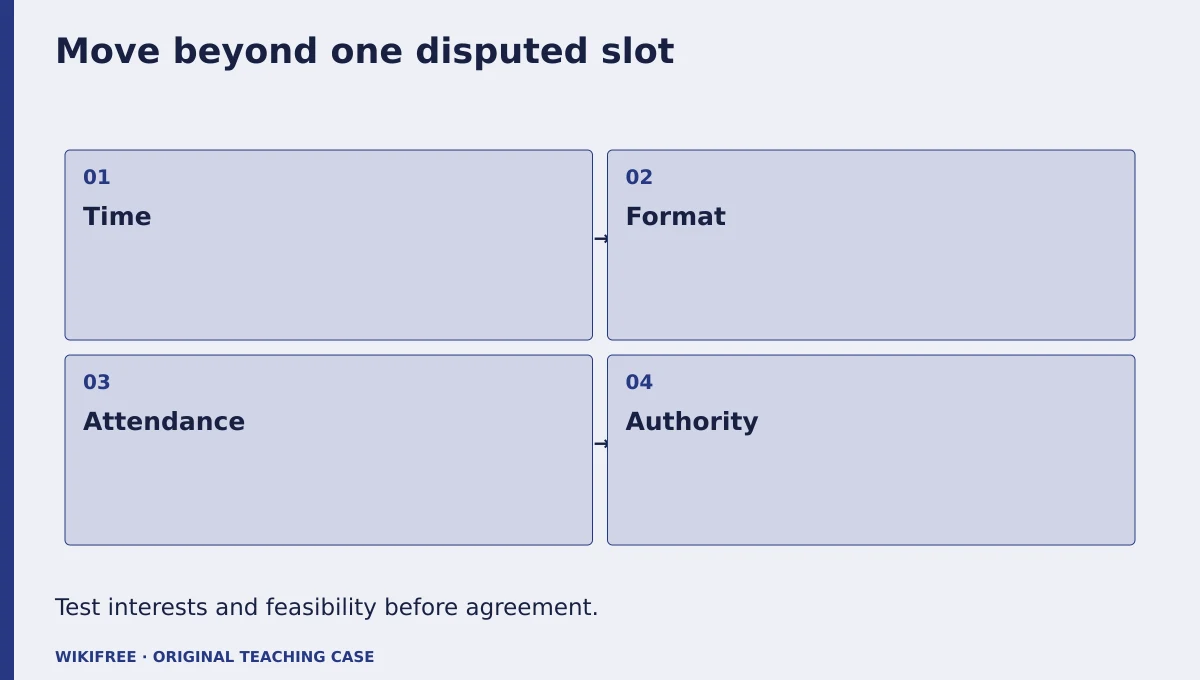
The table and explanations preserve the essential case information when the diagram is unavailable.
Your route
Five outputs, then a final handoff
- 01Prepare interests and boundariesTwo-sided preparation brief
About 1h 8m including assigned learning and practice. - 02Open with listeningListening and clarification transcript
About 1h 21m including assigned learning and practice. - 03Generate conditional optionsConditional option matrix
About 1h 26m including assigned learning and practice. - 04Handle deadlock constructivelyDeadlock and escalation plan
About 1h 2m including assigned learning and practice. - 05Record and follow throughAgreement record and review date
About 1h 9m including assigned learning and practice. - FINALCapstone reviewCombine the evidence into one inspectable handoff.
About 2h .
0 of 6 outputs checked. JavaScript adds browser-only progress saving.
The complete lesson and all downloads remain available. Use the printable project workbook to track your progress.
Use the minimum useful source material
The courses behind this route
Management Courses
Workplace Negotiation: Free Course
The published negotiation course contains preparation, listening, bargaining, deadlock, closure and follow-up lessons.
Selected material only; this path does not claim completion of the entire provider course.
Course publication and selected public lesson metadata were checked on 13 October 2026. This is not a claim of full video playback, provider-course completion or permanent availability. Recheck the linked source if a lesson changes.
Learn, make, inspect
The five-stage workshop
Prepare interests and boundaries
Video 13m · reading budget 0m · original practice about 55m.
Preparation identifies your objective, constraints, alternatives and decision authority. Separate the requested slot from the reasons it matters. Ask what can genuinely change and what requires approval. Do not invent a strong alternative merely to sound confident: an unavailable fallback cannot support a responsible decision.
Watch these selected lessons
Do the work
Write each team’s interests, fixed constraints and one question that could reveal flexibility.
Save this output
Two-sided preparation brief
Pass the review gate
The brief states that neither team may cancel the other’s booking.
If you need another attempt
Replace an assumed motive with a question about the operational constraint.
Open with listening
Video 21m · reading budget 0m · original practice about 1h .
Questions and accurate summaries can uncover the problem behind a demand. Use open questions to learn, then specific questions to check facts. A neutral summary does not mean you accept every proposal. It shows that you understood the concern well enough to evaluate options fairly and reduces arguments about what the other person meant.
Watch these selected lessons
Do the work
Write and rehearse an opening with three questions and a summary of each team’s concern.
Save this output
Listening and clarification transcript
Pass the review gate
Both teams’ interests are represented without assigning blame or hidden motives.
If you need another attempt
Ask the other role to correct your summary before moving to a solution.
Generate conditional options
Video 16m · reading budget 0m · original practice about 1h 10m.
An option can trade across time, format, attendance or resources. Link any concession to the condition that makes it workable, and test it against both sides’ important needs. The supplied table contains incomplete information, so a proposal may require a further check. Avoid declaring a win-win before the people affected confirm feasibility.
Watch these selected lessons
- Bargaining Stage of the Negotiation Process11:25
- Scope for Agreement – Key Concepts in Negotiation4:32
Do the work
Create three options, including a split session or remote component, and list the assumption each requires.
Save this output
Conditional option matrix
Pass the review gate
Every option includes a feasibility question and does not assume unauthorized cancellation.
If you need another attempt
Separate a proposed option from an agreement the other team has actually accepted.
Handle deadlock constructively
Video 6m · reading budget 0m · original practice about 55m.
Deadlock may reflect missing information, a narrow option set or incompatible constraints. Pause to identify which. A proportionate next step can be a short evidence check or a decision from the authorized room owner. Keep the process respectful and avoid coercive deadlines that you lack authority to enforce.
Watch these selected lessons
Do the work
Write a deadlock response that requests one missing fact and defines a bounded escalation to the room owner.
Save this output
Deadlock and escalation plan
Pass the review gate
The plan names the decision needed and keeps both teams informed.
If you need another attempt
Do not treat escalating a resource decision as punishment for disagreement.
Record and follow through
Video 9m · reading budget 0m · original practice about 1h .
An agreement needs the decision, responsibilities, timing and a method for handling a changed condition. Summarize it in plain language and ask both sides to confirm the same understanding. A friendly conversation alone can leave operational ambiguity. Keep proposed terms marked as draft until the parties with authority accept them.
Watch these selected lessons
- Closing Stage of the Negotiation Process5:53
- Negotiation Follow-up – after the Negotiating Process2:41
Do the work
Draft a confirmation note and a follow-up check for a chosen fictional arrangement.
Save this output
Agreement record and review date
Pass the review gate
The note separates accepted terms from pending checks and assigns each action.
If you need another attempt
Replace we will sort it out with an owner, date and fallback condition.
Make the result inspectable
Your final project
Deliver both preparation briefs, the listening transcript, option matrix, deadlock plan and draft agreement. Run a role-play where the remote option becomes unavailable and revise the recommendation.
The ZIP includes synthetic input data, a project workbook, worked reference, evidence log, scoring rubric and case-specific materials. Code projects include source and clearly stated local execution requirements.
Use one consistent rubric
| Criterion | Maximum | Evidence |
|---|---|---|
| Evidence and correctness | 30 | Calculations, source use and results match the supplied case; limitations are honest. |
| Required artifacts | 30 | All five stage outputs and the capstone handoff are present and inspectable. |
| Reasoning and decisions | 20 | Choices, assumptions, alternatives and the case-specific critical condition are explained. |
| Reproducibility | 10 | A reviewer can follow the stated steps and distinguish expected from observed results. |
| Clear communication | 10 | Labels, units, structure and evidence references make the work easy to review. |
Score at least 80/100, supply every required artifact, and satisfy the path-specific critical condition. Rework missing evidence before marking complete.
The critical condition
No invented authority, acceptance or threat is used to force a fictional agreement.
Compare with a worked reference
The visible conflict is Tuesday morning, but the underlying interests are trainer access and staff attendance. A hybrid or split option may help only if the trainer, room owner and participants confirm it. The matrix should preserve that uncertainty rather than announcing an agreement on their behalf.
Know the boundary
This is ordinary workplace negotiation practice; formal grievances, harassment or legal disputes need the appropriate organizational process.
Questions before you finish
Do I need to finish every source course?
No. This path names selected lessons or reading sections. Complete the full provider course only if it supports your wider goal. The path does not claim equivalence to that course.
How do I know when to advance?
Use the output and review gate in each stage. If evidence is missing or a result conflicts with the case, follow the repair step and retry before advancing.
Can I do the project without paid software?
The selected public provider lessons are free to view. The original case can be completed with paper, a text editor or freely available local tools. Paid exams, certificates, subscriptions and optional provider software are not required for this project.
What does my checklist prove?
It records your own review in this browser only. It does not verify viewing, skill, a provider credential or a real-world deployment.
What if a lesson or tool changes?
Use the linked course and provider page to inspect current availability. Record the change and revisit the relevant assignment; do not invent a replacement lesson or claim an unavailable activity was completed.
Questions & discussion
Share a useful question or correction. Comments appear after moderation. Please avoid personal or sensitive information.