Path 52 · The tender table · Beginner
Make the choice traceable to the need.
A guided, practical route through procurement and supplier evaluation.
What you will be able to do
Write a bounded statement of work and compare three fictional suppliers with a weighted matrix, a sensitivity check and an acceptance plan.
Plan about 7h 53m in total. Reading and practice are editorial estimates; video runtimes come from public provider metadata. Your pace will vary.
Before you begin
Check your starting point
What you need
Comfort with percentages and a spreadsheet or calculator. No real procurement, payment or legal drafting is required.
The selected public provider lessons are free to view. The original case can be completed with paper, a text editor or freely available local tools. Paid exams, certificates, subscriptions and optional provider software are not required for this project.
Completing this WikiFree path does not award a provider certificate. Any provider assessment, account requirement or credential must be checked separately on its official page.
Three readiness questions
Should weights change secretly after seeing a preferred vendor?
No. Any revision needs a reason and a new recorded comparison.
Is a high score evidence by itself?
No. A score needs a defined scale and supporting observation.
What comes before scoring?
Requirements and mandatory eligibility checks.
Use a workable pace
At 5 hours per week, allow about 2 weeks. Start with Stage 1, continue in order and reserve 2h for the capstone. If a gate fails, use its repair step before advancing. At another weekly budget, divide 473 estimated minutes by your available weekly minutes and round up.
Keep a small evidence folder. A checked box means you reviewed your output; it is not a certificate or proof that a provider lesson was watched.
The working case
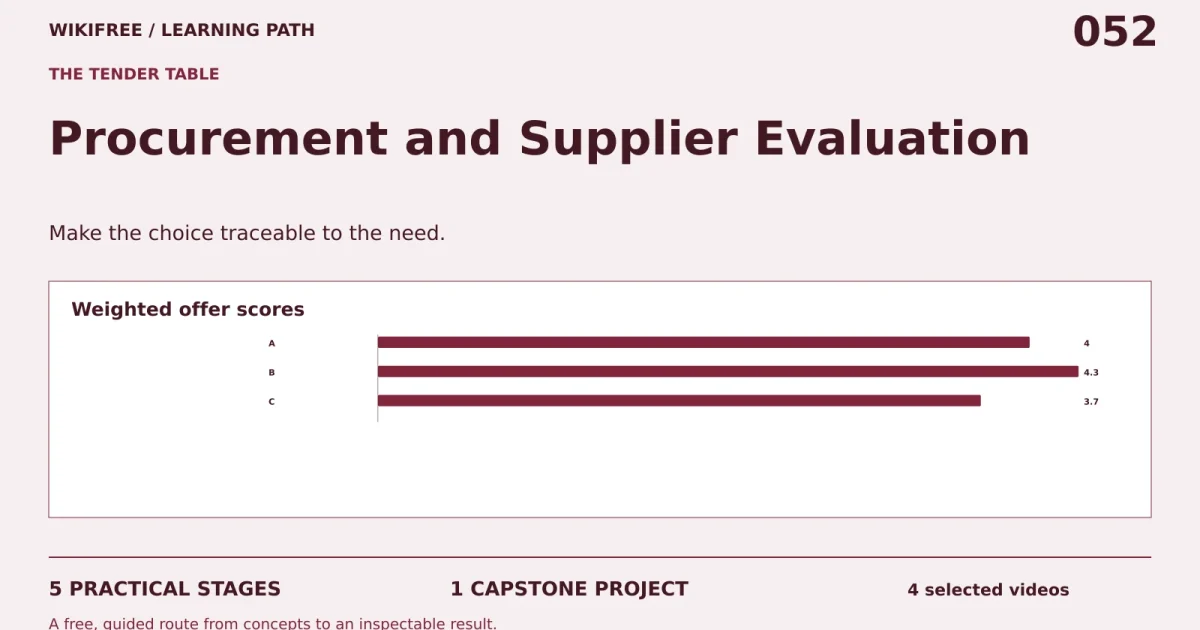
Weighted offer scores
Juniper Learning Club needs 80 printed workbooks by a fixed event date. Three fictional suppliers meet the minimum deadline. The club agrees weights before reviewing scores: quality 50%, delivery 30% and cost 20%. Scores are supplied teaching judgments on a 1–5 scale, not verified vendor performance.
| Supplier | Quality score | Delivery score | Cost score |
|---|---|---|---|
| A | 5 | 3 | 3 |
| B | 4 | 5 | 4 |
| C | 3 | 4 | 5 |
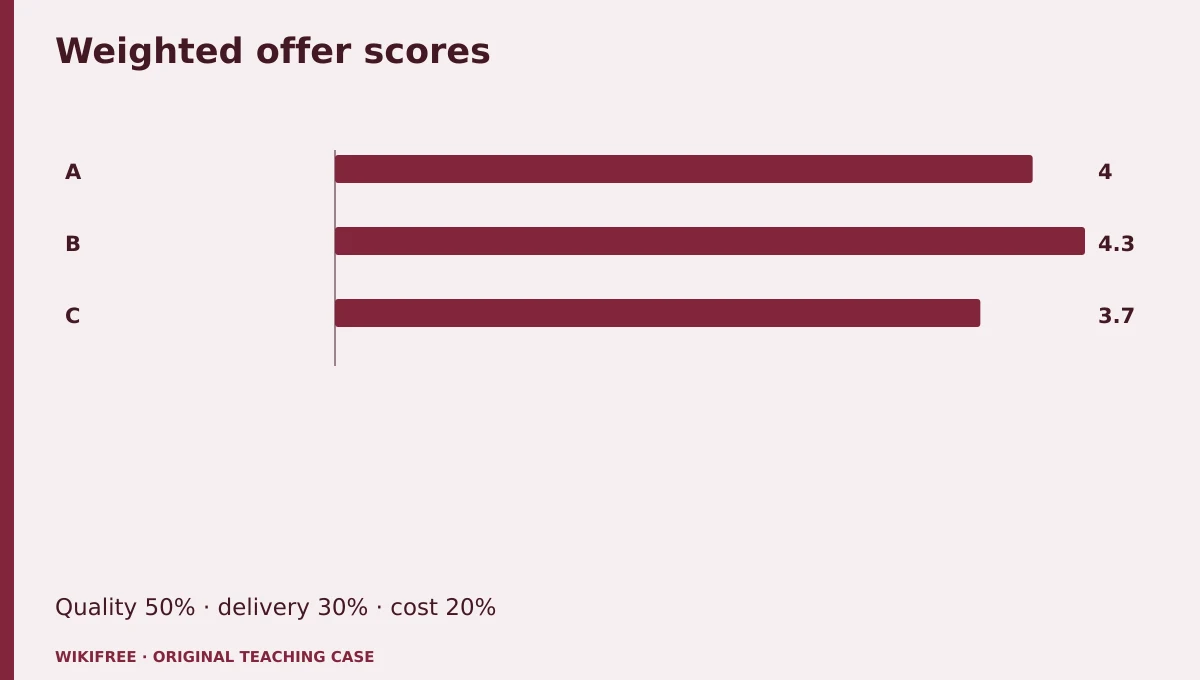
The table and explanations preserve the essential case information when the diagram is unavailable.
Your route
Five outputs, then a final handoff
- 01Specify the resultOne-page statement of work
About 1h 3m including assigned learning and practice. - 02Create a fair comparisonEvaluation rules
About 1h 12m including assigned learning and practice. - 03Calculate and challenge the rankingWeighted matrix and sensitivity note
About 1h 32m including assigned learning and practice. - 04Plan supplier follow-throughSupplier follow-through plan
About 1h 2m including assigned learning and practice. - 05Write the recommendationProcurement recommendation
About 1h 5m including assigned learning and practice. - FINALCapstone reviewCombine the evidence into one inspectable handoff.
About 2h .
0 of 6 outputs checked. JavaScript adds browser-only progress saving.
The complete lesson and all downloads remain available. Use the printable project workbook to track your progress.
Use the minimum useful source material
The courses behind this route
OnlinePMCourses
Project Procurement: Free Course
Existing procurement lessons cover statements of work, tender documents, comparison and vendor management.
Selected material only; this path does not claim completion of the entire provider course.
Course publication and selected public lesson metadata were checked on 13 October 2026. This is not a claim of full video playback, provider-course completion or permanent availability. Recheck the linked source if a lesson changes.
Learn, make, inspect
The five-stage workshop
Specify the result
Video 7m · reading budget 0m · original practice about 55m.
A statement of work describes what the buyer needs and how completion will be accepted. Define quantity, format, delivery date and evidence rather than prescribing every supplier method. Keep mandatory requirements distinct from preferences. In this exercise the written brief is a learning artifact, not an executed contract or a substitute for procurement review.
Watch these selected lessons
Do the work
Draft the 80-workbook brief, including print specification, a sample approval and delivery acceptance.
Save this output
One-page statement of work
Pass the review gate
A supplier could identify the quantity, deadline and three acceptance checks without guessing.
If you need another attempt
Convert an adjective such as premium into a visible paper, legibility or binding requirement.
Create a fair comparison
Video 11m · reading budget 0m · original practice about 1h .
A comparison is meaningful only when suppliers answer the same questions. Set a scoring scale and decide how unknown evidence is handled before evaluating offers. A mandatory failure must not be averaged away by a cheap price. Use a separate eligibility gate, then apply weighted preferences only to eligible proposals.
Watch these selected lessons
Do the work
Build a response form, eligibility checklist and 1–5 scoring definitions. Mark all supplied suppliers eligible for the practice case.
Save this output
Evaluation rules
Pass the review gate
Rules explain every score and keep mandatory failures outside the weighted calculation.
If you need another attempt
Do not use zero for missing evidence without stating what zero means.
Calculate and challenge the ranking
Video 12m · reading budget 0m · original practice about 1h 20m.
Multiply each criterion score by its weight and sum the products. The total is a structured judgment, not a precise prediction of success. Show how a reasonable weighting change affects the decision. If two offers are close, the discussion should focus on uncertainty and evidence rather than treating a decimal difference as unquestionable truth.
Watch these selected lessons
Do the work
Calculate the three totals with weights 50/30/20. Repeat with 30/20/50 and explain whether the choice changes.
Save this output
Weighted matrix and sensitivity note
Pass the review gate
Baseline scores are 4.0,4.3,3.7; alternative scores are 3.6,4.2,4.2.
If you need another attempt
Check that weights total 100% and that a higher cost score means better value, not a higher price.
Plan supplier follow-through
Video 7m · reading budget 0m · original practice about 55m.
A selection decision is only the beginning of delivery control. Agree an owner, sample checkpoint, escalation route and receipt check. Track issues as observed facts with the next action. A supplier relationship benefits from clear expectations and proportionate follow-up, not a surprise rejection after the entire order has been produced.
Watch these selected lessons
Do the work
Create a sample-review checkpoint and a receiving checklist for quantity, legibility and damage.
Save this output
Supplier follow-through plan
Pass the review gate
Every checkpoint has an owner, date and action if the check fails.
If you need another attempt
Add a recovery route before the final deadline, not only a late-delivery warning.
Write the recommendation
Video 0m · reading budget 0m · original practice about 1h 5m.
A defensible recommendation states the decision, alternatives, assumptions and residual uncertainty. Explain why the preferred offer fits the agreed need and what evidence would change the recommendation. Keep the decision separate from actual commitment: this fictional case does not authorize an order, payment or negotiation with a real supplier.
Original application stage. Use your preceding outputs and the supplied case; there is no additional required provider lesson.
Do the work
Write a 250-word decision memo and explain how you would resolve the alternative-weight tie between B and C.
Save this output
Procurement recommendation
Pass the review gate
The memo names B under baseline weights and treats the alternative tie as unresolved, not a hidden win.
If you need another attempt
Request discriminating evidence rather than inventing a new score to force a result.
Make the result inspectable
Your final project
Submit the brief, response form, eligibility rules, both scored matrices, receiving plan and recommendation. Add a scenario where the cheapest supplier misses the mandatory deadline and demonstrate that it fails eligibility before scoring.
The ZIP includes synthetic input data, a project workbook, worked reference, evidence log, scoring rubric and case-specific materials. Code projects include source and clearly stated local execution requirements.
Use one consistent rubric
| Criterion | Maximum | Evidence |
|---|---|---|
| Evidence and correctness | 30 | Calculations, source use and results match the supplied case; limitations are honest. |
| Required artifacts | 30 | All five stage outputs and the capstone handoff are present and inspectable. |
| Reasoning and decisions | 20 | Choices, assumptions, alternatives and the case-specific critical condition are explained. |
| Reproducibility | 10 | A reviewer can follow the stated steps and distinguish expected from observed results. |
| Clear communication | 10 | Labels, units, structure and evidence references make the work easy to review. |
Score at least 80/100, supply every required artifact, and satisfy the path-specific critical condition. Rework missing evidence before marking complete.
The critical condition
Mandatory requirements cannot be traded away through a weighted total, and no real purchase is implied.
Compare with a worked reference
A scores 5×0.5+3×0.3+3×0.2=4.0. B scores 4.3 and C 3.7, so B leads under the agreed baseline. With cost weighted 50%, B and C tie at 4.2. The tie is a reason to inspect evidence and preferences, not proof that cost alone determines the right supplier.
Know the boundary
This develops evaluation judgment and documentation, not legal contract advice or permission to commit organizational funds.
Questions before you finish
Do I need to finish every source course?
No. This path names selected lessons or reading sections. Complete the full provider course only if it supports your wider goal. The path does not claim equivalence to that course.
How do I know when to advance?
Use the output and review gate in each stage. If evidence is missing or a result conflicts with the case, follow the repair step and retry before advancing.
Can I do the project without paid software?
The selected public provider lessons are free to view. The original case can be completed with paper, a text editor or freely available local tools. Paid exams, certificates, subscriptions and optional provider software are not required for this project.
What does my checklist prove?
It records your own review in this browser only. It does not verify viewing, skill, a provider credential or a real-world deployment.
What if a lesson or tool changes?
Use the linked course and provider page to inspect current availability. Record the change and revisit the relevant assignment; do not invent a replacement lesson or claim an unavailable activity was completed.
Questions & discussion
Share a useful question or correction. Comments appear after moderation. Please avoid personal or sensitive information.