Path 51 · The boundary desk · Beginner
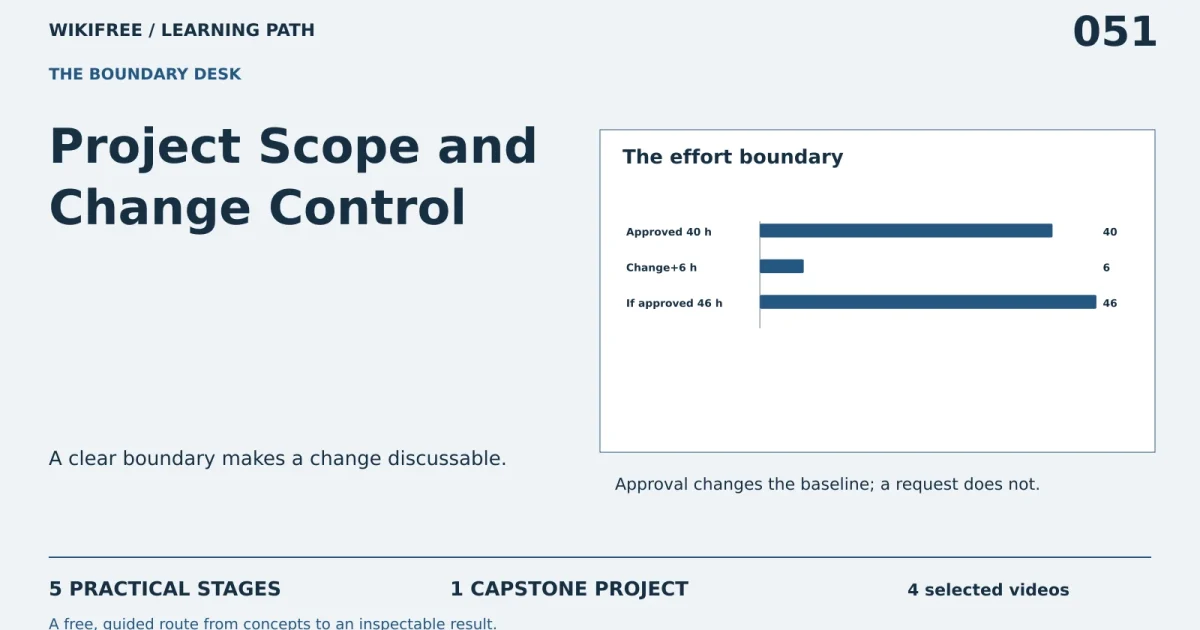
A clear boundary makes a change discussable.
A guided, practical route through project scope and change control.
What you will be able to do
Build a scope baseline, work breakdown and change register, then decide a proposed addition using explicit time, cost and acceptance effects.
Plan about 7h 30m in total. Reading and practice are editorial estimates; video runtimes come from public provider metadata. Your pace will vary.
Before you begin
Check your starting point
What you need
Basic project vocabulary. Use a text editor or spreadsheet; no scheduling subscription is required.
The selected public provider lessons are free to view. The original case can be completed with paper, a text editor or freely available local tools. Paid exams, certificates, subscriptions and optional provider software are not required for this project.
Completing this WikiFree path does not award a provider certificate. Any provider assessment, account requirement or credential must be checked separately on its official page.
Three readiness questions
Does a request automatically change the baseline?
No. It needs the agreed review and authorization.
Is extra work free if no invoice changes?
No. Time, capacity or risk can still change.
What distinguishes an output from an activity?
An output is an inspectable result; an activity describes work.
Use a workable pace
At 5 hours per week, allow about 2 weeks. Start with Stage 1, continue in order and reserve 2h for the capstone. If a gate fails, use its repair step before advancing. At another weekly budget, divide 450 estimated minutes by your available weekly minutes and round up.
Keep a small evidence folder. A checked box means you reviewed your output; it is not a certificate or proof that a provider lesson was watched.
The working case
The effort boundary
The fictional Cedar Library needs an event-registration page. The agreed scope is a form, confirmation message and attendance export, with a 40-hour effort allowance and Friday acceptance. A sponsor later requests a reminder feature estimated at 6 additional hours. The exercise is about making the decision visible, not automatically refusing change.
| Item | Effort hours | Baseline status |
|---|---|---|
| Form | 18 | included |
| Confirmation | 8 | included |
| Export | 10 | included |
| Acceptance checks | 4 | included |
| Reminder request | 6 | proposed |
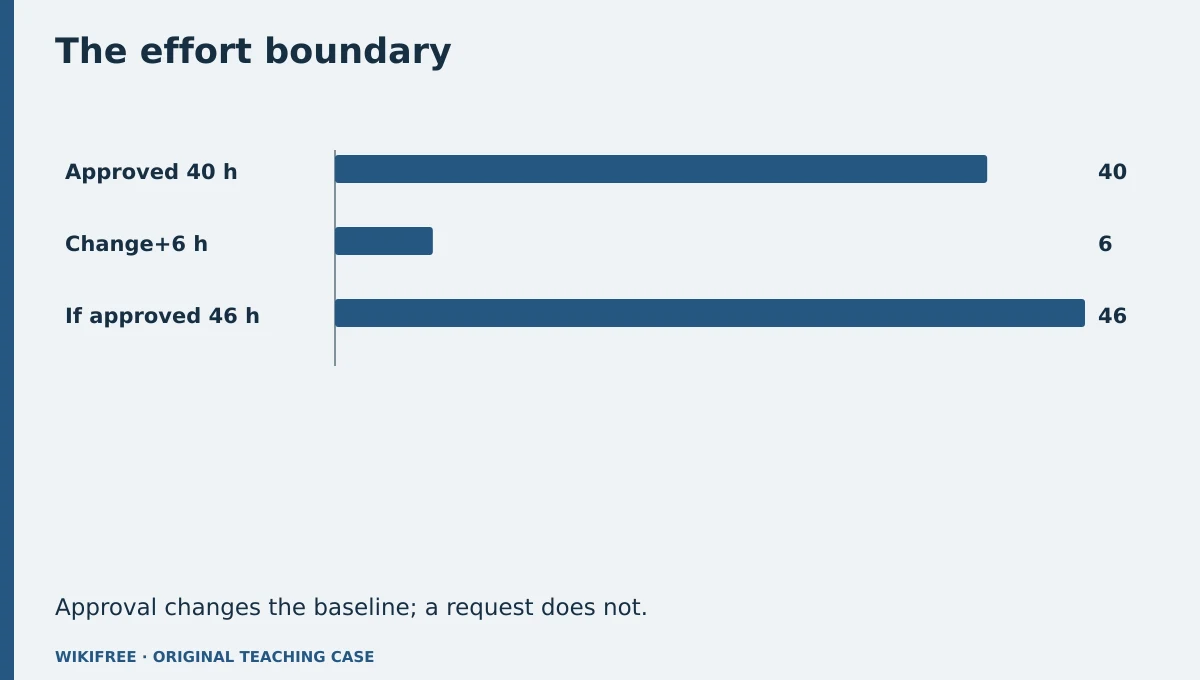
The table and explanations preserve the essential case information when the diagram is unavailable.
Your route
Five outputs, then a final handoff
- 01Define the boundaryScope baseline v 1
About 54m including assigned learning and practice. - 02Decompose deliverablesWork breakdown and 40-hour reconciliation
About 1h 19m including assigned learning and practice. - 03Describe the requested changeChange impact brief
About 1h 12m including assigned learning and practice. - 04Make and log a decisionDecision log and baseline v 2 or unchanged v 1
About 1h 6m including assigned learning and practice. - 05Rehearse another changeTwo-request control demonstration
About 1h including assigned learning and practice. - FINALCapstone reviewCombine the evidence into one inspectable handoff.
About 2h .
0 of 6 outputs checked. JavaScript adds browser-only progress saving.
The complete lesson and all downloads remain available. Use the printable project workbook to track your progress.
Use the minimum useful source material
The courses behind this route
OnlinePMCourses
Project Scope Management: Free Course
The published scope lessons explain boundaries, work breakdown and change-control decisions; the registration-page case supplies original practice.
Selected material only; this path does not claim completion of the entire provider course.
Course publication and selected public lesson metadata were checked on 13 October 2026. This is not a claim of full video playback, provider-course completion or permanent availability. Recheck the linked source if a lesson changes.
Learn, make, inspect
The five-stage workshop
Define the boundary
Video 4m · reading budget 0m · original practice about 50m.
A scope statement needs an intended result, included deliverables, exclusions and acceptance conditions. An exclusion is not a refusal to discuss future work; it prevents an assumption from becoming an invisible obligation. Record who may accept the result. A deadline alone says nothing about what must work on that date.
Watch these selected lessons
Do the work
Write a one-page baseline for the registration page. State three included outputs, two exclusions and who accepts each output.
Save this output
Scope baseline v 1
Pass the review gate
The reminder is clearly proposed, and every included output has an observable acceptance condition.
If you need another attempt
Replace vague words such as complete with a behavior a reviewer can check.
Decompose deliverables
Video 14m · reading budget 0m · original practice about 1h 5m.
A work breakdown connects the promised result to manageable outputs. Keep a consistent level of detail and check that the parts cover the whole scope without double counting. The supplied effort values are planning assumptions, not measured productivity. Track acceptance work explicitly so it does not disappear inside an optimistic delivery estimate.
Watch these selected lessons
Do the work
Create a two-level work breakdown and reconcile the included hours. Add an owner and evidence of completion to every leaf.
Save this output
Work breakdown and 40-hour reconciliation
Pass the review gate
Included effort totals 40 hours and the reminder is outside the approved total.
If you need another attempt
Separate the deliverable structure from a chronological task list before reconciling totals.
Describe the requested change
Video 11m · reading budget 0m · original practice about 1h .
A useful change request names the reason, proposed result, affected baseline and consequences of both doing and deferring it. Do not reduce the conversation to an extra-hour number: a reminder also raises content, timing and error-handling questions. Keep estimates separate from commitments and identify unanswered dependencies before recommending a decision.
Watch these selected lessons
Do the work
Prepare change CR-01 with 6 extra hours, acceptance questions, schedule implications and a defer option.
Save this output
Change impact brief
Pass the review gate
The brief compares approve, defer and reduce another agreed output; none is presented as already authorized.
If you need another attempt
Add the consequences of doing nothing and the owner of any missing estimate.
Make and log a decision
Video 11m · reading budget 0m · original practice about 55m.
A change log records a decision trail rather than a list of wishes. Record request date, decision owner, status, rationale and affected version. A pending request should not quietly appear in the delivery promise. If the sponsor approves a revised baseline, communicate the revision to the people who plan and accept the work.
Watch these selected lessons
Do the work
Role-play the sponsor decision. Record either approval with a 46-hour baseline or deferral with the 40-hour baseline, including rationale.
Save this output
Decision log and baseline v 2 or unchanged v 1
Pass the review gate
The log, work breakdown and stated effort all reflect the same decision.
If you need another attempt
Find contradictory versions and label the superseded one instead of erasing its history.
Rehearse another change
Video 0m · reading budget 0m · original practice about 1h .
A repeatable process must also handle an urgent or poorly specified request. Use the same evidence requirements when someone says could you just. Urgency can alter review speed, but it does not supply missing acceptance criteria or authority. A short clarification can protect both the requester and the delivery team.
Original application stage. Use your preceding outputs and the supplied case; there is no additional required provider lesson.
Do the work
Add a second request for an unspecified dashboard. Return it for clarification and list three questions that would permit an impact assessment.
Save this output
Two-request control demonstration
Pass the review gate
No unestimated dashboard work is included in the approved total.
If you need another attempt
Replace a guessed estimate with an explicit information request and review date.
Make the result inspectable
Your final project
Deliver the baseline, work breakdown, CR-01 impact brief, decision log and second-request response. Ask a reviewer to reconstruct which version is approved without verbal explanation. Then show the alternative decision and its effect on the documents.
The ZIP includes synthetic input data, a project workbook, worked reference, evidence log, scoring rubric and case-specific materials. Code projects include source and clearly stated local execution requirements.
Use one consistent rubric
| Criterion | Maximum | Evidence |
|---|---|---|
| Evidence and correctness | 30 | Calculations, source use and results match the supplied case; limitations are honest. |
| Required artifacts | 30 | All five stage outputs and the capstone handoff are present and inspectable. |
| Reasoning and decisions | 20 | Choices, assumptions, alternatives and the case-specific critical condition are explained. |
| Reproducibility | 10 | A reviewer can follow the stated steps and distinguish expected from observed results. |
| Clear communication | 10 | Labels, units, structure and evidence references make the work easy to review. |
Score at least 80/100, supply every required artifact, and satisfy the path-specific critical condition. Rework missing evidence before marking complete.
The critical condition
No proposed change is represented as approved and every displayed total matches the selected baseline.
Compare with a worked reference
The original included effort is 18+8+10+4=40 hours. Accepting the reminder without removing work changes effort to 46 hours, a 15% increase. These numbers do not establish a new finish date: the team must inspect available capacity and dependencies before committing to one.
Know the boundary
This is a small scope-control exercise, not a contractual change procedure or certification course.
Questions before you finish
Do I need to finish every source course?
No. This path names selected lessons or reading sections. Complete the full provider course only if it supports your wider goal. The path does not claim equivalence to that course.
How do I know when to advance?
Use the output and review gate in each stage. If evidence is missing or a result conflicts with the case, follow the repair step and retry before advancing.
Can I do the project without paid software?
The selected public provider lessons are free to view. The original case can be completed with paper, a text editor or freely available local tools. Paid exams, certificates, subscriptions and optional provider software are not required for this project.
What does my checklist prove?
It records your own review in this browser only. It does not verify viewing, skill, a provider credential or a real-world deployment.
What if a lesson or tool changes?
Use the linked course and provider page to inspect current availability. Record the change and revisit the relevant assignment; do not invent a replacement lesson or claim an unavailable activity was completed.
Questions & discussion
Share a useful question or correction. Comments appear after moderation. Please avoid personal or sensitive information.