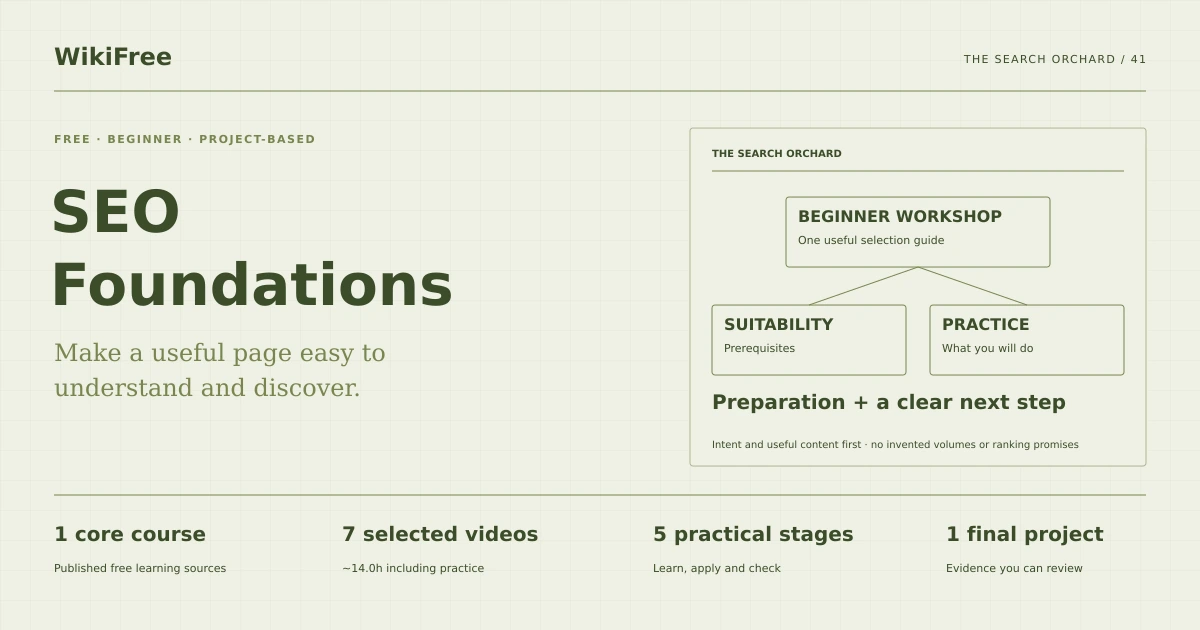
WikiFree learning path 41 · Beginner
The search orchard
Make a useful page easy to understand and discover.
Prepare an evidence-based SEO brief for one helpful article, including intent, structure, metadata, internal links and a measurement plan.
Video duration uses the selected lessons only. Reading and practice times are planning estimates; repeat difficult work as needed.
A clear starting point
Who this is for
Basic writing and browser skills. No paid keyword tool or existing Search Console property.
Your practical result
Prepare an evidence-based SEO brief for one helpful article, including intent, structure, metadata, internal links and a measurement plan.
This is a one-page SEO content project, not technical SEO mastery or a promise of traffic. Older provider interface demonstrations should be checked against current official guidance.
Access and cost
Assigned public videos can be watched free. Complete the original case in a text editor, on paper or in a spreadsheet you already have. No paid course, exam or provider certificate is included.
The project pack contains an original workbook, case inputs, an evidence log and reference notes. Some technical paths include starter code and a runnable reference. Read the pack README before starting.
Three-minute readiness check
Answer first, then open each explanation. A missed answer identifies what to revisit; it does not stop you from starting.
Can a metadata change guarantee a ranking?
No.
Should keyword volume be invented when a tool is unavailable?
No. Label qualitative research as qualitative.
Who is the page for?
A reader choosing a suitable beginner workshop.
The case you will work on
The fictional Linden Repair Club wants a page explaining how to choose a beginner bicycle-maintenance workshop. The page must answer a real planning question, disclose its own course offering and avoid fabricated rankings or search-volume claims.
| Reader question | Content need |
|---|---|
| Is this suitable for beginners? | Prerequisites and level |
| What will I practice? | Concrete tasks and outcomes |
| What must I bring? | Tools and preparation |
| How do I choose a date? | Clear next step and current schedule link |
These are supplied synthetic inputs, not observations from a real organization. Label assumptions and any additional data you create.
Keep an evidence trail
Save each stage output in the project folder. In evidence_log.csv, record the decision, the artifact or test that supports it, what failed, and the revision you made.
Your route from learning to evidence
- Stage 1Match the reader intentAn intent and usefulness brief.60 minutes of original practice
- Stage 2Build a modest query mapA transparent query-to-question map.75 minutes of original practice
- Stage 3Draft the page and metadataAn article draft and metadata set.100 minutes of original practice
- Stage 4Plan links and technical checksAn internal-link plan and technical checklist.65 minutes of original practice
- Stage 5Measure the result responsiblyA measurement plan and review template.70 minutes of original practice
- Final projectMake the evidence reviewableConnect the five stage outputs and test a change.240 minutes estimated
Progress stays in this browser. Tick a stage only after its evidence check passes. This is a personal checklist, not a certificate.
Why these source courses
The path uses selected material from courses already published on WikiFree. The original exercises below connect that material to one practical outcome. Follow only the listed assignments; completing the full source courses is optional.
Simplilearn
Free Simplilearn Course: SEO, Keyword Research and Search Optimization
Selected existing SEO lessons cover intent, keywords, on-page work and Search Console concepts. The original repair-club brief and current Google guidance constrain the exercise.
Access: Free Video
Certificate: Free video viewing; Simplilearn certificate not included
Learn it, apply it, check it
Work in order. Every stage produces something the next stage uses. Revisit the repair instruction when a check fails.
Match the reader intent
Basic writing and browser skills. No paid keyword tool or existing Search Console property.
The idea to use
Start with the task behind a query. A person choosing a beginner workshop needs suitability, activities, preparation and a next step. Write a content promise that the page can fulfill. Search visibility is useful only if the page actually helps that person; repeating a phrase does not substitute for an answer or credible evidence.
Watch the selected lessons
Selected video time: 49m. Open this course on WikiFree.
Your 60-minute lab
Write the target reader, primary question and a one-sentence page promise. List four questions the article must answer.
Save: An intent and usefulness brief..
Evidence check
The promise matches the beginner selection task and makes no unsupported best-in-market claim.
If it fails: Replace a generic keyword list with the specific decision the reader needs to make.
Build a modest query map
Bring your previous output: An intent and usefulness brief.
The idea to use
Group related phrases by meaning rather than creating a thin page for every wording variation. Without paid tools, use the supplied reader questions and public search observations you actually make. Record source and date for any observed suggestion; do not label a guess as measured demand. One coherent article can address several closely related beginner questions.
Watch the selected lessons
- 2. Keyword Research Tutorial — Keyword Research For SEO 2026 — SEO Tutorial For Beginners44:47
- 10. SEO Keyword Research — SEO Tutorial For Beginners21:15
Selected video time: 1h 06m. Open this course on WikiFree.
Your 75-minute lab
Create a primary topic and four supporting query groups. Mark each as a hypothesis or a dated observation.
Save: A transparent query-to-question map..
Evidence check
No search-volume number or competitor result is invented.
If it fails: If phrases have different intent, explain why they belong on separate pages instead of forcing them together.
Draft the page and metadata
Bring your previous output: A transparent query-to-question map.
The idea to use
Give the page a descriptive title, a clear main heading and sections that answer the mapped questions. Write an honest summary for the meta description and use descriptive link text. Search systems may choose a different snippet, so metadata is an editorial signal rather than a guaranteed display. Keep the draft readable before checking keyword coverage.
Watch the selected lessons
- 3. SEO On-Page Optimization Tutorial — On Page SEO Tutorial — SEO Tutorial For Beginners18:05
- 4. On-Page SEO Tutorial — On-Page Optimization Step By Step — SEO Tutorial For Beginners24:22
Selected video time: 42m. Open this course on WikiFree.
Your 100-minute lab
Draft 600–800 original words, a concise title and a meta description. Add a preparation checklist and a clear next step.
Save: An article draft and metadata set..
Evidence check
Every promised question has a useful answer and the title accurately describes the content.
If it fails: Remove repetitive phrases added only to reach a keyword count.
Plan links and technical checks
Bring your previous output: An article draft and metadata set.
The idea to use
Internal links should help the reader move between related tasks and establish discoverable paths. A page also needs a working URL, an appropriate canonical decision and indexability consistent with its intended use. These checks are distinct from a ranking promise. In a planning exercise, record them as checks to perform after publication rather than claiming they already passed.
Original practice stage. No additional video or reading assignment is required.
Your 65-minute lab
Propose three relevant internal links and a publication checklist for status, canonical, mobile readability and indexability.
Save: An internal-link plan and technical checklist..
Evidence check
Each link has a reader purpose, and unperformed live checks remain pending.
If it fails: Do not mark indexing complete because a draft contains a canonical tag.
Measure the result responsibly
Bring your previous output: An internal-link plan and technical checklist.
The idea to use
A measurement plan should define the page, time period and signals before interpreting changes. Search impressions, clicks and useful on-page actions answer different questions. If you lack property access, create a plan and a blank review template; do not fabricate Search Console data. Compare like periods and record other changes that could explain a difference.
Watch the selected lessons
- 21. Google Search Console Tutorial — How To Use Google Search Console? — Search Console31:42
- 22. What Is Google Search Console ? — Google Search Console Tutorial For Beginners40:21
Selected video time: 1h 12m. Open this course on WikiFree.
Your 70-minute lab
Write a four-week review plan and a metric glossary. Include a check for whether visitors reach the workshop-selection next step.
Save: A measurement plan and review template..
Evidence check
The plan separates visibility, visits and useful actions and contains no invented performance results.
If it fails: Avoid attributing every later change to SEO without considering seasonality or concurrent edits.
A worked reference to compare
A useful title might be Beginner Bicycle Workshop: What to Expect and Bring. The draft answers level, practical activities and preparation, then links to the real schedule. Its success plan measures discovery and the next useful action without guaranteeing rankings.
Compare your reasoning as well as the result. If your answer differs, state the assumption or input that explains the difference. Reference notes are for checking after an attempt; copying them is not evidence of independent work.
Your final project
Your brief
Deliver the intent brief, query map, original article, metadata, link plan and measurement template. Review the draft against every promised reader question and record unresolved factual checks.
Time box: 4h 00m estimated. Extend it if a gate needs repair.
Hand in these artifacts
- An intent and usefulness brief.
- A transparent query-to-question map.
- An article draft and metadata set.
- An internal-link plan and technical checklist.
- A measurement plan and review template.
- A short README: outcome, how to inspect or run the work, assumptions and limitations.
- A before-and-after change test and the completed evidence log.
Run a final review
- Use the supplied reference to reconcile the baseline result.
- Choose one relevant input or constraint to change. Write your expected effect before testing it.
- Run the calculation, walkthrough or test again and save the actual result.
- Ask a peer to inspect the evidence, or perform a separate self-review. Label which review you used.
- Score the work using the rubric and repair every critical failure.
Review rubric · 100 points
| Criterion | Points | Evidence to inspect |
|---|---|---|
| Practical outcome and case reasoning | 25 | Prepare an evidence-based SEO brief for one helpful article, including intent, structure, metadata, internal links and a measurement plan. |
| Five stage checks | 30 | Award 6 points for each stage only when its stated gate is demonstrably met. |
| Traceable evidence | 20 | Artifacts, inputs and calculations or tests are reproducible; synthetic and simulated evidence is labelled. |
| Revision after a changed condition | 15 | Change one input or constraint, predict the effect, test it and record the result. |
| Handoff quality | 10 | A reviewer can find the files, follow the instructions and understand the remaining limitations. |
Completion target: at least 80/100, all five stage gates passed, and every critical issue below corrected. This is a learning benchmark, not an accredited qualification.
Critical issue: The article is useful and original, with no fabricated search data, testimonials or ranking guarantees.
Before you go further
What will I be able to produce?
Prepare an evidence-based SEO brief for one helpful article, including intent, structure, metadata, internal links and a measurement plan.
Is the whole path free?
Assigned public videos can be watched free. Complete the original case in a text editor, on paper or in a spreadsheet you already have. No paid course, exam or provider certificate is included.
Do I need to finish every source course?
No. Follow the selected assignments at each stage. Source courses provide context, while the original case, labs and final review build the practical result. Extra study is optional.
What counts as completion?
Complete all five stage checks, earn at least 80/100 on the final rubric and correct every critical issue. This is a one-page SEO content project, not technical SEO mastery or a promise of traffic. Older provider interface demonstrations should be checked against current official guidance.
Questions & discussion
Share a useful question or correction. Comments appear after moderation. Please avoid personal or sensitive information.