WikiFree learning path 37 · Beginner
The test matrix
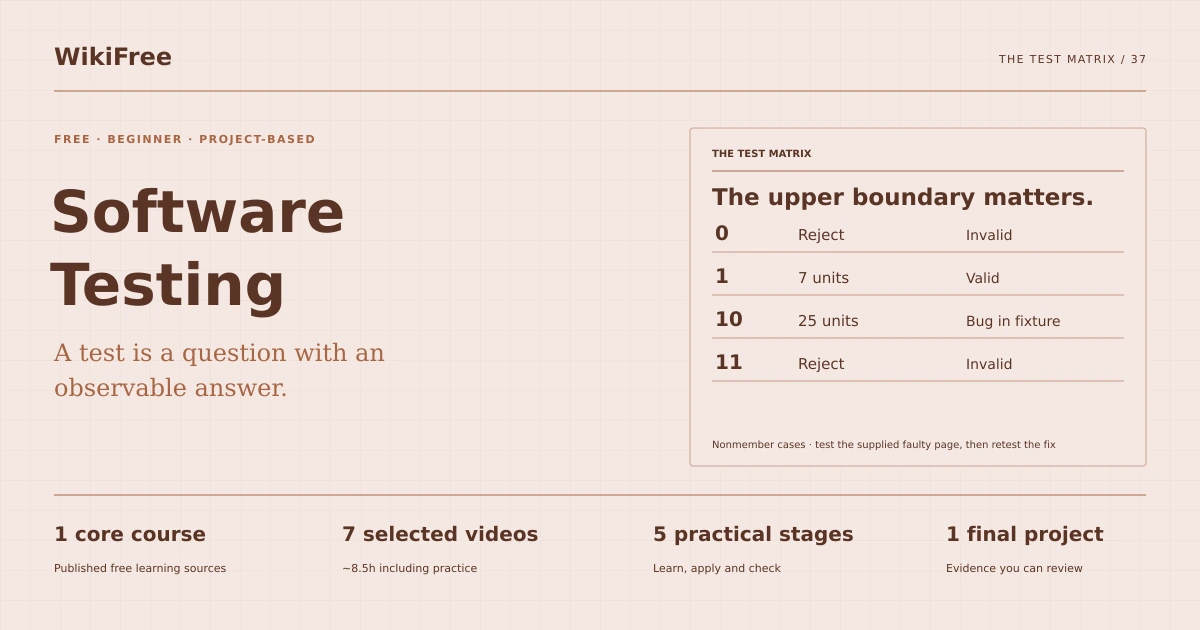
A test is a question with an observable answer.
Design and execute a small manual test suite, report a reproducible defect and verify a fix against a shipping-price specification.
Video duration uses the selected lessons only. Reading and practice times are planning estimates; repeat difficult work as needed.
A clear starting point
Who this is for
Basic browser use and arithmetic. Coding is optional; the supplied practice page can be opened locally.
Your practical result
Design and execute a small manual test suite, report a reproducible defect and verify a fix against a shipping-price specification.
The short provider videos introduce terminology; this path is not complete ISTQB preparation, certification or exhaustive application testing.
Access and cost
Assigned public videos can be watched free. Complete the original case in a text editor, on paper or in a spreadsheet you already have. No paid course, exam or provider certificate is included.
The project pack contains an original workbook, case inputs, an evidence log and reference notes. Some technical paths include starter code and a runnable reference. Read the pack README before starting.
Three-minute readiness check
Answer first, then open each explanation. A missed answer identifies what to revisit; it does not stop you from starting.
Is a test case just a click sequence?
It also needs a condition and an expected observable result.
Does one passing example prove correctness?
No.
Is severity the same as fix priority?
No. Impact and scheduling are related but distinct.
The case you will work on
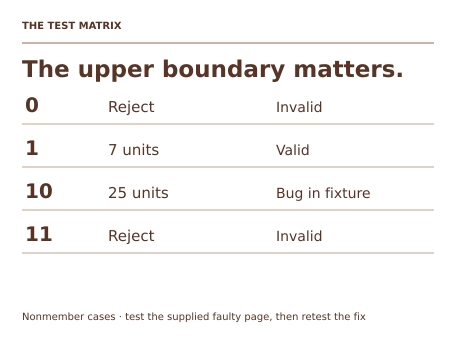
The fictional Ash Delivery calculator accepts an integer quantity from 1 through 10. Shipping costs 5+2×quantity units. Members receive a fixed 3-unit reduction. A deliberately faulty practice version rejects quantity 10, giving learners a real boundary defect to investigate.
| Quantity | Member | Expected shipping |
|---|---|---|
| 1 | No | 7 |
| 1 | Yes | 4 |
| 10 | No | 25 |
| 10 | Yes | 22 |
| 0 | No | Invalid |
| 11 | No | Invalid |
These are supplied synthetic inputs, not observations from a real organization. Label assumptions and any additional data you create.
Keep an evidence trail
Save each stage output in the project folder. In evidence_log.csv, record the decision, the artifact or test that supports it, what failed, and the revision you made.
Your route from learning to evidence
- Stage 1Turn the specification into checksA requirement-to-test map.45 minutes of original practice
- Stage 2Select useful partitions and boundariesA compact boundary-focused test suite.65 minutes of original practice
- Stage 3Execute and preserve evidenceAn executed test log with version and environment.70 minutes of original practice
- Stage 4Write a useful defect reportA reproducible boundary-defect report.60 minutes of original practice
- Stage 5Retest the fix and report residual riskA retest log and bounded quality summary.65 minutes of original practice
- Final projectMake the evidence reviewableConnect the five stage outputs and test a change.180 minutes estimated
Progress stays in this browser. Tick a stage only after its evidence check passes. This is a personal checklist, not a certificate.
Why these source courses
The path uses selected material from courses already published on WikiFree. The original exercises below connect that material to one practical outcome. Follow only the listed assignments; completing the full source courses is optional.
Simplilearn
Free Simplilearn Course: Software Testing Foundations and Test Design
The existing short software-testing lessons provide terminology and lifecycle context; the original faulty app, specification and execution work build practical depth.
Access: Free Video
Certificate: Free video viewing; Simplilearn certificate not included
Learn it, apply it, check it
Work in order. Every stage produces something the next stage uses. Revisit the repair instruction when a check fails.
Turn the specification into checks
Basic browser use and arithmetic. Coding is optional; the supplied practice page can be opened locally.
The idea to use
A requirement must be precise enough to judge an outcome. Identify the accepted quantity range, integer rule, price formula and member discount. Separate valid behavior from rejection behavior. The provider videos are short introductions, so the original specification and hands-on exercises carry most of the practice in this path.
Watch the selected lessons
- 1. Introduction To CTFL Training Course — Certified Tester Foundation Level6:11
- 4. Fundamentals of Software Testing — Introduction to ISTQB — What is Testing?3:02
Selected video time: 9m. Open this course on WikiFree.
Your 45-minute lab
Write four testable requirements and a coverage table linking each to at least one planned case.
Save: A requirement-to-test map..
Evidence check
The integer rule, inclusive upper boundary and once-per-order discount are explicit.
If it fails: If expected behavior uses words like reasonable, replace them with a concrete result.
Select useful partitions and boundaries
Bring your previous output: A requirement-to-test map.
The idea to use
Partition inputs into groups expected to behave similarly, then test boundaries where behavior can change. For quantity, include below range, minimum, ordinary valid, maximum and above range. Add decimal, blank and nonnumeric values. Combining every possible input is unnecessary here, but omitting the upper boundary leaves a meaningful risk uncovered.
Watch the selected lessons
Selected video time: 3m. Open this course on WikiFree.
Your 65-minute lab
Create at least ten cases with input, membership, expected outcome and requirement ID.
Save: A compact boundary-focused test suite..
Evidence check
Cases include 0, 1, 10, 11, 1.5, blank and text input, plus both membership states.
If it fails: Do not fill the suite with ten ordinary middle-range values.
Execute and preserve evidence
Bring your previous output: A compact boundary-focused test suite.
The idea to use
Execution records actual behavior, not what should have happened. Record the practice-page version, browser and the input used. Mark a case pass, fail or blocked with a concise reason. Screenshots can support a report, but exact values and steps make it reproducible. Keep unexecuted cases visibly unexecuted.
Watch the selected lessons
- 2. Software Development Models — What is SDLC? — Software Development Life Cycle3:02
- 5. Types Of Testing Tools — How to Use Testing Tools? — CTFL Video Tutorials3:02
Selected video time: 6m. Open this course on WikiFree.
Your 70-minute lab
Run the suite against the intentionally faulty page. Record the quantity-10 result and all other observed outcomes.
Save: An executed test log with version and environment..
Evidence check
The upper-boundary defect is reported as observed, with expected 25 or 22 depending on membership.
If it fails: Never prefill pass statuses from the expected-results column.
Write a useful defect report
Bring your previous output: An executed test log with version and environment.
The idea to use
A defect report should contain a short title, preconditions, minimal steps, expected result, actual result and impact. Separate severity from proposed priority. A static review may reveal an incorrect comparison, but a reproducible runtime example explains why that code matters. Keep the report focused on one problem so the fix can be checked clearly.
Watch the selected lessons
- 3. What is Test Management ? — What is Test Organization? — CTFL Online Certification3:02
- 7. Static And Dynamic Techniques — Static Analysis — CTFL Online Certification Course3:01
Selected video time: 6m. Open this course on WikiFree.
Your 60-minute lab
Write a report for quantity 10, including exact inputs and a suggested regression case.
Save: A reproducible boundary-defect report..
Evidence check
Another learner can reproduce the failure from the report without guessing membership or version.
If it fails: Avoid vague titles such as calculator broken when the failure is a specific inclusive boundary.
Retest the fix and report residual risk
Bring your previous output: A reproducible boundary-defect report.
The idea to use
Retesting checks the original failing case on the corrected version. Regression testing checks nearby behavior that the change might affect. The fixed page should accept 10 while still rejecting 11 and decimals. A completion report states what was tested, the result and what remains outside scope; it does not promise the absence of all defects.
Original practice stage. No additional video or reading assignment is required.
Your 65-minute lab
Run the failing case and nearby boundaries against the reference fix. Write a short release recommendation for the practice app.
Save: A retest log and bounded quality summary..
Evidence check
Quantity 10 succeeds; 11 and decimals remain invalid; the tested version is identified.
If it fails: Do not close the defect after checking only that the edited code looks right.
A worked reference to compare
The faulty comparison excludes 10 even though the specification includes it. Expected shipping for ten nonmember items is 25. A meaningful retest checks that correction and confirms that 11 still fails.
Compare your reasoning as well as the result. If your answer differs, state the assumption or input that explains the difference. Reference notes are for checking after an attempt; copying them is not evidence of independent work.
Your final project
Your brief
Deliver the requirement map, test suite, execution log, defect report and retest summary. Add a new requirement that the discount never changes quantity validation and design two cases to cover it.
Time box: 3h 00m estimated. Extend it if a gate needs repair.
Hand in these artifacts
- A requirement-to-test map.
- A compact boundary-focused test suite.
- An executed test log with version and environment.
- A reproducible boundary-defect report.
- A retest log and bounded quality summary.
- A short README: outcome, how to inspect or run the work, assumptions and limitations.
- A before-and-after change test and the completed evidence log.
Run a final review
- Use the supplied reference to reconcile the baseline result.
- Choose one relevant input or constraint to change. Write your expected effect before testing it.
- Run the calculation, walkthrough or test again and save the actual result.
- Ask a peer to inspect the evidence, or perform a separate self-review. Label which review you used.
- Score the work using the rubric and repair every critical failure.
Review rubric · 100 points
| Criterion | Points | Evidence to inspect |
|---|---|---|
| Practical outcome and case reasoning | 25 | Design and execute a small manual test suite, report a reproducible defect and verify a fix against a shipping-price specification. |
| Five stage checks | 30 | Award 6 points for each stage only when its stated gate is demonstrably met. |
| Traceable evidence | 20 | Artifacts, inputs and calculations or tests are reproducible; synthetic and simulated evidence is labelled. |
| Revision after a changed condition | 15 | Change one input or constraint, predict the effect, test it and record the result. |
| Handoff quality | 10 | A reviewer can find the files, follow the instructions and understand the remaining limitations. |
Completion target: at least 80/100, all five stage gates passed, and every critical issue below corrected. This is a learning benchmark, not an accredited qualification.
Critical issue: Actual execution results are recorded honestly and the boundary fix is retested without weakening input validation.
Before you go further
What will I be able to produce?
Design and execute a small manual test suite, report a reproducible defect and verify a fix against a shipping-price specification.
Is the whole path free?
Assigned public videos can be watched free. Complete the original case in a text editor, on paper or in a spreadsheet you already have. No paid course, exam or provider certificate is included.
Do I need to finish every source course?
No. Follow the selected assignments at each stage. Source courses provide context, while the original case, labs and final review build the practical result. Extra study is optional.
What counts as completion?
Complete all five stage checks, earn at least 80/100 on the final rubric and correct every critical issue. The short provider videos introduce terminology; this path is not complete ISTQB preparation, certification or exhaustive application testing.
Questions & discussion
Share a useful question or correction. Comments appear after moderation. Please avoid personal or sensitive information.