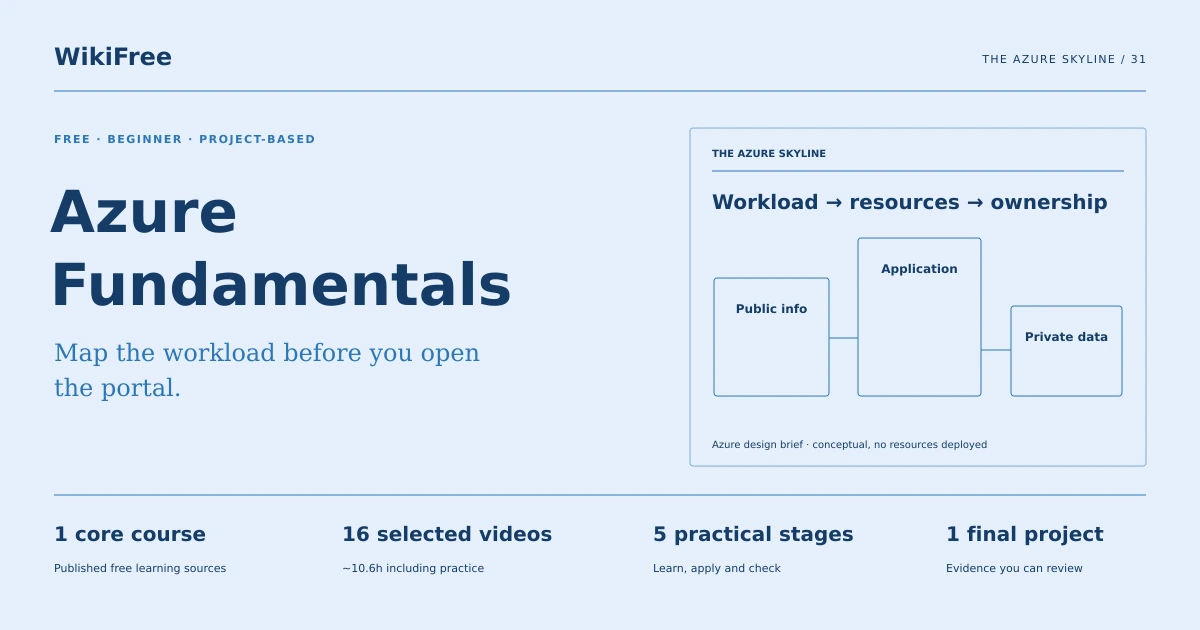
WikiFree learning path 31 · Beginner
The Azure skyline
Map the workload before you open the portal.
Create an Azure-oriented architecture brief covering service choices, resource organization, access boundaries, monitoring and cost assumptions.
Video duration uses the selected lessons only. Reading and practice times are planning estimates; repeat difficult work as needed.
A clear starting point
Who this is for
General computer literacy. A diagram editor or paper; no Azure subscription or payment card.
Your practical result
Create an Azure-oriented architecture brief covering service choices, resource organization, access boundaries, monitoring and cost assumptions.
Provider videos may reflect earlier Azure interfaces and exam editions. This path is conceptual architecture practice, not current AZ-900 exam coverage or a live deployment.
Access and cost
Public videos and paper or a free diagram editor are sufficient. No Azure account, paid resource, exam purchase or cloud deployment is required.
The project pack contains an original workbook, case inputs, an evidence log and reference notes. Some technical paths include starter code and a runnable reference. Read the pack README before starting.
Three-minute readiness check
Answer first, then open each explanation. A missed answer identifies what to revisit; it does not stop you from starting.
Does a resource group itself grant application security?
No. Organization and access controls are different concerns.
Is cloud spending always fixed?
No. Usage and service choices influence cost.
Is this path current exam preparation?
No. It assesses a design brief, not an exam syllabus.
The case you will work on
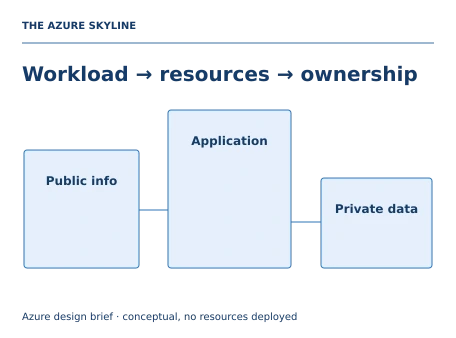
The fictional Cedar Events team needs a public information page, a small booking application and a private booking database. The team expects variable traffic and wants named owners and a recovery plan. This is a design exercise; no cloud resources are deployed.
| Need | Constraint |
|---|---|
| Public information | Readable during a booking outage |
| Booking application | Variable traffic |
| Booking database | Private access from application |
| Operations | Owner, alert and recovery instructions |
These are supplied synthetic inputs, not observations from a real organization. Label assumptions and any additional data you create.
Keep an evidence trail
Save each stage output in the project folder. In evidence_log.csv, record the decision, the artifact or test that supports it, what failed, and the revision you made.
Your route from learning to evidence
- Stage 1Choose the service responsibilityA service-choice decision record.50 minutes of original practice
- Stage 2Organize resources and ownershipAn Azure resource organization map.60 minutes of original practice
- Stage 3Describe identity and network boundariesAn access and connectivity matrix.70 minutes of original practice
- Stage 4Plan observability and recoveryAn operations checklist and recovery test outline.60 minutes of original practice
- Stage 5Estimate and review cost driversA cost-assumption and architecture handover.55 minutes of original practice
- Final projectMake the evidence reviewableConnect the five stage outputs and test a change.180 minutes estimated
Progress stays in this browser. Tick a stage only after its evidence check passes. This is a personal checklist, not a certificate.
Why these source courses
The path uses selected material from courses already published on WikiFree. The original exercises below connect that material to one practical outcome. Follow only the listed assignments; completing the full source courses is optional.
John Savill
Azure Fundamentals AZ-900: Free Course
Selected existing Azure lessons provide service models, resource organization, access, monitoring and cost concepts without requiring all 65 videos.
Access: Free Video
Certificate: Free video viewing; certificate not included
Learn it, apply it, check it
Work in order. Every stage produces something the next stage uses. Revisit the repair instruction when a check fails.
Choose the service responsibility
General computer literacy. A diagram editor or paper; no Azure subscription or payment card.
The idea to use
Compare how much infrastructure the team wants to operate. A virtual machine, a managed application platform and a hosted software product leave different responsibilities with the customer. Choose based on workload and operations needs rather than a product-name collection. The public information page can be separated from booking so a booking failure does not automatically remove all visitor information.
Watch the selected lessons
- 4. Differences Between Cloud Service Categories – AZ-900 Certification Course15:16
- 5. Identify the Right Service Type – AZ-900 Certification Course4:01
- 6. Differences Between Types of Cloud Computing – AZ-900 Certification Course12:41
Selected video time: 32m. Open this course on WikiFree.
Your 50-minute lab
Compare two service approaches for the booking application and state which maintenance tasks remain with the team.
Save: A service-choice decision record..
Evidence check
The choice names a workload need and at least three retained responsibilities.
If it fails: Do not assume a managed service removes responsibility for application data and access.
Organize resources and ownership
Bring your previous output: A service-choice decision record.
The idea to use
Regions and availability zones describe deployment locations and failure boundaries; resource groups and subscriptions organize resources and management scope. They are not interchangeable. Sketch only the resources needed for the scenario and attach an owner and environment label. A region choice needs a reason such as audience location or a documented requirement, not an invented compliance claim.
Watch the selected lessons
- 8. Benefits and Usage of Regions and Region Pairs – AZ-900 Certification Course13:08
- 9. Benefits and Usage of Availability Zones – AZ-900 Certification Course8:41
- 10. Benefits and Usage of Resource Groups – AZ-900 Certification Course9:38
- 11. Benefits and Usage of Subscriptions – AZ-900 Certification Course8:19
Selected video time: 40m. Open this course on WikiFree.
Your 60-minute lab
Draw the resource hierarchy and a simple location plan. Add owner, environment and purpose labels.
Save: An Azure resource organization map..
Evidence check
Every proposed resource has an owner and a clear resource-group context.
If it fails: Do not draw a subscription as if it were a physical data center.
Describe identity and network boundaries
Bring your previous output: An Azure resource organization map.
The idea to use
Separate a visitor reading a public page from an administrator changing infrastructure. Least privilege assigns only the needed management actions to each role. The database should be reachable through the intended application path, not casually exposed for convenience. A conceptual diagram should label public and private flows, while acknowledging that exact implementation needs service-specific configuration and testing.
Watch the selected lessons
- 17. Benefits and Usage of Core Network Resources – AZ-900 Certification Course22:04
- 18. Describe Public and Private Endpoints – AZ-900 Certification Course – May 2022 New7:23
- 42. Explain Authentication and Authorization – AZ-900 Certification Course3:52
- 47. Functionality and Usage of RBAC – AZ-900 Certification Course9:19
Selected video time: 43m. Open this course on WikiFree.
Your 70-minute lab
Add visitor, application and administrator flows to the map. Define three roles and the actions each needs.
Save: An access and connectivity matrix..
Evidence check
Visitors have no management role and database access is limited to the intended application path.
If it fails: Replace broad administrator access with the minimum actions needed by each role.
Plan observability and recovery
Bring your previous output: An access and connectivity matrix.
The idea to use
An alert needs a signal, threshold, owner and action. A recovery plan needs a backup assumption and a test, not merely a backup icon. Choose an application error-rate signal and a booking-data recovery scenario. Availability and recovery objectives are requirements to validate; they are not automatically guaranteed by drawing multiple components.
Watch the selected lessons
- 7. Reliability and Predictability – AZ-900 Certification Course – May 2022 New7:16
- 31. Functionality and Usage of Azure Monitor – AZ-900 Certification Course10:20
Selected video time: 18m. Open this course on WikiFree.
Your 60-minute lab
Write two alerts and a recovery rehearsal plan, including who verifies bookings after restoration.
Save: An operations checklist and recovery test outline..
Evidence check
Each alert has an owner and response; recovery includes a verification step.
If it fails: Do not equate backup existence with a demonstrated successful restore.
Estimate and review cost drivers
Bring your previous output: An operations checklist and recovery test outline.
The idea to use
A useful cost worksheet records usage assumptions and what could change the bill. Compute, storage, network transfer and support are distinct drivers. This path intentionally avoids live price claims. Use fictional units to compare scenarios, or consult the current official calculator yourself and record its date and inputs. Set a review cadence and an owner for unexpected growth.
Watch the selected lessons
- 58. Factors That Affect Costs – AZ-900 Certification Course6:32
- 59. Factors to Reduce Cost – AZ-900 Certification Course15:30
- 61. Functionality and Usage of Azure Cost Management – AZ-900 Certification Course5:48
Selected video time: 28m. Open this course on WikiFree.
Your 55-minute lab
Create a cost-driver worksheet for normal and doubled traffic. Add an idle-resource review and a budget alert owner.
Save: A cost-assumption and architecture handover..
Evidence check
The worksheet labels fictional figures and identifies at least one non-compute cost driver.
If it fails: Remove a precise monthly price that has no dated configuration and source.
A worked reference to compare
A coherent design separates public information from the booking workflow, gives the application a constrained database route and assigns management access to named roles. A diagram alone does not prove availability, security or cost; each claim needs a test or explicit assumption.
Compare your reasoning as well as the result. If your answer differs, state the assumption or input that explains the difference. Reference notes are for checking after an attempt; copying them is not evidence of independent work.
Your final project
Your brief
Submit the service decision, resource map, access matrix, operations plan and cost worksheet. Review a scenario in which the booking application fails while the information page remains available.
Time box: 3h 00m estimated. Extend it if a gate needs repair.
Hand in these artifacts
- A service-choice decision record.
- An Azure resource organization map.
- An access and connectivity matrix.
- An operations checklist and recovery test outline.
- A cost-assumption and architecture handover.
- A short README: outcome, how to inspect or run the work, assumptions and limitations.
- A before-and-after change test and the completed evidence log.
Run a final review
- Use the supplied reference to reconcile the baseline result.
- Choose one relevant input or constraint to change. Write your expected effect before testing it.
- Run the calculation, walkthrough or test again and save the actual result.
- Ask a peer to inspect the evidence, or perform a separate self-review. Label which review you used.
- Score the work using the rubric and repair every critical failure.
Review rubric · 100 points
| Criterion | Points | Evidence to inspect |
|---|---|---|
| Practical outcome and case reasoning | 25 | Create an Azure-oriented architecture brief covering service choices, resource organization, access boundaries, monitoring and cost assumptions. |
| Five stage checks | 30 | Award 6 points for each stage only when its stated gate is demonstrably met. |
| Traceable evidence | 20 | Artifacts, inputs and calculations or tests are reproducible; synthetic and simulated evidence is labelled. |
| Revision after a changed condition | 15 | Change one input or constraint, predict the effect, test it and record the result. |
| Handoff quality | 10 | A reviewer can find the files, follow the instructions and understand the remaining limitations. |
Completion target: at least 80/100, all five stage gates passed, and every critical issue below corrected. This is a learning benchmark, not an accredited qualification.
Critical issue: The design distinguishes public visitor access from management access and never claims a deployed or tested Azure system.
Before you go further
What will I be able to produce?
Create an Azure-oriented architecture brief covering service choices, resource organization, access boundaries, monitoring and cost assumptions.
Is the whole path free?
Public videos and paper or a free diagram editor are sufficient. No Azure account, paid resource, exam purchase or cloud deployment is required.
Do I need to finish every source course?
No. Follow the selected assignments at each stage. Source courses provide context, while the original case, labs and final review build the practical result. Extra study is optional.
What counts as completion?
Complete all five stage checks, earn at least 80/100 on the final rubric and correct every critical issue. Provider videos may reflect earlier Azure interfaces and exam editions. This path is conceptual architecture practice, not current AZ-900 exam coverage or a live deployment.
Questions & discussion
Share a useful question or correction. Comments appear after moderation. Please avoid personal or sensitive information.