WikiFree learning path 22 · Beginner
The balance room
Make the three statements tell one story.
Prepare a small transaction ledger, income statement, balance sheet and cash-flow reconciliation for a fictional service business.
Video duration uses the selected lessons only. Reading and practice times are planning estimates; repeat difficult work as needed.
A clear starting point
Who this is for
Arithmetic, percentages and a spreadsheet or calculator; no accounting software or professional experience.
Your practical result
Prepare a small transaction ledger, income statement, balance sheet and cash-flow reconciliation for a fictional service business.
This covers a simplified service-business example. It does not establish compliance with a reporting standard or teach tax filing, audit or professional accounting practice.
Access and cost
Assigned public videos can be watched free. Complete the original case in a text editor, on paper or in a spreadsheet you already have. No paid course, exam or provider certificate is included.
The project pack contains an original workbook, case inputs, an evidence log and reference notes. Some technical paths include starter code and a runnable reference. Read the pack README before starting.
Three-minute readiness check
Answer first, then open each explanation. A missed answer identifies what to revisit; it does not stop you from starting.
Is collected cash always revenue?
No. Owner capital is cash received but not revenue.
Does buying equipment always equal a current expense?
Not in this simplified case; it creates an asset.
What balances?
Assets equal liabilities plus equity.
The case you will work on
Cedar Studio starts with no balances. Ignore taxes, depreciation and financing costs for this deliberately simplified teaching period. All values are in fictional currency units.
| Transaction | Amount | Treatment clue |
|---|---|---|
| Owner contributes cash | 2000 | Capital |
| Buy equipment with cash | 500 | Asset |
| Services earned | 900 | 700 collected, 200 receivable |
| Operating expense paid | 300 | Expense |
| Owner withdrawal | 100 | Equity withdrawal |
These are supplied synthetic inputs, not observations from a real organization. Label assumptions and any additional data you create.
Keep an evidence trail
Save each stage output in the project folder. In evidence_log.csv, record the decision, the artifact or test that supports it, what failed, and the revision you made.
Your route from learning to evidence
- Stage 1Classify the transactionsA five-row transaction classification.55 minutes of original practice
- Stage 2Calculate performanceAn income statement with a recognition note.50 minutes of original practice
- Stage 3Build the closing positionA balanced closing balance sheet.60 minutes of original practice
- Stage 4Reconcile the cash movementA cash-flow statement and profit-to-cash bridge.55 minutes of original practice
- Stage 5Review the storyA statement review and collection scenario.45 minutes of original practice
- Final projectMake the evidence reviewableConnect the five stage outputs and test a change.180 minutes estimated
Progress stays in this browser. Tick a stage only after its evidence check passes. This is a personal checklist, not a certificate.
Why these source courses
The path uses selected material from courses already published on WikiFree. The original exercises below connect that material to one practical outcome. Follow only the listed assignments; completing the full source courses is optional.
Aswath Damodaran
Accounting for Finance: Free Course
The public accounting series explains the three statements and inconsistencies. WikiFree provides the original service-business exercise and reconciliation.
Access: Free Video
Certificate: Free video viewing; certificate not included
Learn it, apply it, check it
Work in order. Every stage produces something the next stage uses. Revisit the repair instruction when a check fails.
Classify the transactions
Arithmetic, percentages and a spreadsheet or calculator; no accounting software or professional experience.
The idea to use
Track the economic event separately from its payment. An owner contribution changes equity, a customer invoice can create a receivable, and equipment remains an asset in this simplified period. Give each transaction a reference and explain both sides of the accounting equation. Keeping a clear transaction trail makes later reconciliations possible and prevents cash receipts from being mistaken for income.
Watch the selected lessons
Selected video time: 13m. Open this course on WikiFree.
Your 55-minute lab
Classify all five transactions as asset, liability, revenue, expense or owner equity movements. Show the cash effect separately.
Save: A five-row transaction classification..
Evidence check
The contribution and withdrawal are excluded from revenue and operating expense.
If it fails: If cash and profit move identically, revisit capital and equipment.
Calculate performance
Bring your previous output: A five-row transaction classification.
The idea to use
The income statement summarizes revenue earned and expenses recognized for a period. It does not list every cash movement. For this case, service revenue is 900 even though only 700 has arrived. The 300 operating expense belongs to the same period. The resulting profit is 600; the owner withdrawal does not reduce that operating result.
Watch the selected lessons
Selected video time: 34m. Open this course on WikiFree.
Your 50-minute lab
Build the period income statement and explain why the uncollected 200 is included.
Save: An income statement with a recognition note..
Evidence check
Revenue 900 minus expenses 300 equals profit 600.
If it fails: Do not subtract the owner withdrawal or the equipment purchase from this simplified income statement.
Build the closing position
Bring your previous output: An income statement with a recognition note.
The idea to use
A balance sheet is a snapshot at a date. Reconcile cash, receivables and equipment to the closing position rather than using income totals as assets. With no liabilities here, closing equity combines initial capital, earned profit and withdrawals. Equality is necessary but does not prove every classification is correct, so retain the transaction explanations alongside the totals.
Watch the selected lessons
Selected video time: 32m. Open this course on WikiFree.
Your 60-minute lab
Calculate closing cash, receivables, equipment and equity, then check the accounting equation.
Save: A balanced closing balance sheet..
Evidence check
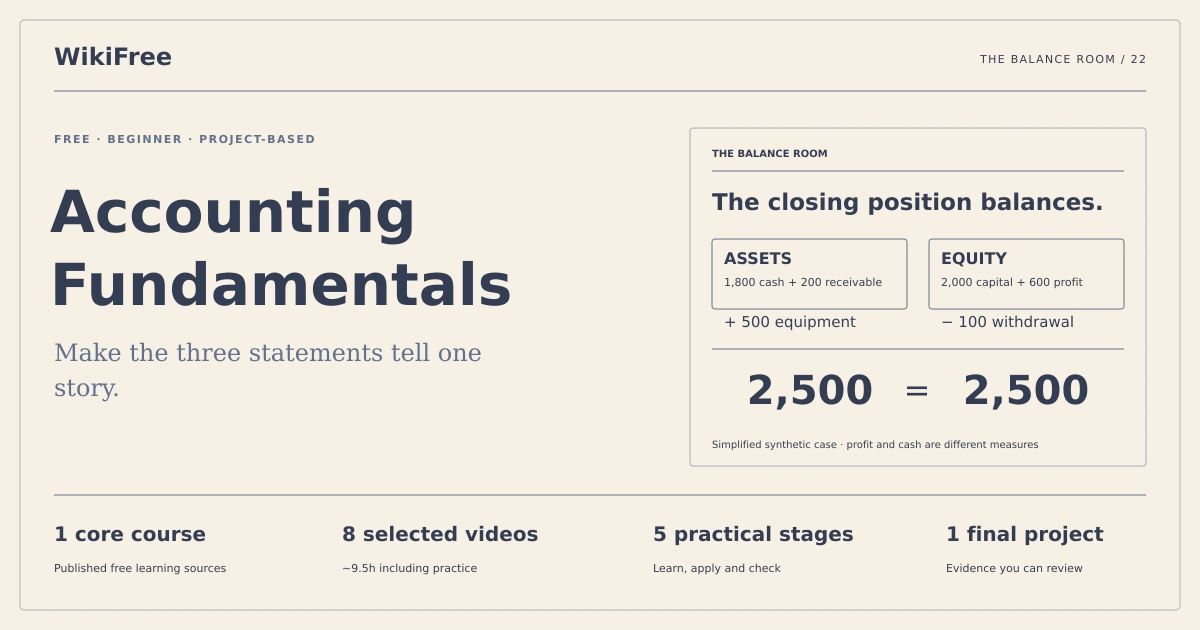
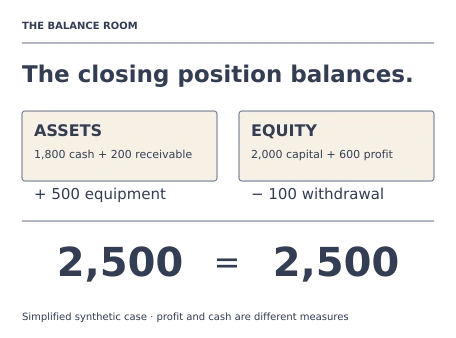
Assets 1800+200+500=2500 equal equity 2000+600-100=2500.
If it fails: If the sheet balances only with a plug figure, trace each transaction instead.
Reconcile the cash movement
Bring your previous output: A balanced closing balance sheet.
The idea to use
Group cash movements by operating, investing and financing purpose. This educational classification treats the owner contribution and withdrawal as financing, and equipment as investing. Opening cash plus the net movement must equal closing cash. Explaining the difference between profit and operating cash is essential: the uncollected invoice accounts for 200 of that difference here.
Watch the selected lessons
- 7. Session 4: The Statement of Cash Flows13:24
- 8. Session 4A: The Statement of Cash Flows (Examples)15:36
Selected video time: 29m. Open this course on WikiFree.
Your 55-minute lab
Prepare the three cash-flow sections and bridge profit to operating cash.
Save: A cash-flow statement and profit-to-cash bridge..
Evidence check
Operating 400, investing -500 and financing 1900 sum to closing cash 1800.
If it fails: Exclude the unpaid invoice from cash receipts while retaining it in revenue.
Review the story
Bring your previous output: A cash-flow statement and profit-to-cash bridge.
The idea to use
Review statements together. A cash balance can rise because owners supplied money even when operations are weak. A useful explanation separates performance, liquidity and capital changes without inferring business health from one number. Document simplified assumptions and unresolved items so a reviewer knows which conclusions the statements can support.
Watch the selected lessons
Selected video time: 16m. Open this course on WikiFree.
Your 45-minute lab
Write a 180-word owner update and three reconciliation checks. Then model collecting the remaining 200 next period with no new revenue.
Save: A statement review and collection scenario..
Evidence check
The later collection increases cash and decreases receivables without creating revenue twice.
If it fails: If the collection raises profit again, reverse the duplicate recognition.
A worked reference to compare
Closing cash is 1800 and profit is 600. They differ because capital, equipment, withdrawals and the unpaid invoice affect the statements differently. Collecting the receivable later changes asset composition, not the original earned revenue.
Compare your reasoning as well as the result. If your answer differs, state the assumption or input that explains the difference. Reference notes are for checking after an attempt; copying them is not evidence of independent work.
Your final project
Your brief
Submit all three statements, the transaction ledger and a one-page explanation. Add a 120 cash expense to the original period and reconcile the updated statements without a balancing plug.
Time box: 3h 00m estimated. Extend it if a gate needs repair.
Hand in these artifacts
- A five-row transaction classification.
- An income statement with a recognition note.
- A balanced closing balance sheet.
- A cash-flow statement and profit-to-cash bridge.
- A statement review and collection scenario.
- A short README: outcome, how to inspect or run the work, assumptions and limitations.
- A before-and-after change test and the completed evidence log.
Run a final review
- Use the supplied reference to reconcile the baseline result.
- Choose one relevant input or constraint to change. Write your expected effect before testing it.
- Run the calculation, walkthrough or test again and save the actual result.
- Ask a peer to inspect the evidence, or perform a separate self-review. Label which review you used.
- Score the work using the rubric and repair every critical failure.
Review rubric · 100 points
| Criterion | Points | Evidence to inspect |
|---|---|---|
| Practical outcome and case reasoning | 25 | Prepare a small transaction ledger, income statement, balance sheet and cash-flow reconciliation for a fictional service business. |
| Five stage checks | 30 | Award 6 points for each stage only when its stated gate is demonstrably met. |
| Traceable evidence | 20 | Artifacts, inputs and calculations or tests are reproducible; synthetic and simulated evidence is labelled. |
| Revision after a changed condition | 15 | Change one input or constraint, predict the effect, test it and record the result. |
| Handoff quality | 10 | A reviewer can find the files, follow the instructions and understand the remaining limitations. |
Completion target: at least 80/100, all five stage gates passed, and every critical issue below corrected. This is a learning benchmark, not an accredited qualification.
Critical issue: The accounting equation and cash reconciliation both hold, and owner movements are not treated as revenue or expense.
Before you go further
What will I be able to produce?
Prepare a small transaction ledger, income statement, balance sheet and cash-flow reconciliation for a fictional service business.
Is the whole path free?
Assigned public videos can be watched free. Complete the original case in a text editor, on paper or in a spreadsheet you already have. No paid course, exam or provider certificate is included.
Do I need to finish every source course?
No. Follow the selected assignments at each stage. Source courses provide context, while the original case, labs and final review build the practical result. Extra study is optional.
What counts as completion?
Complete all five stage checks, earn at least 80/100 on the final rubric and correct every critical issue. This covers a simplified service-business example. It does not establish compliance with a reporting standard or teach tax filing, audit or professional accounting practice.
Questions & discussion
Share a useful question or correction. Comments appear after moderation. Please avoid personal or sensitive information.