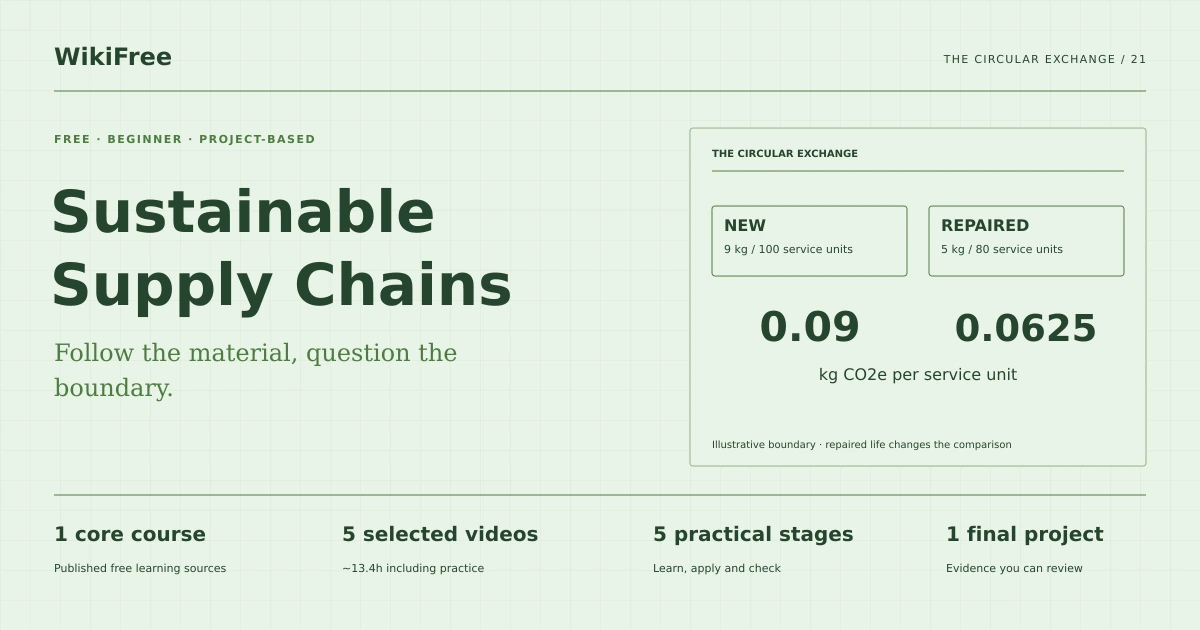
WikiFree learning path 21 · Beginner
The circular exchange
Follow the material, question the boundary.
Compare a new-product and repair route with a transparent footprint worksheet and a supplier evidence request.
Video duration uses the selected lessons only. Reading and practice times are planning estimates; repeat difficult work as needed.
A clear starting point
Who this is for
Basic percentages and a spreadsheet or paper calculator. No environmental accounting software is required.
Your practical result
Compare a new-product and repair route with a transparent footprint worksheet and a supplier evidence request.
This small educational comparison is not a verified life-cycle assessment, legal review or product certification.
Access and cost
Assigned public videos can be watched free. Complete the original case in a text editor, on paper or in a spreadsheet you already have. No paid course, exam or provider certificate is included.
The project pack contains an original workbook, case inputs, an evidence log and reference notes. Some technical paths include starter code and a runnable reference. Read the pack README before starting.
Three-minute readiness check
Answer first, then open each explanation. A missed answer identifies what to revisit; it does not stop you from starting.
Why use a common service unit?
Different useful lives make per-item totals misleading.
Can a guessed factor support an audited claim?
No. Record it as an assumption and seek evidence.
Does recycling remove transport impacts?
No. The collection and processing boundary still matters.
The case you will work on
The fictional Cedar Repair Cooperative is considering repairing returned lamps instead of replacing them. The figures below are invented teaching assumptions, not verified emissions factors or a product environmental claim.
| Route | Manufacture or repair kg CO2e | Transport kg CO2e | Useful service units |
|---|---|---|---|
| New lamp | 8 | 1 | 100 |
| Repaired lamp | 3 | 2 | 80 |
These are supplied synthetic inputs, not observations from a real organization. Label assumptions and any additional data you create.
Keep an evidence trail
Save each stage output in the project folder. In evidence_log.csv, record the decision, the artifact or test that supports it, what failed, and the revision you made.
Your route from learning to evidence
- Stage 1Draw the return loopA return-flow map with decision points.50 minutes of original practice
- Stage 2Set a fair comparisonA boundary statement and normalized comparison.60 minutes of original practice
- Stage 3Test an assumptionA sensitivity table and a decision threshold.55 minutes of original practice
- Stage 4Ask suppliers for evidenceA supplier evidence request with owners.45 minutes of original practice
- Stage 5Write a bounded recommendationA conditional circular-supply pilot brief.50 minutes of original practice
- Final projectMake the evidence reviewableConnect the five stage outputs and test a change.180 minutes estimated
Progress stays in this browser. Tick a stage only after its evidence check passes. This is a personal checklist, not a certificate.
Why these source courses
The path uses selected material from courses already published on WikiFree. The original exercises below connect that material to one practical outcome. Follow only the listed assignments; completing the full source courses is optional.
MIT
Free MIT Course: Sustainable Supply Chain Management
MIT lectures supply reverse logistics, footprint boundaries, stakeholder engagement and strategy; the lamp worksheet is original WikiFree practice.
Access: Free Video
Certificate: Free video viewing; no MIT certificate or academic credit
Learn it, apply it, check it
Work in order. Every stage produces something the next stage uses. Revisit the repair instruction when a check fails.
Draw the return loop
Basic percentages and a spreadsheet or paper calculator. No environmental accounting software is required.
The idea to use
A return flow needs collection, inspection, routing and an owner for exceptions. Keep usable products distinct from parts recovery and disposal. A circular-looking diagram is not evidence of a smaller footprint. First identify what actually moves, which condition changes its route, and what information travels with it. A lamp that fails an electrical safety inspection must not silently enter the reuse route.
Watch the selected lessons
Selected video time: 1h 01m. Open this course on WikiFree.
Your 50-minute lab
Draw the five steps from customer return to the next user. Add separate routes for repairable and non-repairable lamps and label two unknowns.
Save: A return-flow map with decision points..
Evidence check
Every returned item has a disposition, an owner and an inspection checkpoint.
If it fails: If everything goes straight to reuse, add the inspection and rejection branch.
Set a fair comparison
Bring your previous output: A return-flow map with decision points.
The idea to use
State the functional unit before adding impacts. Our example compares one unit of useful lighting service, not one lamp purchase. Include manufacture or repair and transport for both routes; other effects are explicitly outside this simplified exercise. Dividing each route total by its service units permits a like-for-like comparison, but only within these assumptions. Avoid presenting this worksheet as a full life-cycle assessment.
Watch the selected lessons
Selected video time: 1h 23m. Open this course on WikiFree.
Your 60-minute lab
Write the functional unit and boundary. Calculate total kg CO2e per lamp and per service unit for both routes.
Save: A boundary statement and normalized comparison..
Evidence check
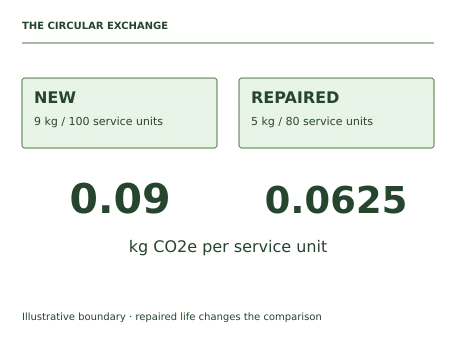
New is 9/100=0.09; repaired is 5/80=0.0625 kg CO2e per service unit.
If it fails: If you compare 9 and 5 alone, normalize by the unequal useful service.
Test an assumption
Bring your previous output: A boundary statement and normalized comparison.
The idea to use
A result can depend more on an uncertain input than on arithmetic. Change one assumption at a time and preserve the baseline. At 40 service units, repair rises to 0.125 kg CO2e per unit and loses its advantage. The break-even repaired service life is 5/0.09, about 55.6 units. This is sensitivity analysis, not proof of actual product performance.
Watch the selected lessons
Selected video time: 1h 13m. Open this course on WikiFree.
Your 55-minute lab
Test repair lifetimes of 40, 60 and 80 service units. Explain what evidence would resolve the choice.
Save: A sensitivity table and a decision threshold..
Evidence check
All three scenarios use the same 5 kg total and disclose that service life is assumed.
If it fails: Do not change lifetime and transport together unless you label a separate combined scenario.
Ask suppliers for evidence
Bring your previous output: A sensitivity table and a decision threshold.
The idea to use
An evidence request should identify the measurement period, unit, method, boundary and responsible person. A supplier sustainability slogan cannot populate a calculation cell. Track whether each value is measured, estimated or missing. Involving repair staff also reveals practical constraints such as parts availability and inspection time that a carbon-only comparison misses.
Watch the selected lessons
Selected video time: 1h 02m. Open this course on WikiFree.
Your 45-minute lab
Draft five questions for a repair supplier and a simple evidence register. Include one question about safety inspection and one about service life.
Save: A supplier evidence request with owners..
Evidence check
Every numeric assumption has a requested source or a visibly unresolved status.
If it fails: Replace vague requests for green credentials with the specific data your calculation needs.
Write a bounded recommendation
Bring your previous output: A supplier evidence request with owners.
The idea to use
A recommendation combines the comparison, uncertainty and operating conditions. Prefer a controlled pilot when critical evidence is missing. Name the conditions that would stop the pilot, the person who reviews returns and the data required to revisit the estimate. Do not describe a smaller modeled footprint as certified, carbon neutral or legally compliant.
Watch the selected lessons
Selected video time: 1h 22m. Open this course on WikiFree.
Your 50-minute lab
Write a one-page pilot recommendation with a measurement plan, inspection gate and review date.
Save: A conditional circular-supply pilot brief..
Evidence check
The brief states the simplified boundary, threshold, unresolved evidence and stop condition.
If it fails: Remove absolute environmental claims that go beyond the worksheet.
A worked reference to compare
The modeled repair route is 0.0625 kg CO2e per service unit versus 0.09 for new. Its modeled reduction is about 30.6%, but a 40-unit repaired life reverses the choice. A defensible brief therefore recommends checking useful life and transport evidence before making any public claim.
Compare your reasoning as well as the result. If your answer differs, state the assumption or input that explains the difference. Reference notes are for checking after an attempt; copying them is not evidence of independent work.
Your final project
Your brief
Deliver the return map, normalized comparison, sensitivity table, supplier request and a conditional pilot decision. Add a new transport assumption of 4 kg CO2e for repaired lamps and explain whether the 80-unit route still improves on new.
Time box: 3h 00m estimated. Extend it if a gate needs repair.
Hand in these artifacts
- A return-flow map with decision points.
- A boundary statement and normalized comparison.
- A sensitivity table and a decision threshold.
- A supplier evidence request with owners.
- A conditional circular-supply pilot brief.
- A short README: outcome, how to inspect or run the work, assumptions and limitations.
- A before-and-after change test and the completed evidence log.
Run a final review
- Use the supplied reference to reconcile the baseline result.
- Choose one relevant input or constraint to change. Write your expected effect before testing it.
- Run the calculation, walkthrough or test again and save the actual result.
- Ask a peer to inspect the evidence, or perform a separate self-review. Label which review you used.
- Score the work using the rubric and repair every critical failure.
Review rubric · 100 points
| Criterion | Points | Evidence to inspect |
|---|---|---|
| Practical outcome and case reasoning | 25 | Compare a new-product and repair route with a transparent footprint worksheet and a supplier evidence request. |
| Five stage checks | 30 | Award 6 points for each stage only when its stated gate is demonstrably met. |
| Traceable evidence | 20 | Artifacts, inputs and calculations or tests are reproducible; synthetic and simulated evidence is labelled. |
| Revision after a changed condition | 15 | Change one input or constraint, predict the effect, test it and record the result. |
| Handoff quality | 10 | A reviewer can find the files, follow the instructions and understand the remaining limitations. |
Completion target: at least 80/100, all five stage gates passed, and every critical issue below corrected. This is a learning benchmark, not an accredited qualification.
Critical issue: All comparisons use the same functional unit and clearly label invented factors.
Before you go further
What will I be able to produce?
Compare a new-product and repair route with a transparent footprint worksheet and a supplier evidence request.
Is the whole path free?
Assigned public videos can be watched free. Complete the original case in a text editor, on paper or in a spreadsheet you already have. No paid course, exam or provider certificate is included.
Do I need to finish every source course?
No. Follow the selected assignments at each stage. Source courses provide context, while the original case, labs and final review build the practical result. Extra study is optional.
What counts as completion?
Complete all five stage checks, earn at least 80/100 on the final rubric and correct every critical issue. This small educational comparison is not a verified life-cycle assessment, legal review or product certification.
Questions & discussion
Share a useful question or correction. Comments appear after moderation. Please avoid personal or sensitive information.