WikiFree learning path 19 · Beginner
The improvement workshop
See the wait. Test the change.
Map a small process, distinguish work from waiting and propose a measurable improvement with a balancing check.
Video duration uses the selected lessons only. Reading and practice times are planning estimates; repeat difficult work as needed.
A clear starting point
Who this is for
Basic arithmetic and observation skills; the case uses supplied synthetic times.
Your practical result
Map a small process, distinguish work from waiting and propose a measurable improvement with a balancing check.
This is an introductory service-process project, not Six Sigma certification or a validated industrial-control design.
Access and cost
Assigned public videos can be watched free. Complete the original case in a text editor, on paper or in a spreadsheet you already have. No paid course, exam or provider certificate is included.
The project pack contains an original workbook, case inputs, an evidence log and reference notes. Some technical paths include starter code and a runnable reference. Read the pack README before starting.
Three-minute readiness check
Answer first, then open each explanation. A missed answer identifies what to revisit; it does not stop you from starting.
Is all non-processing time automatically removable waste?
No. Investigate its purpose and constraints before removing it.
Can faster output with more defects be called an improvement?
Only after considering quality and other balancing measures.
Does a before-and-after change prove causality?
Not by itself; other conditions may have changed.
The case you will work on
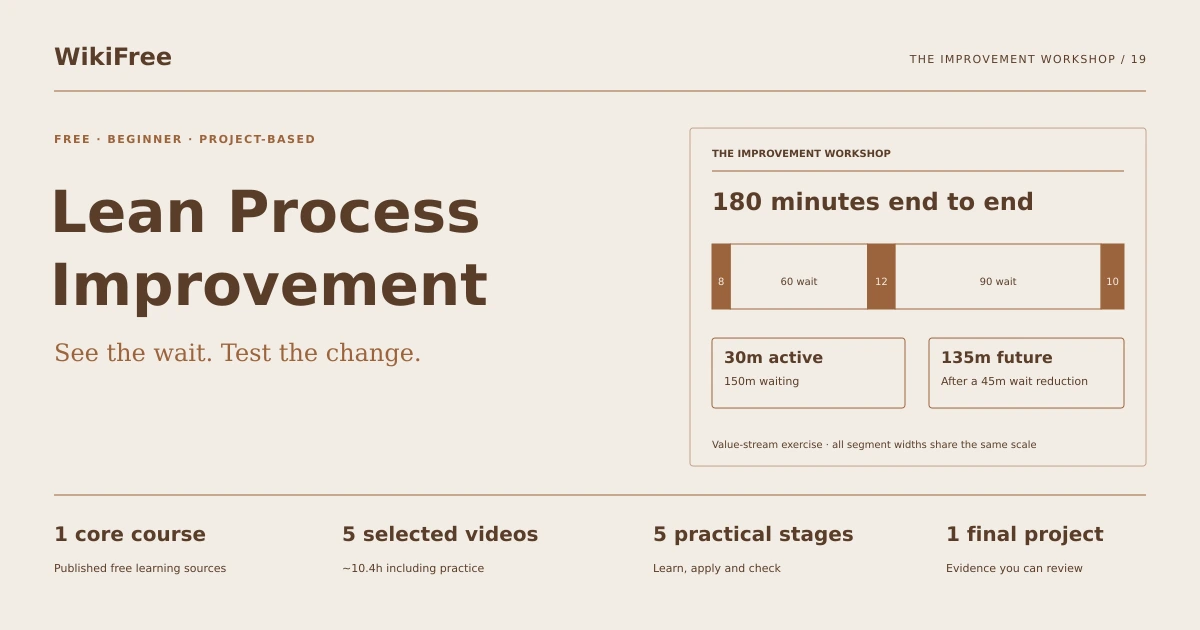
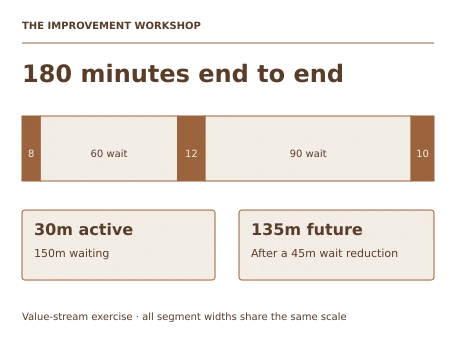
Fern Print Desk processes a poster request through intake, proofing and printing. Each request takes 8, 12 and 10 minutes of active work. It waits 60 minutes before proofing and 90 before printing. The training case is a service process, not a healthcare procedure.
| Step | Active minutes | Waiting before next step |
|---|---|---|
| Intake | 8 | 60 |
| Proofing | 12 | 90 |
| Printing | 10 | 0 |
These are supplied synthetic inputs, not observations from a real organization. Label assumptions and any additional data you create.
Keep an evidence trail
Save each stage output in the project folder. In evidence_log.csv, record the decision, the artifact or test that supports it, what failed, and the revision you made.
Your route from learning to evidence
- Stage 1Define value and the boundaryA process purpose and boundary statement45 minutes of original practice
- Stage 2Map the current conditionA current-state value-stream sketch60 minutes of original practice
- Stage 3Investigate the causeA cause-and-evidence table60 minutes of original practice
- Stage 4Design a modest experimentAn improvement experiment brief75 minutes of original practice
- Stage 5Standardize only what worksA result review and provisional standard45 minutes of original practice
- Final projectMake the evidence reviewableConnect the five stage outputs and test a change.150 minutes estimated
Progress stays in this browser. Tick a stage only after its evidence check passes. This is a personal checklist, not a certificate.
Why these source courses
The path uses selected material from courses already published on WikiFree. The original exercises below connect that material to one practical outcome. Follow only the listed assignments; completing the full source courses is optional.
MIT
Free MIT Course: Lean Six Sigma and Process Improvement
The MIT lean, mapping, quality-tool and A3 selections support a disciplined small improvement cycle; healthcare-specific units are outside this assessed route.
Access: Free Video
Certificate: Free video viewing; no MIT certificate or academic credit
Learn it, apply it, check it
Work in order. Every stage produces something the next stage uses. Revisit the repair instruction when a check fails.
Define value and the boundary
Basic arithmetic and observation skills; the case uses supplied synthetic times.
The idea to use
Describe value from the recipient’s task, not from the amount of activity in the department. State where the process begins and ends so timing comparisons use the same boundary. Separate customer requirements from internal convenience. A faster intake is unhelpful if it sends incomplete specifications downstream and increases proofing rework.
Watch the selected lessons
Selected video time: 1h 44m. Open this course on WikiFree.
Your 45-minute lab
Write the request-to-accepted-poster boundary, three recipient requirements and one process measure. Identify what would make an output unusable.
Save: A process purpose and boundary statement.
Evidence check
The endpoint is accepted output and quality requirements are explicit.
If it fails: If the purpose says keep the printer busy, rewrite it around the recipient’s completed task.
Map the current condition
Bring your previous output: A process purpose and boundary statement
The idea to use
A current-state map should include queues and information handoffs as well as active work. Use actual observations where available and clearly label the synthetic case. Keep time units consistent. Do not draw the proposed future state as though it already exists. The first map is an explanation of what happens now and where further observation is needed.
Watch the selected lessons
Selected video time: 34m. Open this course on WikiFree.
Your 60-minute lab
Map the three active steps and two waits. Calculate total active time and elapsed time, then identify the longest wait.
Save: A current-state value-stream sketch.
Evidence check
Active time is 30 minutes and elapsed time is 180 minutes; printing wait is 90.
If it fails: If the map totals only 30 minutes, add queue time rather than assuming work flows continuously.
Investigate the cause
Bring your previous output: A current-state value-stream sketch
The idea to use
A cause hypothesis must connect to evidence. The 90-minute queue may reflect batch release, setup constraints or missing approvals; a long queue alone does not tell you which. Use a small cause-and-evidence table before selecting a solution. Ask what observation would disprove your preferred explanation. This protects the team from buying a tool to solve the wrong problem.
Watch the selected lessons
Selected video time: 26m. Open this course on WikiFree.
Your 60-minute lab
Propose three possible causes of the printing wait and one observation for each. Choose a hypothesis to test without claiming it is already proven.
Save: A cause-and-evidence table.
Evidence check
Each proposed cause has a discriminating observation and an explicit uncertainty.
If it fails: If every cause points to worker effort, examine batching, information quality and scheduling rules.
Design a modest experiment
Bring your previous output: A cause-and-evidence table
The idea to use
An improvement experiment changes a defined condition and checks its effect. Here, trial smaller release batches while retaining the proof approval. Set a balancing measure such as reprint rate or setup time. Keep the scope small enough to reverse if it worsens quality. An A3-style narrative works when it connects condition, cause hypothesis, action and evidence; the page size is not the method.
Watch the selected lessons
Selected video time: 25m. Open this course on WikiFree.
Your 75-minute lab
Plan a one-week smaller-batch trial. Predict a change in waiting, set a reprint-rate guardrail and define how to record comparable requests.
Save: An improvement experiment brief.
Evidence check
The plan has a prediction, comparison window, quality guardrail and stop rule.
If it fails: If the intervention removes proofing, explain how quality will be protected before proceeding.
Standardize only what works
Bring your previous output: An improvement experiment brief
The idea to use
A new process is not better because its map looks cleaner. Compare observed outcomes with the prediction and inspect unintended effects. If the trial succeeds, write the minimum useful standard and a review trigger. If it fails, retain what was learned and change the hypothesis. Do not erase inconvenient results to make the experiment appear successful.
Original practice stage. No additional video or reading assignment is required.
Your 45-minute lab
Assume printing wait falls to 45 minutes while all other times and quality remain unchanged. Calculate the new elapsed time and propose a standard and review trigger.
Save: A result review and provisional standard.
Evidence check
Elapsed time becomes 135 minutes, a 25% reduction; unchanged quality is an explicit case assumption.
If it fails: If the report claims 50% overall improvement, distinguish the halved queue from the whole process.
A worked reference to compare
The current process is 8+60+12+90+10=180 minutes, with 30 active minutes. Reducing only the printing wait from 90 to 45 yields 135 minutes overall. The improvement is 45/180=25%, not 50%. Whether it persists requires further observation.
Compare your reasoning as well as the result. If your answer differs, state the assumption or input that explains the difference. Reference notes are for checking after an attempt; copying them is not evidence of independent work.
Your final project
Your brief
Deliver the Fern improvement case: boundary, current map, cause hypotheses, trial plan and a cautious result/standardization decision.
Time box: 2h 30m estimated. Extend it if a gate needs repair.
Hand in these artifacts
- A process purpose and boundary statement
- A current-state value-stream sketch
- A cause-and-evidence table
- An improvement experiment brief
- A result review and provisional standard
- A short README: outcome, how to inspect or run the work, assumptions and limitations.
- A before-and-after change test and the completed evidence log.
Run a final review
- Use the supplied reference to reconcile the baseline result.
- Choose one relevant input or constraint to change. Write your expected effect before testing it.
- Run the calculation, walkthrough or test again and save the actual result.
- Ask a peer to inspect the evidence, or perform a separate self-review. Label which review you used.
- Score the work using the rubric and repair every critical failure.
Review rubric · 100 points
| Criterion | Points | Evidence to inspect |
|---|---|---|
| Practical outcome and case reasoning | 25 | Map a small process, distinguish work from waiting and propose a measurable improvement with a balancing check. |
| Five stage checks | 30 | Award 6 points for each stage only when its stated gate is demonstrably met. |
| Traceable evidence | 20 | Artifacts, inputs and calculations or tests are reproducible; synthetic and simulated evidence is labelled. |
| Revision after a changed condition | 15 | Change one input or constraint, predict the effect, test it and record the result. |
| Handoff quality | 10 | A reviewer can find the files, follow the instructions and understand the remaining limitations. |
Completion target: at least 80/100, all five stage gates passed, and every critical issue below corrected. This is a learning benchmark, not an accredited qualification.
Critical issue: Do not invent observations, remove a quality check without replacement or confuse one queue improvement with total-process improvement.
Before you go further
What will I be able to produce?
Map a small process, distinguish work from waiting and propose a measurable improvement with a balancing check.
Is the whole path free?
Assigned public videos can be watched free. Complete the original case in a text editor, on paper or in a spreadsheet you already have. No paid course, exam or provider certificate is included.
Do I need to finish every source course?
No. Follow the selected assignments at each stage. Source courses provide context, while the original case, labs and final review build the practical result. Extra study is optional.
What counts as completion?
Complete all five stage checks, earn at least 80/100 on the final rubric and correct every critical issue. This is an introductory service-process project, not Six Sigma certification or a validated industrial-control design.
Questions & discussion
Share a useful question or correction. Comments appear after moderation. Please avoid personal or sensitive information.