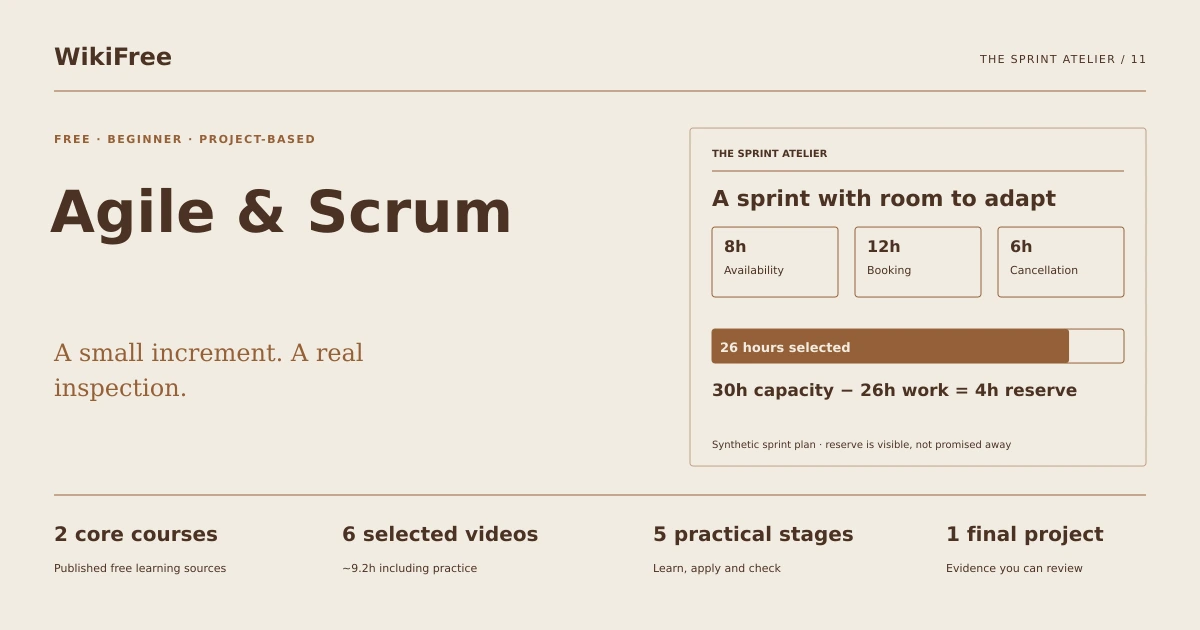
WikiFree learning path 11 · Beginner
The sprint atelier
A small increment. A real inspection.
Plan and simulate a short Scrum delivery cycle with a coherent goal, ordered backlog, Definition of Done and evidence-led review.
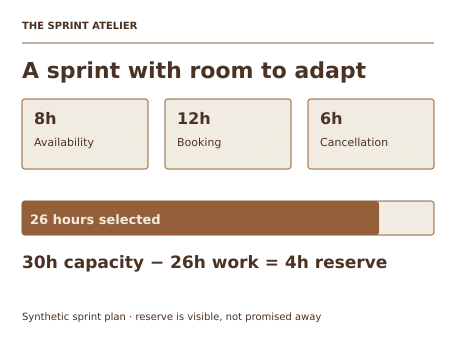
Video duration uses the selected lessons only. Reading and practice times are planning estimates; repeat difficult work as needed.
A clear starting point
Who this is for
Basic project vocabulary; no Scrum role or paid software is required.
Your practical result
Plan and simulate a short Scrum delivery cycle with a coherent goal, ordered backlog, Definition of Done and evidence-led review.
This is a guided Scrum simulation, not certification preparation or proof of delivery experience.
Access and cost
Assigned public videos can be watched free. Complete the original case in a text editor, on paper or in a spreadsheet you already have. No paid course, exam or provider certificate is included.
The project pack contains an original workbook, case inputs, an evidence log and reference notes. Some technical paths include starter code and a runnable reference. Read the pack README before starting.
Three-minute readiness check
Answer first, then open each explanation. A missed answer identifies what to revisit; it does not stop you from starting.
Is a Sprint Goal the same as a task list?
No. It explains the valuable outcome the selected work should support.
Can a partially tested item count as Done?
Only if it satisfies the actual Definition of Done; waive no quality condition for the demonstration.
Must a Scrum team use story points?
No. The case uses hours for capacity reasoning; this is not a rule of Scrum.
The case you will work on
Cedar Library wants patrons to reserve a study room without phoning the desk. Simulate one Sprint with three developers and 30 available team hours. The product goal is fewer failed reservations, not more screens. All user comments below are fictional case inputs.
| Backlog item | Estimated hours | Case value |
|---|---|---|
| See available slots | 8 | Essential to reserve |
| Reserve a slot | 12 | Completes the core journey |
| Cancel a reservation | 6 | Releases unused capacity |
| Choose a color theme | 10 | Cosmetic preference |
These are supplied synthetic inputs, not observations from a real organization. Label assumptions and any additional data you create.
Keep an evidence trail
Save each stage output in the project folder. In evidence_log.csv, record the decision, the artifact or test that supports it, what failed, and the revision you made.
Your route from learning to evidence
- Stage 1Choose a useful goalA goal and success-check card45 minutes of original practice
- Stage 2Order and size the workAn ordered backlog and capacity note60 minutes of original practice
- Stage 3Define usable completionA Definition of Done and acceptance examples60 minutes of original practice
- Stage 4Adapt the daily planThree short adaptation logs45 minutes of original practice
- Stage 5Inspect and improveA review note and improvement experiment60 minutes of original practice
- Final projectMake the evidence reviewableConnect the five stage outputs and test a change.150 minutes estimated
Progress stays in this browser. Tick a stage only after its evidence check passes. This is a personal checklist, not a certificate.
Why these source courses
The path uses selected material from courses already published on WikiFree. The original exercises below connect that material to one practical outcome. Follow only the listed assignments; completing the full source courses is optional.
Free Project Management Course by Google
The selected Google lessons explain Scrum and practical team delivery; they do not require repeating the full project-management route.
Access: Free Video
Certificate: Free video viewing; a Google certificate is not included
Scrum.org
Definition of Done in Scrum: Free Course
Scrum.org adds focused guidance on Done and acceptance conditions at the quality decision point.
Access: Free Video
Certificate: Free video viewing; certificate not included
Learn it, apply it, check it
Work in order. Every stage produces something the next stage uses. Revisit the repair instruction when a check fails.
Choose a useful goal
Basic project vocabulary; no Scrum role or paid software is required.
The idea to use
A delivery cycle needs a reason beyond completing tickets. Start with a user action and an observable result. A coherent goal lets the team negotiate scope while protecting that purpose. Keep the product goal, the short-cycle goal and individual acceptance conditions distinct: they describe different levels of intent. A convincing demonstration shows a usable journey rather than a collection of unrelated interface fragments.
Watch the selected lessons
- 23. What is Scrum?25:02
Selected video time: 25m. Open this course on WikiFree.
Your 45-minute lab
Write one Sprint Goal and two observable success checks for the room-reservation journey. Explain which backlog item can be deferred without defeating that goal.
Save: A goal and success-check card.
Evidence check
The goal names a user outcome and can survive removal of the color theme.
If it fails: Replace vague goals such as improve the app with a specific action the patron can complete.
Order and size the work
Bring your previous output: A goal and success-check card
The idea to use
Order work by contribution to the goal, dependency and uncertainty. Estimates support a conversation; they are not guarantees or employee performance measures. Available hours also cover integration and testing. Selecting 30 hours of feature work for 30 hours of capacity leaves no room to discover a problem. Make the trade-off visible before work starts, and preserve a smaller fallback increment.
Watch the selected lessons
Selected video time: 47m. Open this course on WikiFree.
Your 60-minute lab
Order the four items, select a feasible set and reserve four hours for integration and review. Describe what you would negotiate if reservation work takes longer.
Save: An ordered backlog and capacity note.
Evidence check
Selected work plus the reserve does not exceed 30 hours; a fallback still produces user value.
If it fails: If every item is essential, distinguish the minimum usable journey from later convenience.
Define usable completion
Bring your previous output: An ordered backlog and capacity note
The idea to use
An item-specific acceptance condition might say that a booked slot cannot be offered to another patron. A shared Definition of Done might require tests, readable error messages and integration with the current product. Checking one does not replace the other. Choose evidence a reviewer can inspect. A screenshot alone cannot prove that duplicate reservations are rejected.
Watch the selected lessons
- 1. What it Means to Have a Done Increment5:41
- 3. The Difference Between Acceptance Criteria and the Definition of Done4:20
- 6. Crafting a Definition of Done4:30
Selected video time: 15m. Open this course on WikiFree.
Your 60-minute lab
Write three shared Done conditions and two acceptance examples for the reservation item. Include an unsuccessful attempt, such as selecting an already booked slot.
Save: A Definition of Done and acceptance examples.
Evidence check
Shared quality conditions and item-specific behavior are separate and testable.
If it fails: Turn subjective phrases such as looks finished into a demonstration, test or inspection criterion.
Adapt the daily plan
Bring your previous output: A Definition of Done and acceptance examples
The idea to use
A short daily inspection helps developers adapt their plan toward the goal. It is not a mandatory report to a manager. In this simulation, the slot feed is unavailable on day two. Identify what can still be learned using a labelled fixture, what becomes uncertain, and who can help remove the dependency. Never call a simulated integration a completed live connection.
Watch the selected lessons
Selected video time: 46m. Open this course on WikiFree.
Your 45-minute lab
Record three daily updates: progress toward the goal, impediment, and next adaptation. On day two, introduce the unavailable feed and revise the plan.
Save: Three short adaptation logs.
Evidence check
Each update changes or confirms a concrete next action and labels simulated evidence.
If it fails: If an update only lists activity, add its implication for the goal and the next decision.
Inspect and improve
Bring your previous output: Three short adaptation logs
The idea to use
A review examines the increment and informs what to do next. A retrospective examines how the team worked and identifies an improvement. Keep these conversations separate enough that customer feedback does not become a blame discussion. Record an observation, an interpretation and a decision independently. One fictional review is practice evidence, not proof that the product will succeed in the market.
Original practice stage. No additional video or reading assignment is required.
Your 60-minute lab
Run a five-minute reservation demonstration, capture two fictional stakeholder responses and reorder the next work. Choose one measurable teamwork experiment for the next cycle.
Save: A review note and improvement experiment.
Evidence check
Product feedback changes the backlog; the teamwork experiment has an owner and a check date.
If it fails: If the improvement says communicate better, specify which handoff or check will change.
A worked reference to compare
A feasible starting selection is availability (8h), reservation (12h) and cancellation (6h), with 4h reserved: 30h total. The color theme stays outside. If a new integration risk consumes the reserve, renegotiate cancellation before weakening the Done conditions. This is one defensible forecast, not a required Scrum formula.
Compare your reasoning as well as the result. If your answer differs, state the assumption or input that explains the difference. Reference notes are for checking after an attempt; copying them is not evidence of independent work.
Your final project
Your brief
Deliver a Cedar Sprint simulation: goal, backlog, completion standard, three daily adaptations, a usable-increment demonstration plan and the next-cycle decision.
Time box: 2h 30m estimated. Extend it if a gate needs repair.
Hand in these artifacts
- A goal and success-check card
- An ordered backlog and capacity note
- A Definition of Done and acceptance examples
- Three short adaptation logs
- A review note and improvement experiment
- A short README: outcome, how to inspect or run the work, assumptions and limitations.
- A before-and-after change test and the completed evidence log.
Run a final review
- Use the supplied reference to reconcile the baseline result.
- Choose one relevant input or constraint to change. Write your expected effect before testing it.
- Run the calculation, walkthrough or test again and save the actual result.
- Ask a peer to inspect the evidence, or perform a separate self-review. Label which review you used.
- Score the work using the rubric and repair every critical failure.
Review rubric · 100 points
| Criterion | Points | Evidence to inspect |
|---|---|---|
| Practical outcome and case reasoning | 25 | Plan and simulate a short Scrum delivery cycle with a coherent goal, ordered backlog, Definition of Done and evidence-led review. |
| Five stage checks | 30 | Award 6 points for each stage only when its stated gate is demonstrably met. |
| Traceable evidence | 20 | Artifacts, inputs and calculations or tests are reproducible; synthetic and simulated evidence is labelled. |
| Revision after a changed condition | 15 | Change one input or constraint, predict the effect, test it and record the result. |
| Handoff quality | 10 | A reviewer can find the files, follow the instructions and understand the remaining limitations. |
Completion target: at least 80/100, all five stage gates passed, and every critical issue below corrected. This is a learning benchmark, not an accredited qualification.
Critical issue: An over-capacity plan, a fabricated live integration or unfinished work labelled Done must be corrected.
Before you go further
What will I be able to produce?
Plan and simulate a short Scrum delivery cycle with a coherent goal, ordered backlog, Definition of Done and evidence-led review.
Is the whole path free?
Assigned public videos can be watched free. Complete the original case in a text editor, on paper or in a spreadsheet you already have. No paid course, exam or provider certificate is included.
Do I need to finish every source course?
No. Follow the selected assignments at each stage. Source courses provide context, while the original case, labs and final review build the practical result. Extra study is optional.
What counts as completion?
Complete all five stage checks, earn at least 80/100 on the final rubric and correct every critical issue. This is a guided Scrum simulation, not certification preparation or proof of delivery experience.
Questions & discussion
Share a useful question or correction. Comments appear after moderation. Please avoid personal or sensitive information.