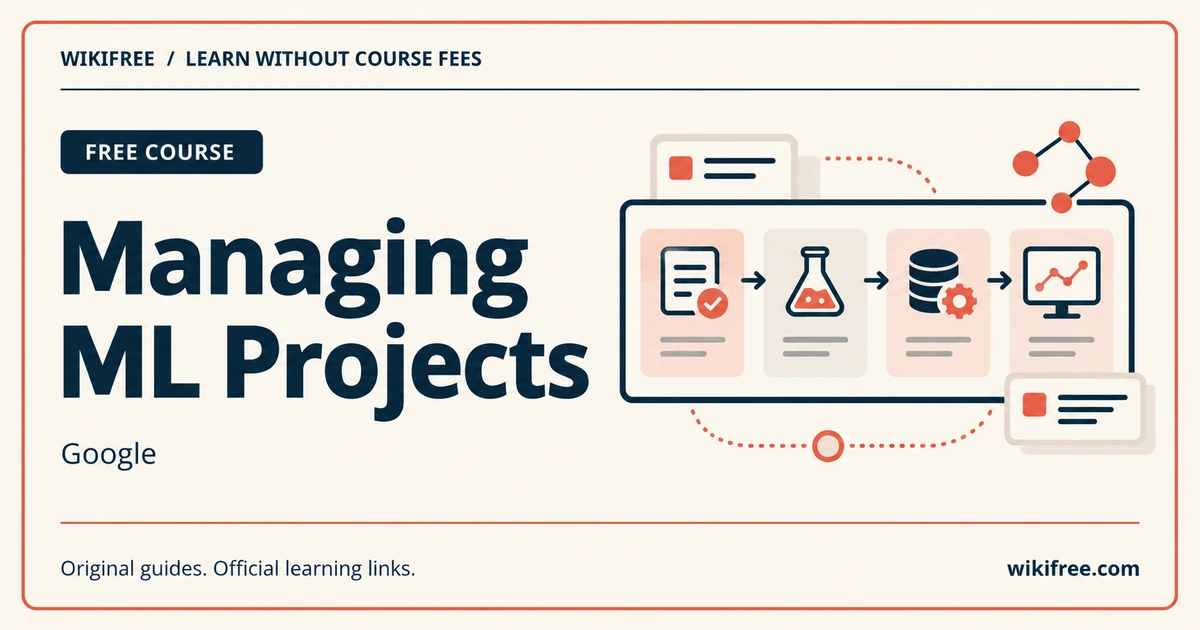
A promising machine-learning idea needs more than an accurate model. It needs a useful problem, a realistic plan and a way to judge whether the result helps people. Managing ML Projects, Google’s free self-study course, explains how those pieces fit together as a project moves from an initial proposal toward production.
This is a practical choice for someone who understands basic machine learning and wants to participate more confidently in project decisions. The focus is planning and coordination: what to explore, how to evaluate progress and what a team should consider before turning an experiment into an ongoing service.
Course at a glance
| Provider | |
|---|---|
| Platform | Google for Developers |
| Level | Intermediate |
| Language | English |
| Format | Self-study lessons with understanding checks |
| Estimated study time | 90 minutes, as listed by Google |
| Access | Free public browser-based study; no paid lab required |
| Recognition | No formal certificate or course credit |
What you’ll learn
- Understand the project lifecycle: connect ideation and planning, experimentation, pipeline building and productionization.
- Plan around uncertainty: make room for experiments, changing assumptions and evidence that an approach may need to stop.
- Define meaningful success: distinguish the business problem from the metrics used to evaluate a model.
- Coordinate the transition to production: consider how the work changes when an experiment becomes a maintained system.
- Include responsible-development concerns: examine fairness, privacy, transparency and safety alongside technical choices.
Skills you’ll gain
- ML project planning
- Experiment scoping
- Success-metric selection
- Stakeholder communication
- Production-readiness thinking
- Responsible AI awareness
Choose the problem before the model
Imagine a team wants to help customers find the right support article. “Build a machine-learning model” is only a proposed approach. The useful question is whether customers can find relevant help more easily. A project discussion becomes clearer when it separates that outcome from the model’s evaluation score.
The success material develops this distinction. A strong model metric does not automatically establish business value, so a team needs to connect technical measures with the intended user benefit. This helps you ask better questions when reviewing an experiment: which outcome matters, what evidence supports it and where might the measures disagree?
Make a plan that can learn
Machine-learning work includes uncertainty about data, feasibility and performance. The planning lessons explain why a rigid schedule can be a poor match for exploratory work. Timeboxing experiments and narrowing scope can make progress easier to assess while leaving room for an approach to change.
The lifecycle is iterative rather than a guaranteed straight path. An experiment may reveal that the data is unsuitable or that a simpler solution deserves another look. Understanding these possibilities can help project managers and technical contributors discuss changes without treating every revised assumption as a failure.
Later lessons address the move toward a production pipeline and an operational system. That broadens your view beyond a promising experiment. The course principally discusses traditional machine learning, with notes about how some considerations differ for generative AI; it is not a complete generative-AI engineering curriculum.
Who will get the most from it?
The course suits project managers, product collaborators and technical practitioners who already understand basic ML concepts. Google lists introductory machine-learning knowledge and ML problem framing as prerequisites. If model terminology is still unfamiliar, build those foundations before relying on this course for project decisions.
You are studying a project framework rather than a full programming lab. The public lessons and checks can be completed in a browser without purchasing cloud compute, installing a paid application or providing a credit card. No account is needed to read the learning material.
Apply the ideas to a one-page brief
For optional independent practice, outline one potential ML project in a document you can edit. Record the user problem, the available data, one business measure, one model measure and the next uncertainty to investigate. Add a small experiment that could change your decision.
Then note a fairness, privacy or safety concern relevant to that use case. This is a personal practice exercise, not a Google assessment or a substitute for a specialist review. Its value is making your assumptions visible enough for another person to question them.
Frequently asked questions
Do I need to write code for this course?
The advertised learning route is reading and understanding checks. Basic ML knowledge helps, but a paid coding environment or cloud lab is not required.
Is the 90-minute estimate a fixed schedule?
No. It is Google’s listed study estimate. You can pause, revisit lessons and spend additional time applying the ideas to your own example.
Does Google provide a certificate?
Google does not provide formal certification or course credit for these machine-learning self-study courses. Study it for the project-planning knowledge.
Questions & discussion
Share a useful question or correction. Comments appear after moderation. Please avoid personal or sensitive information.